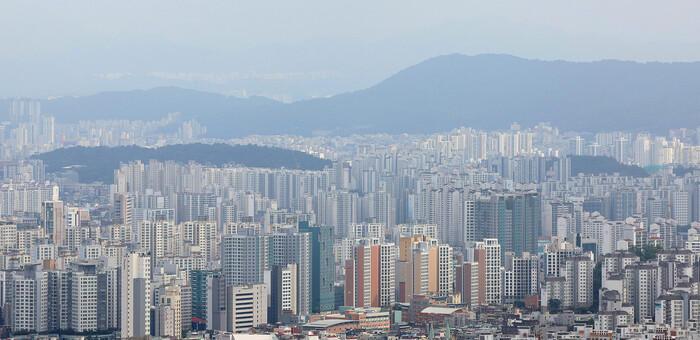
SEOUL — Tens of thousands of apartment tenants in South Korea’s capital are facing a severe financial crunch next year as four-year lease cycles expire, exposing renters to a housing market where lump-sum deposits have surged by more than a third since 2023.
Under South Korea’s Housing Lease Protection Act, tenants are permitted a one-time, two-year contract renewal with deposit increases capped at 5 percent—a system commonly known as the "2+2 year" rule. According to real estate transaction data from the Ministry of Land, Infrastructure and Transport (MOLIT), approximately 64,000 households in Seoul signed initial jeonse (lump-sum deposit) leases during the 2023 market downturn and exercised their renewal rights in 2025.
When these protected terms conclude in 2027, renters entering the open market will encounter dramatically higher costs. A comparative review of mid-sized apartments (60–85㎡) across 24 major Seoul complexes—each housing over 1,000 units—indicates that average jeonse deposits in the second quarter of 2026 climbed 35.6 percent compared to the same period three years earlier.
A Sharp Rebound from the 2023 Market Dip
The impending squeeze stems from a sharp V-shaped recovery in Seoul's rental market. Data from the Korea Real Estate Board shows that the jeonse price index peaked at 104.29 in January 2022 before plunging roughly 20 percent to a trough of 84.08 by May 2023. By October 2026, however, the index had climbed back to 103.84, effectively erasing the 2023 dip.
As a result, tenants who benefited from the 2023 slump and the subsequent 5 percent renewal cap now face steep out-of-pocket jumps even if market prices plateau:
Northern Seoul: In Nowon-gu’s Hanjin Hanhwa Grandville, median deposits rose 46 percent from 445 million won in 2023 to 650 million won in 2026, requiring renewing tenants to secure roughly 180 million won in additional capital. In neighboring Dobong-gu, Dobong Hyuhanshin saw a 42 percent jump over the same period, translating to an extra 110 million won burden.
Eastern and Western Districts: Gangdong-gu’s Raemian Hillstate Godeok recorded a 45 percent surge (from 700 million to 1.02 billion won), while Yeongdeungpo-gu’s Yeongdeungpo Prugio rose 40 percent (500 million to 700 million won). Seongdong-gu’s e-Pyeonhansesang Geumho Park Hills and Gangseo-gu’s Ujangsan I-Park e-Pyeonhansesang posted increases of 38 percent and 33 percent, respectively.
Supply Bottlenecks and Policy Dilemmas
Market analysts warn that shrinking listing inventories and seasonal moving demand—driven by the upcoming school semester and large-scale reconstruction relocations in southern Seoul—will further strain supply heading into early 2027.
To alleviate the bottleneck, real estate specialists point to selective deregulation, such as easing Land Transaction Permit Zones in targeted neighborhoods to free up rental supply. Meanwhile, housing policy researchers caution against relying solely on expanded loan programs or rent subsidies. While such financial support offers immediate relief to current tenants, experts warn it risks fueling further rent inflation and shifting heavier housing burdens onto future renters unless the government pivots toward long-term rental market stabilization.
[Copyright (c) Global Economic Times. All Rights Reserved.]