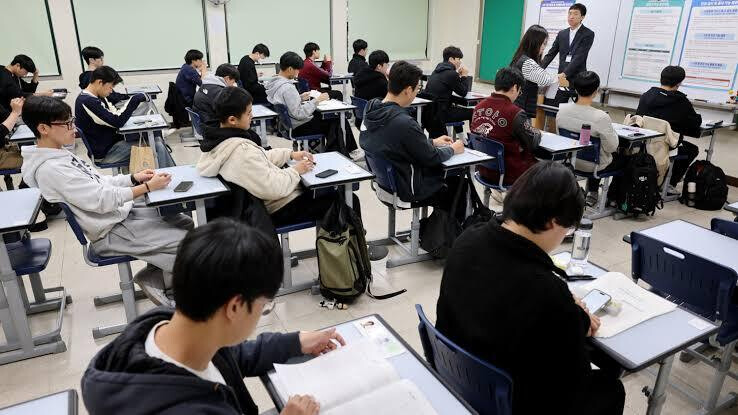
SEOUL, South Korea — A recent wave of artificial intelligence-assisted cheating allegations has rattled South Korea’s notoriously competitive testing system, culminating in a high-profile tragedy and sparking a nationwide debate over the country’s reliance on standardized exams.
The controversy reached a fever pitch around the 2027 College Scholastic Ability Test (CSAT), the annual nationwide exam that largely dictates university admissions and future career prospects. Prior to the test, authorities scrambled to implement strict anti-cheating protocols—including distributing specialized stickers to cover clothing buttons and offering financial rewards for reporting misconduct—amid fears that candidates could use hidden micro-cameras and AI tools to bypass exam security.
The crisis intensified following the death of a prominent Seoul National University student who had gained celebrity status earlier this year after reportedly achieving the first-ever perfect score on the Legal Education Eligibility Test (LEET). Leveraging the rare accolade, the student had quickly become a bestselling author and frequent media guest. However, when a separate cheating confession in a national tax accountant exam triggered widespread online scrutiny into his own test results, he faced intense public backlash, doxxing, and a formal police investigation. He was found dead days later, shortly before a scheduled public verification of his abilities.
Following the incident, President Lee Jae-myung vowed a sweeping overhaul of test administration and strict penalties for academic fraud to uphold societal fairness. Law enforcement officials also took the unusual step of continuing their investigation into the alleged misconduct despite the suspect's death, while lawmakers renewed pushes to regulate the sale of miniature spy cameras.
Beyond immediate security measures, however, educators and sociologists are calling for a broader reckoning with South Korea’s deeply entrenched credentialism. Critics argue that the intense public glorification of top scorers—followed by relentless online shaming when allegations arise—reflects a toxic obsession with academic pedigree.
Civic groups and education experts contend that tightening surveillance will not solve the root problem. Instead, they urge policymakers to reconsider a social structure where a single exam score holds disproportionate power over an individual's lifetime opportunities, questioning whether traditional standardized testing remains valid in the era of rapidly evolving artificial intelligence.
[Copyright (c) Global Economic Times. All Rights Reserved.]