
• 2025.12.05 (Fri)
  • All articles
  • LOGIN
  • JOIN
Global Economic Times
APEC2025KOREA가이드북
  • Synthesis
  • World
  • Business
  • Industry
  • ICT
  • Distribution Economy
  • Well+Being
  • Travel
  • Eco-News
  • Education
  • Korean Wave News
  • Opinion
  • Arts&Culture
  • Sports
  • People & Life
  • Column
    • Cho Kijo Column
    • Lee Yeon-sil Column
    • Ko Yong-chul Column
    • Cherry Garden Story
  • Photo News
  • New Book Guide
MENU
 
Home > New Book Guide

The decline of the Japanese electronics industry was due to competitiveness, not the high yen.

ONLINE TEAM / Updated : 2024-10-25 06:56:10
  • -
  • +
  • Print
What can we learn from Japan's 30 years of experience?
Written by Masaaki Shirakawa / Translated by Kiyoung Park and Jiyeon Min 
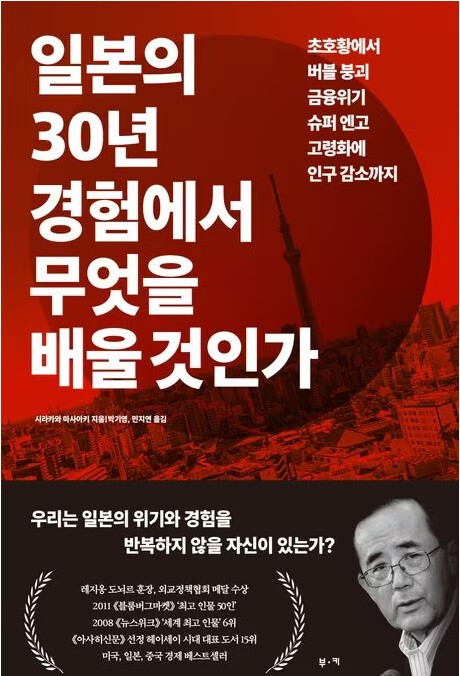
[GLOBAL ECONOMIC TIMES]  When the Gulf War broke out in 1991, leaflets were circulated in the academy area of ​​Gangnam Station in Seoul, urging people to learn Japanese, the language of the world's best country, saying, "Both the U.S. and Iraqi troops fight with weapons made from Japanese parts." Looking back, that was the peak. Japan's last 'lost 30 years' were a period of hardships, including a sharp decline from a super boom to a bursting bubble, followed by a financial crisis, a super high yen, aging population, and population decline.

Now that Japan seems to be trying to get out of a long tunnel, this memoir (original title 中央銀行) by Masaaki Shirakawa (白川方明), an economist who served as governor of the Bank of Japan, is very noteworthy. In this book, which provides insight into the last 30 years of Japan's economic upheaval, he argues that the recession was prolonged because the Bank of Japan did not intervene with an active monetary easing policy when the bubble burst.

The decline of the Japanese electronics industry was not due to the strong yen, but to its lack of competitiveness compared to Samsung and LG, and political pressures such as ‘Abenomics’ actually delayed recovery. Explaining the situation in the storm of fighting low inflation, low growth, and low interest rates, he says, ‘Financial policy is not a magic wand, and ultimately, the role of each economic entity and population measures determine the situation.’

[Copyright (c) Global Economic Times. All Rights Reserved.]

ONLINE TEAM
ONLINE TEAM
Reporter Page

Popular articles

  • The Unemployment Paradox: South Korea's Falling Jobless Rate Masks Deeper Economic Woes

  • Seoul Prosecution Joint Investigation Team Clears 'Drug Probe External Pressure' Allegations, Sparking Fierce Backlash from Police Superintendent

I like it
Share
  • Facebook
  • X
  • Kakaotalk
  • LINE
  • BAND
  • NAVER
  • https://globaleconomictimes.kr/article/1065563665791281 Copy URL copied.
Comments >

Comments 0

Weekly Hot Issue

  • China Stages Massive Naval Show of Force Amid Heightened Tensions with Japan
  • EU Launches Antitrust Probe into Meta Over WhatsApp AI Chatbot Restrictions
  • Sports Icons Converge as 2026 FIFA World Cup Draw Approaches
  • Russia Vows 'Strongest Response' as EU Proposes Using Frozen Assets for Ukraine Loan
  • US Layoffs Surge: Over 1.17 Million Job Cuts Announced in First 11 Months of 2025
  • EU Weighs 'Buy European' Rule: Up to 70% Local Content for Key Products

Most Viewed

1
Korean War Ally, Reborn as an 'Economic Alliance' Across 70 Years: Chuncheon's 'Path of Reciprocity,' a Strategic
2
A Garden Where the City's Rhythm Stops: Dongdaemun's 'Cherry Garden', Cooking Consideration and Diversity
3
The Sudden Halt of Ayumi Hamasaki's Shanghai Concert: Unpacking the Rising Sino-Japanese Tensions
4
Farewell to a Legend: South Korea Mourns the Passing of Esteemed Actor Lee Soon-jae
5
China’s Anti-Starlink Strategy: Simulation Suggests 2,000 Drones Needed for Taiwan Disruption
광고문의
임시1
임시3
임시2

Hot Issue

Global Billionaire Count Hits 2,919, Total Wealth Reaches $15.8 Trillion

China Stages Massive Naval Show of Force Amid Heightened Tensions with Japan

Russia Vows 'Strongest Response' as EU Proposes Using Frozen Assets for Ukraine Loan

UK and Norway Form Joint Naval Fleet to Counter Rising Russian Submarine Threat

Let’s recycle the old blankets in Jeju Island’s closet instead of incinerating them.

Global Economic Times
korocamia@naver.com
CEO : LEE YEON-SIL
Publisher : KO YONG-CHUL
Registration number : Seoul, A55681
Registration Date : 2024-10-24
Youth Protection Manager: KO YONG-CHUL
Singapore Headquarters
5A Woodlands Road #11-34 The Tennery. S'677728
Korean Branch
Phone : +82(0)10 4724 5264
#304, 6 Nonhyeon-ro 111-gil, Gangnam-gu, Seoul
Copyright © Global Economic Times All Rights Reserved
  • 에이펙2025
  • APEC2025가이드북TV
  • 세종시
Search
Category
  • All articles
  • Synthesis
  • World
  • Business
  • Industry
  • ICT
  • Distribution Economy
  • Well+Being
  • Travel
  • Eco-News
  • Education
  • Korean Wave News
  • Opinion
  • Arts&Culture
  • Sports
  • People & Life
  • Column 
    • 전체
    • Cho Kijo Column
    • Lee Yeon-sil Column
    • Ko Yong-chul Column
    • Cherry Garden Story
  • Photo News
  • New Book Guide
  • Multicultural News
  • Jobs & Workers













