![[등록] 2026-09-01 15:48:31](/support/_updata/banner2/tl181982910_6749.png)


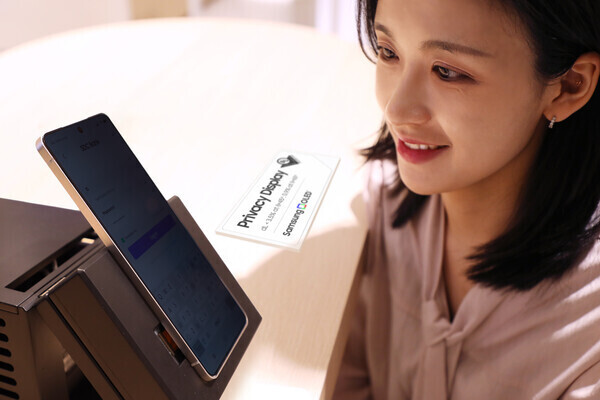
SAN FRANCISCO – In an era where digital surveillance and "shoulder surfing" have become everyday anxieties, Samsung Electronics has unveiled a hardware breakthrough that seeks to reclaim personal space without compromising the visual excellence the brand is known for.
At a hardware innovation briefing held in San Francisco on the 26th (local time), Moon Sung-hoon, Executive Vice President of Hardware at Samsung’s MX (Mobile eXperience) Business, introduced the "Privacy Display." This built-in security technology, debuting on the Galaxy S26 Ultra, allows users to restrict screen visibility to their direct line of sight, effectively masking sensitive information from curious onlookers.
A Hardware Revolution in Stealth
The industry reaction has been immediate and overwhelmingly positive. Global tech analysts have characterized the Privacy Display as a "must-copy feature for competitors," noting that Samsung has achieved what was previously only possible through cumbersome third-party accessories.
Unlike software-based filters that merely dim the screen or physical privacy films that degrade color accuracy and brightness, Samsung’s solution is baked into the very architecture of the panel. By redesigning the pixel driving structure at the fabrication level, Samsung has created a display that can physically manipulate light directionality.
"We strive to provide the world’s best display experience, yet it was disheartening to see customers sacrifice that quality by applying dark privacy films," said EVP Moon. "Our goal was to find a solution that protects privacy while maintaining 100% of the original image quality for the user."
The Science Behind the Shield
To solve the "dimming" issue inherent in privacy tech, Samsung developed a dual-pixel control system. In Privacy Mode, the display intensifies the output of "Narrow Pixels" (directed toward the user) while simultaneously suppressing "Wide Pixels" (scattered light).
This precision allows the Galaxy S26 Ultra to maintain peak brightness and color volume for the person holding the device, while appearing as a dark or illegible screen to anyone standing at an angle. Moon emphasized that, unlike standard polarizing films, this technology offers omnidirectional viewing angle restriction, ensuring privacy from all sides.
Strategic Independence and the AI Future
The Privacy Display is the result of a tight-knit collaboration between Samsung’s MX division and Samsung Display. While the initial concept and core patents originated within the MX division, Samsung Display provided the manufacturing processes and driving logic.
Crucially, Moon confirmed that Samsung has no plans to supply this specific technology to other smartphone manufacturers, signaling a move to keep the Privacy Display as a premium differentiator for the Galaxy ecosystem.
Looking ahead, Samsung plans to merge this hardware with Artificial Intelligence. Future iterations may include:
Context-Aware Privacy: Automatically activating the mode in crowded public spaces or when sensors detect "peeking" eyes.
App-Specific Security: Enabling the shield only when opening banking or messaging apps.
The Road to Mass Adoption and Exynos Ambitions
While the technology is currently exclusive to the Ultra model due to high production costs and complex manufacturing, Moon left the door open for future expansion. "As the technology matures and economies of scale are achieved, there is a possibility it could trickle down to the Galaxy A series," he noted.
Beyond the display, Moon addressed the return of the Exynos processor in the Galaxy S26 and S26+ models. He expressed high confidence in the new 2nm-based AP, citing significant improvements in thermal management and power consumption. When asked about bringing the homegrown chip back to the flagship Ultra model, Moon stated, "In the mid-to-long term, we certainly want to apply Exynos to the Ultra as well."
As the Galaxy S26 Ultra hits the global market, the Privacy Display stands as a testament to Samsung’s engineering persistence—a five-year journey to prove that in the digital age, security doesn't have to look dull.
[Copyright (c) Global Economic Times. All Rights Reserved.]