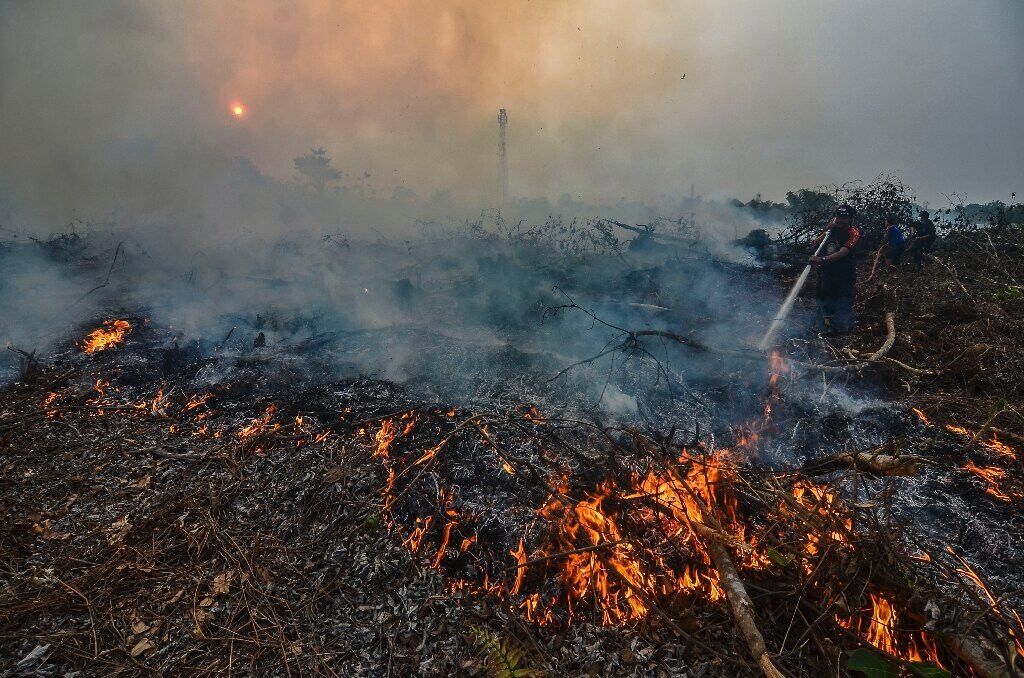
PALANGKARAYA, Indonesia — When the morning sun pierces through the heavy smog enveloping Indonesian Borneo, it casts a dystopian, rust-colored hue over everything. Cars, houses, and streets drift in and out of a dense, russet fog—a bleak, apocalyptic landscape that has become the grim reality for millions.
While the daytime views are haunting, it is in the dead of night that the true human cost of this disaster becomes painfully clear. Dianyra Eka Nastiti, a mother of three living in Palangkaraya, listens anxiously in the dark as her baby’s chest rattles.
"She was hospitalised for bronchopneumonia when she was just a month and a half old, and every single night I worry: Will my child cough tomorrow?" Nastiti asks, her voice heavy with fatigue. "Those thoughts haunt me every night."
Nastiti’s family is trapped at the frontline of a months-long environmental catastrophe that has blanketed large parts of Southeast Asia in a toxic haze. According to the open-access satellite platform Nusantara Atlas, wildfires have incinerated approximately 1.9 million hectares across Indonesia since the start of the year—an area roughly equivalent to the entire landmass of Fiji. September alone accounted for a staggering one million burning hectares.
A Regional Health Emergency
The fallout extends far beyond the burn zones. Swathes of smoldering forests, swamps, and carbon-rich peatlands have choked the air with microparticles and carbon monoxide. This noxious cloud has not only blanketed Indonesia but has also drifted across borders into Singapore, Malaysia, and the Philippines.
As of mid-October, Indonesia’s Health Ministry reported more than 277,000 cases of chronic coughs and acute respiratory infections. Over 62,000 of those affected are infants and toddlers under the age of five.
"The forest fires have had a huge impact, especially on everyone's health," says 22-year-old Natari Victoria, who sought treatment at a local health center after suffering from a persistent cough for over a week. "I have young cousins, including babies, who are coughing too. It's really taking a toll on them."
Medical experts warn that the complex mixture of pollutants in peat smoke poses severe long-term health risks. Tiny microparticles can penetrate deep into human lungs and enter the bloodstream, triggering inflammation, chronic respiratory diseases, and an elevated risk of premature mortality. Furthermore, the massive release of greenhouse gases and carbon dioxide starves the brain and body of vital fresh oxygen.
Trapped Indoors: The Illusion of Safety
While official government advice urges residents to stay indoors, many locals argue this directive is detached from economic and daily realities.
"I still need to buy vegetables, stock up on food, purchase school supplies, and take care of other necessities," Nastiti explains. "It’s simply not possible, and I feel like the people who say things like that have no idea what is actually happening here."
When the smog thickens to an ominous burnt orange, parents like Lola Macitri—living in the rural village of Ramang, 50 kilometers north of Palangkaraya—are forced to keep their children confined indoors. Local children attend school online, while adults struggle to scrape together half a day of work amidst the poisonous air. Countless farmers, daily-wage earners, and small vendors face an impossible dilemma: risk chronic illness or sacrifice their livelihoods.
"If you ask whether we are afraid of the health risks, of course we are. But where else can we go?" Macitri asks. "We just have to endure and stay strong through this situation, because there is simply no other option."
An Uphill Battle for Firefighters
Mounting public frustration has targeted the government for what many critics view as an inadequate initial response. Authorities, however, insist they are mobilizing all available resources, deploying more than 60D,000 personnel on land operations, utilizing aerial waterbombing, and experimenting with weather modification technology.
Yet, responders on the ground are operating near their breaking point. Juni, a firefighter who has battled the blazes for over 100 days, describes an exhausting war of attrition. While surface flames appear extinguished, underground fires continue to consume ancient layers of carbon and peat.
"The haze makes it hard to breathe," Juni says, citing a persistent cough, shortness of breath, and aching eyes. When asked what he needs most, his answer is simple: "Air."
Experts note that this year’s crisis has been exponentially worsened by a severe Super El Nino, which has prolonged drought conditions, delayed critical seasonal rainfall, and dried out water sources. Fauzi Rahman, another firefighter in Palangkaraya, explains the unique frustration of fighting peat fires.
"On regular land, we can clear 20 hectares in a single day with a large team," Rahman notes. "On peatland, it can take months. We really have to inject water deep down to the bottom, which requires a huge amount of water. And right now, water is hard to find."
Worse still, conservationists report that fires are now erupting in unprecedented regions with no prior history of burning, signaling a worsening ecological vulnerability.
Prayers for Rain
Back in Palangkaraya, residents are clinging to whatever hope remains. While civil authorities, police, and military personnel coordinate extraordinary suppression efforts, everyone acknowledges that human intervention alone may not be enough.
"What can we hope for?" asks Riduan, head of the Palangkaraya Health Office. "Our greatest hope is that Almighty God will bring us rain soon." Until the heavens finally open up to drench the smoldering earth, the people of Borneo remain locked in a desperate struggle for their very breath.
[Copyright (c) Global Economic Times. All Rights Reserved.]