![[등록] 2026-09-01 15:48:31](/support/_updata/banner2/tl181982910_6749.png)


(C) Tech Xplore
BEIJING – China’s robotics industry is rapidly asserting its dominance on the global stage, transitioning from a fast follower to a trendsetter in both specialized combat and humanoid technology. From clinching international championship trophies to performing high-difficulty acrobatic stunts, Chinese robotics firms are demonstrating a level of technical maturity that is beginning to outpace Western rivals in mass production and patent filings.
Dominance in Competition and Performance
On December 22, the state-run Global Times reported that the Chinese national team secured a victory at "The Games of the Future (GOTF) 2025" held in Abu Dhabi. The Chinese-made robot, "Deep Sea Shark 3," defeated its American counterpart in the finals of the robot combat division. The 110kg machine utilized a sophisticated algorithm designed to suppress current surges during high-intensity maneuvers, preventing motor overload—a testament to China’s evolving circuit and software engineering.
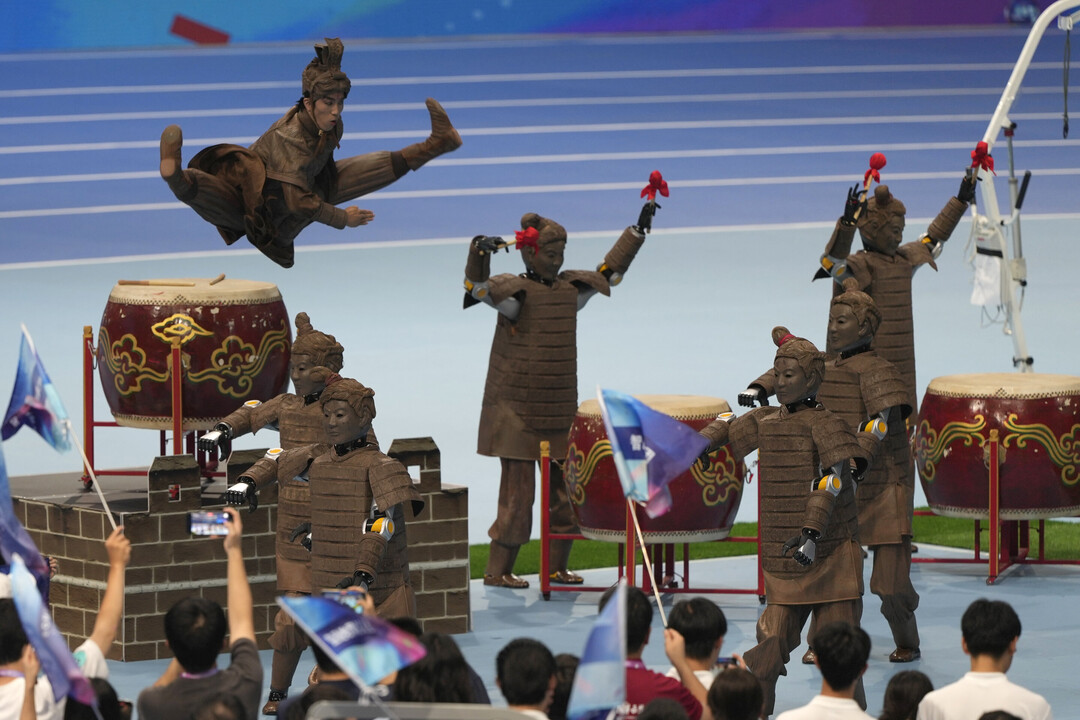
The prowess of Chinese robotics was further highlighted during a recent concert by singer Wang Leehom in Chengdu. Six humanoid robots, developed by the prominent firm Unitree, performed a synchronized dance routine that included forward flips—a feat challenging even for humans. The display caught the attention of Tesla CEO Elon Musk, who described the performance as "impressive" on social media, noting that Chinese robots are now performing across diverse environments.
The Numbers Behind the Surge
According to the International Federation of Robotics (IFR), China accounted for 57.6% of global industrial robot installations last year. In the humanoid sector specifically, the gap between China and the United States is widening in terms of intellectual property. Data from Morgan Stanley indicates that China filed 7,705 humanoid-related patents over the past five years, nearly five times the 1,561 filings from the U.S.
In terms of market share, China currently leads with 30%, followed by the U.S. (25%) and Japan (10%). Agibot, a Shanghai-based startup, recently surpassed a cumulative production of 5,000 humanoid units, beating Tesla’s Optimus in the race toward mass commercialization. Agibot’s founder, Peng Zhihui, announced plans to scale production to 100,000 units in the long term.
Concerns Over Market Overheating
Despite the rapid growth, Beijing has begun to signal caution regarding "irrational exuberance." The National Development and Reform Commission (NDRC) warned that over 150 companies are flooding the market with highly similar humanoid models, which could lead to redundant R&D and wasted capital.
Furthermore, a Morgan Stanley survey revealed a gap between adoption intent and satisfaction. While 62% of Chinese executives plan to introduce robots within three years, only 23% expressed satisfaction with current performance levels. Experts suggest that while China has achieved a lead in quantity and manufacturing speed, the industry must still overcome hurdles in technical maturity and cost-efficiency to achieve full-scale commercial viability.
[Copyright (c) Global Economic Times. All Rights Reserved.]