• 2026.06.05 (Fri)
  • All articles
  • LOGIN
  • JOIN
Global Economic Times
fashionrunwayshow2026
  • Synthesis
  • World
  • Business
  • Industry
  • ICT
  • Distribution Economy
  • Well+Being
  • Travel
  • Eco-News
  • Education
  • Korean Wave News
  • Opinion
  • Arts&Culture
  • Sports
  • People & Life
    • International Student Report
    • With Ambassador
  • Column
    • Cho Kijo Column
    • Cherry Garden Story
    • Ko Yong-chul Column
    • Kim Seul-Ong Column
    • Lee Yeon-sil Column
  • Photo News
  • New Book Guide
MENU
 
Home > Distribution Economy

BOK Holds Rate Steady for Seventh Consecutive Meeting, Signaling End of Easing Cycle

Global Economic Times Reporter / Updated : 2026-04-10 12:59:26
  • -
  • +
  • Print
Amidst heightening tensions in the Middle East and a volatile Won, the Bank of Korea opts for a "wait-and-see" approach, prioritizing stability over growth.


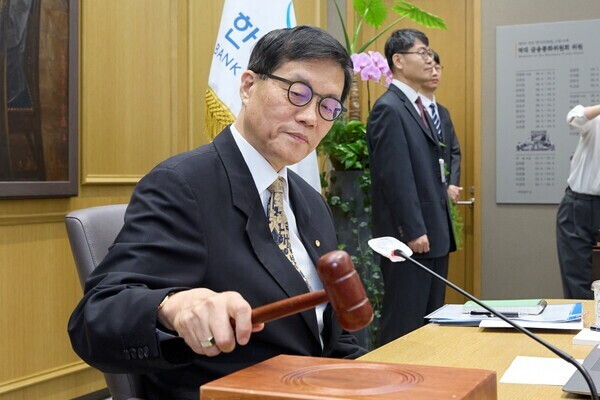
The Bank of Korea (BOK) on Friday maintained its benchmark interest rate at 2.50%, marking the seventh consecutive session of status quo. The decision by the Monetary Policy Board reflects a cautious stance as the central bank grapples with the fallout from the ongoing conflict in the Middle East, which has simultaneously fueled inflationary pressures and dampened growth prospects.

With this latest freeze, the base rate has remained unchanged for ten months since July of last year. Market analysts suggest that the "pivot" toward lower rates, which many had anticipated earlier this year, has effectively been shelved as the BOK shifts its focus toward managing external shocks and foreign exchange volatility.

A Balancing Act Under Fire
The Monetary Policy Board today faced an increasingly complex economic landscape. The central bank is currently wedged between the "twin evils" of resurgent inflation and a looming economic slowdown.

The primary driver of the hawkish-hold is the surge in global energy prices triggered by the war involving Iran. South Korea’s consumer price index (CPI) climbed to 2.2% in March, up 0.2 percentage points from the previous month. While still relatively low by global standards, the upward trajectory is a concern for a central bank determined to anchor inflation expectations.

Furthermore, the foreign exchange market has entered a period of extreme turbulence. The South Korean Won recently plummeted to the 1,520 level against the U.S. dollar. A rate cut at this juncture could exacerbate capital outflows and weaken the Won further, especially given the persistent interest rate differential between Seoul and Washington.

Growth Outlook Dims
On the other side of the ledger, the BOK faces mounting pressure to support a cooling economy. The escalating Middle East crisis has disrupted global trade, prompting the Organization for Economic Cooperation and Development (OECD) to slash South Korea’s 2026 GDP growth forecast from 2.1% to a somber 1.7%.

The decision to freeze rather than hike rates is likely a nod to these recessionary risks. Raising rates to combat inflation could further stifle domestic consumption and clash with the government’s fiscal policy. The administration recently announced a 26 trillion won supplementary budget aimed at revitalizing the economy, and a tightening of monetary policy would create a significant "policy mismatch" with the government’s stimulus efforts.

The End of the "Incentive to Ease"
Governor Rhee Chang-yong’s recent actions and the upcoming leadership transition suggest a definitive end to the easing cycle. Shin Hyun-song, the nominee for the next BOK Governor, has already hinted at a balanced but firm monetary policy, citing the high degree of uncertainty stemming from geopolitical shifts.

"The BOK’s priority has clearly shifted from supporting growth to maintaining financial stability and defense of the currency," said one senior market analyst in Seoul. "Given the 1,500-won exchange rate and the risk of $100-per-barrel oil, the door for a rate cut in 2026 appears firmly shut."

As the Middle East conflict enters a critical phase, the Bank of Korea is expected to maintain its restrictive stance for the foreseeable future, monitoring whether the fragile two-week ceasefire between the U.S. and Tehran holds. For now, the "Era of Higher for Longer" remains the reality for the South Korean economy.

[Copyright (c) Global Economic Times. All Rights Reserved.]

  • #globaleconomictimes
  • #micorea
  • #mykorea
  • #nammidonganews
  • #singaporenewsk
  • #Samsung
  • #Daewoo
  • #Hyosung
  • #Apple
  • #korea
Global Economic Times Reporter
Reporter Page

Popular articles

  • Hyundai Motor Group Bets $700 Million on Mexico Amid Trade Policy Volatility

  • IRANIAN STATE MEDIA DEMONSTRATES ASSAULT RIFLES ON-AIR, TARGETING UAE FLAG AMID RISING REGIONAL PRESSURES

  • Tesla Model Y Becomes First to Pass Grueling New U.S. Autonomous Safety Tests

I like it
Share
  • Facebook
  • X
  • Kakaotalk
  • LINE
  • BAND
  • NAVER
  • https://globaleconomictimes.kr/article/1065585481366379 Copy URL copied.
Comments >

Comments 0

Weekly Hot Issue

  • Samsung Electronics Super-Enterprise Union Loses Majority Status Amid Backlash Over Bonus Disparities
  • Samsung to Embed Vital Signs and Heart Health Scores in Upcoming Galaxy Watch9 Lineup
  • Apple Honors Digital Excellence: 12 Exceptional Apps and Games Celebrated at the 2026 Design Awards
  • Nexon Revamps Signature Youth Coding Competition into AI-Driven 'Nexon Young Programmers Cup'
  • Tech University of Korea Gathers 200 Game and AI Researchers to Discuss Industrial Expansion
  • Major Korean Telcos Trim Online-Exclusive Plans by Up to 50% Amid Shift to Unified Mobile Tariffs

Most Viewed

1
From a moment of collective sacrifice to a moment of collective democracy: The Timing of the Election in Ethiopia and Korea
2
U.S. Holds Off on Immediate Comprehensive Semiconductor Tariffs, but Pressure Mounts for Samsung and SK Hynix to Accelerate Domestic Investments
3
[Interview] "Halal is Not a Religious Regulation, but a 'Trust Infrastructure'… Creating a Premium 'K-Halal' Centered on Data and Platforms"
4
‘600 Million Won Bonus’ at Samsung Electronics Triggers Deep Sense of Relative Deprivation Among Korean Workers
5
Musk’s SpaceX Secures Space Hegemony with Flawless Starship V3 Recovery Ahead of Historic IPO
광고문의
임시1
임시3
임시2

Hot Issue

Murata Unveils Next-Gen Resin Electrode MLCC for Automotive Applications

Samsung to Embed Vital Signs and Heart Health Scores in Upcoming Galaxy Watch9 Lineup

L&F Plus Secures KRW 220 Billion from National Growth Fund to Anchor South Korea’s First Mass LFP Cathode Production

Samsung Electronics Super-Enterprise Union Loses Majority Status Amid Backlash Over Bonus Disparities

Fashion Runway Show 2026

Global Economic Times
korocamia@naver.com
CEO : LEE YEON-SIL
Publisher : KO YONG-CHUL
Registration number : Seoul, A55681
Registration Date : 2024-10-24
Youth Protection Manager: KO YONG-CHUL
Singapore Headquarters
5A Woodlands Road #11-34 The Tennery. S'677728
Korean Branch
Phone : +82(0)10 4724 5264
#304, 6 Nonhyeon-ro 111-gil, Gangnam-gu, Seoul
Copyright © Global Economic Times All Rights Reserved
  • 에이펙2025
  • APEC2025가이드북TV
  • 반달곰 프로젝트
Search
Category
  • All articles
  • Synthesis
  • World
  • Business
  • Industry
  • ICT
  • Distribution Economy
  • Well+Being
  • Travel
  • Eco-News
  • Education
  • Korean Wave News
  • Opinion
  • Arts&Culture
  • Sports
  • People & Life 
    • 전체
    • International Student Report
    • With Ambassador
  • Column 
    • 전체
    • Cho Kijo Column
    • Cherry Garden Story
    • Ko Yong-chul Column
    • Kim Seul-Ong Column
    • Lee Yeon-sil Column
  • Photo News
  • New Book Guide
  • Multicultural News
  • Jobs & Workers