

In the arena of international politics, the "words" spoken by a national leader are by no means mere rhetoric. They represent the country’s national prestige and serve as a measure of the trust the international community places in that nation. When a head of state breaks international promises and goes back on their word, the repercussions transcend borders, leading to a catastrophe of global distrust. The current trajectory of the United States serves as a painful testament to how such "inconsistency between word and deed" diminishes the standing of a superpower.
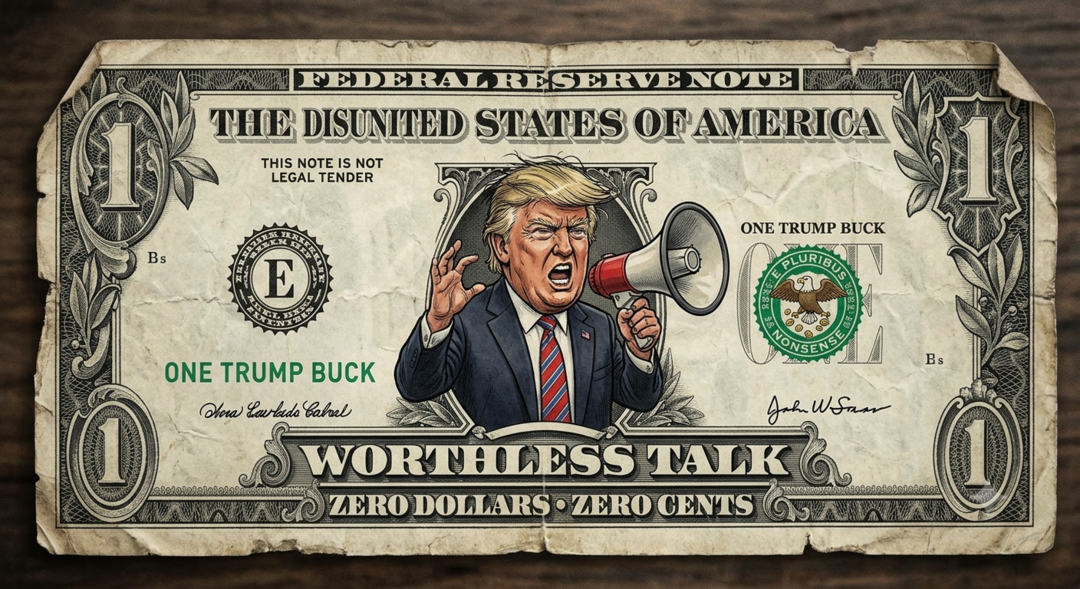
A recent report by the Pew Research Center speaks volumes. In a survey covering 36 countries, a staggering 76% of respondents indicated that they do not trust the U.S. President. Very few believe that the U.S. contributes to world peace, and it is difficult to find support for the legitimacy of its foreign policy. This phenomenon transcends specific political orientations. It signifies that the "language" used by the United States is being treated like a bounced check that no longer holds value in the international community. The collapse of trust, failing to guarantee even the face value of a dollar—this is the harsh reality the U.S. faces today.
President Trump’s diplomatic stance, "peace through strength," is filled with shattered pieces of trust when examined closely. Tactics such as pressuring allies with tariff policies, neutralizing multilateral international organizations, and casting aside existing agreements for the sake of immediate national interests have invited deep distrust from the international community. The proportion of people who believe that decisions made by the U.S. President regarding international issues will be correct has at times been measured lower than the trust ratings for authoritarian leaders like China’s Xi Jinping or Russia’s Vladimir Putin. These figures confirm that the moral authority of the U.S., which once positioned itself as the guardian of global order, has plummeted to the bottom.
A leader's word is the compass for the nation they steer. A compass that has lost its direction plunges the entire community into treacherous waves. The current U.S. is exacerbating confusion across the globe, and the price is returning as instability for the American people and the international order. Unilateralist attitudes, such as withdrawing from international organizations and reducing contributions, are isolating the U.S. itself and diluting the values of democracy.
The White House continues to be absorbed in self-praise, asserting the achievements of "peace through strength." However, objective indicators do not lie. The tangible distrust felt by the public around the world cannot be concealed by promotional statements from the White House. What remains in the place where trust has collapsed is nothing more than an empty echo called "America First."
The essence of politics is built upon a foundation of promises and trust. No matter how overwhelming a nation’s military power or economic strength, if the words of the leader at its apex do not carry the value of a dollar, that nation cannot exercise true leadership. It is time for the U.S. to deeply reflect on the weight of its "words" to recover lost international trust. The status of a superpower does not stem from physical force that suppresses others, but from moral trust that makes the world listen to its words. The U.S. must face the historical lesson that hegemony without the foundation of trust is bound to crumble like a sandcastle.
[Copyright (c) Global Economic Times. All Rights Reserved.]