![[등록] 2026-09-01 15:48:31](/support/_updata/banner2/tl181982910_6749.png)


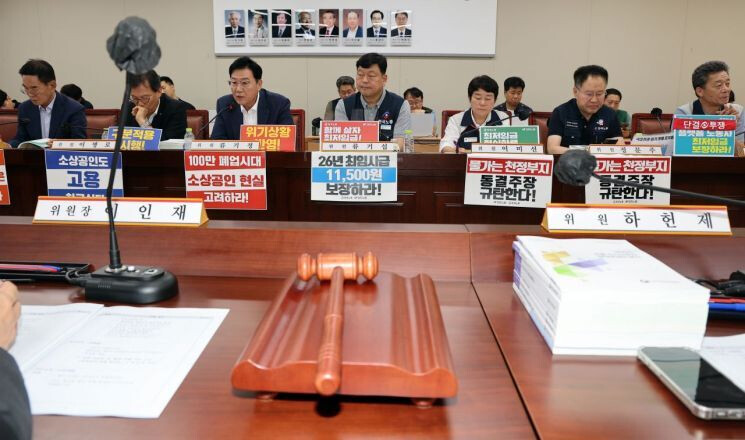
The annual battle over South Korea's minimum wage has officially commenced, with labor and management presenting starkly different opening demands for the 2027 rate. As the Minimum Wage Commission (MWC) gathered at the Government Complex in Sejong on June 23 for its eighth plenary session, the chasm between the two sides highlighted the deepening struggles of both low-wage workers grappling with inflation and small business owners facing a domestic economic downturn.
Labor’s Call for a Double-Digit Hike
Labor representatives proposed an hourly minimum wage of 12,000 KRW, a 16.3% increase from the current 10,320 KRW. Based on a standard 209-hour work month, this translates to a monthly salary of 2,508,000 KRW.
The two major labor federations argued that the past three years of modest increases have failed to keep pace with inflation, leading to a decline in the real wages of low-income earners. "The average minimum wage increase over the past three years was only 2.37%, while inflation averaged 2.66%," labor representatives stated. They further emphasized that current wage levels fall significantly short of the estimated living cost of approximately 2.75 million KRW per month, calling the 12,000 KRW figure a "minimum social demand" to restore purchasing power.
Management’s Stand for a Freeze
In sharp contrast, the management sector, led by the Korea Employers Federation (KEF), has requested a freeze at 10,320 KRW. Business representatives argue that the Korean minimum wage is already high by international standards, noting that it exceeds 60% of the median wage—significantly higher than the average of 49.3% seen in G7 countries.
"Considering the labor productivity levels and the dire management conditions faced by small and medium-sized enterprises (SMEs) and self-employed business owners, any further increase would be an unbearable burden," a management representative stated. Data from recent surveys confirms this sentiment, with nearly 45% of surveyed small business owners advocating for a wage freeze, citing the prolonged slump in domestic demand and rising operational costs. The business sector is also pressing for the "differential application" of the minimum wage, which would allow for lower rates in specific, highly vulnerable industries.
The Road Ahead
The initial gap between the two sides stands at 1,680 KRW. The MWC, composed of 27 members—nine each from labor, management, and the public interest—is now tasked with narrowing this difference through a series of revised proposals. Historically, the process involves multiple rounds of negotiation; last year, the final decision was reached only after ten rounds of revised offers.
While the legal deadline for the deliberation is June 29, the committee typically extends its discussions into mid-July. Once a final agreement is reached, it will be submitted to the Minister of Employment and Labor, who is mandated to finalize and announce the new minimum wage by August 5. The approved rate will take effect on January 1, 2027.
As economic uncertainty persists, the upcoming negotiations are expected to be the most critical in recent years. The outcome will not only impact the livelihoods of millions of workers but also serve as a pivotal indicator of the government’s approach to balancing social equity with economic sustainability in a challenging global and domestic environment.
[Copyright (c) Global Economic Times. All Rights Reserved.]