![[등록] 2026-09-01 15:48:31](/support/_updata/banner2/tl181982910_6749.png)


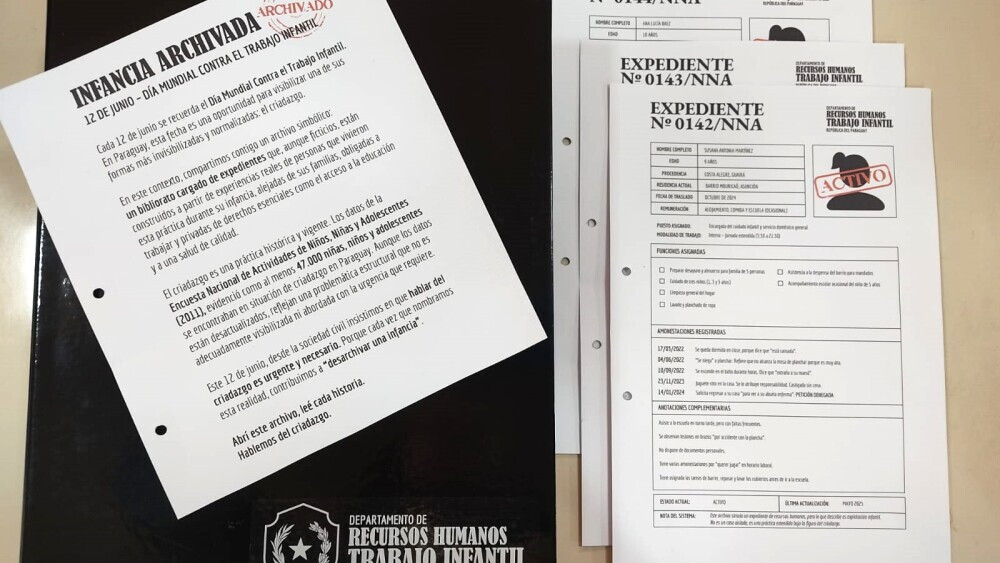
ASUNCIÓN, PARAGUAY – June 12, 2025 – On World Day Against Child Labor, a stark warning has emerged from Paraguay regarding 'criadazgo,' one of the most secretive yet prevalent forms of child labor. Civil society organizations, under the banner of "Archived Childhood" (Infancia archivada), have unveiled fictional case files detailing child exploitation, exposing the dangers, violence, and state indifference faced by children. This initiative aims to confront the deeply rooted reality of 'criadazgo' in Paraguayan society and spark a crucial dialogue for its eradication.
'Criadazgo': Structural Violence Disguised as Custom
'Criadazgo' refers to a system where children, primarily from impoverished rural areas, are sent to third-party households in large cities to perform domestic labor in exchange for room, board, and education. While it may appear to offer opportunities to children in need, it is, in reality, a widespread system of severe exploitation and abuse. These children are not only deprived of schooling but are also exposed to physical, emotional, and in many cases, sexual abuse. Their family ties are severed, leading to a tragic existence in isolated environments.
Marta Benítez, director of Global Infancia, firmly stated, "'Criadazgo' is structural violence disguised as custom." She emphasized, "Naming it, making it visible, and questioning it is the first step towards its eradication." Criticism has also been raised within the Paraguayan Congress, where some legislators, such as Gustavo Leite and Dionisio Amarilla, have attempted to justify 'criadazgo' as 'culture' or a 'Paraguayan characteristic,' hindering efforts to address the issue.
The Tragedy of Ignored Children: The True Face of 'Criadazgo' Through Real Cases
The fictional cases revealed in this campaign are reconstructed based on testimonies from actual 'criadazgo' survivors, vividly illustrating the horrific realities children endure.
Susana (9 years old): Sent from Guairá to a family in Asunción, Susana was responsible for preparing meals for five family members, cleaning, laundry, ironing, and caring for three children aged 1, 3, and 5. If a toy broke, she was punished by being denied dinner. Although she attended school, her absences were frequent, and she often hid in the bathroom, missing her mother. She had scars on her arm from an "ironing accident," and her requests to go home to "visit her sick grandmother" were repeatedly denied.
Celia (8 years old): Working in Asunción caring for a baby, Celia was forbidden from playing with toys.
Lourdes (12 years old): Caring for an elderly person and doing household chores, Lourdes recently stopped attending school and found solace secretly reading books donated by neighbors.
Monica (14 years old): From Guairá, Monica, who cared for an elderly person, was forbidden from making phone calls after she burst into tears during a call with her family.
Milena (9 years old): From Caazapá, sent to Villa Elisa to care for other children and cook, Milena was once punished for falling asleep on the floor with a broom in her hand.
These young female victims endured unpaid, full-time domestic and care labor, deprived of even their basic rights.
Boys are also victims of 'criadazgo,' often subjected to more arduous physical labor than girls, exposing them to a higher risk of injuries and accidents.
Ricardo (13 years old): Carried cement bags, mixed cement, and lifted construction materials onto roofs. He had burns and back injuries from age-inappropriate labor and could only eat after all tasks were completed.
Damián (11 years old): Helped organize goods, carried heavy items, and cared for children in a family store.
Joel (12 years old): Was responsible for garden care and maintenance.
Even children who attended school experienced irregular attendance, relied on donated school supplies, had frequent absences, and struggled academically.
The State of 'Criadazgo' and Government Neglect
According to the 2011 National Survey of Activities of Children and Adolescents (Encuesta Nacional de Actividades de Niños, Niñas y Adolescentes), there were at least 47,000 cases of 'criadazgo' in Paraguay. However, this number has not been updated, and the problem remains ongoing. While the government has stated its intention to pursue new legislative proposals to criminalize 'criadazgo,' given its past indifference and insufficient measures, it remains uncertain whether real change can be achieved.
Cynthia Florentín, director of the Coordinating Committee for the Rights of Children and Adolescents (Coordinadora por los Derechos de la Infancia y la Adolescencia, CDIA), emphasized, "These actions are meant to initiate the necessary dialogue." She added, "Naming 'criadazgo' is the first step towards making it visible and a promise that as members of society, we will work together to eradicate it."
'Criadazgo' is a complex problem deeply embedded in Paraguayan society, a result of a combination of poverty, lack of access to education, and low awareness of child rights. Stripping away the pretense of 'culture' that justifies child exploitation and creating an environment where vulnerable children can grow with dignity is an urgent task for Paraguayan society. This requires strong government will, law enforcement, and continuous monitoring and awareness campaigns by civil society.
[Copyright (c) Global Economic Times. All Rights Reserved.]