"There was a moment when I thought we might not be able to continue sailing, trapped by ice floes. We waited for the sun to rise, and as a path of water began to appear, we slowly made our way through."
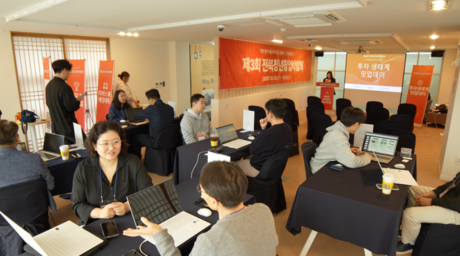
Recalling the most memorable moment of the voyage, Park Ji-jung, first officer of Panstar who returned from completing South Korea’s pilot voyage along the Arctic route, shared this during a press conference held at the Ministry of Oceans and Fisheries (MOF) on the 22nd. Throughout the 50-day journey, unexpected situations unfolded, including ice floes blocking the path and temporary disruptions to the Global Positioning System (GPS) and communications. Each time, the crew recalculated routes, adjusted speeds, and forged ahead.
Departing from the port of Busan on August 22, the Panstar Acro sailed through the Arctic Ocean to Europe, returned via the Arctic route, and docked back in Busan on the 11th. This round-trip pilot voyage by a South Korean-flagged vessel along the Arctic route concluded after 50 days.
The achievements were significant. The vessel successfully navigated the Arctic route without the assistance of an icebreaker, reducing the shipping distance by approximately 35% and travel time by about 10 days compared to traditional routes. Above all, it holds profound meaning as it marks the first time actual commercial shipping data on the Arctic route—previously dependent on foreign sources—and the polar navigation experience of South Korean crews have been accumulated. The Ministry of Oceans and Fisheries plans to analyze the acquired data, share it with industry stakeholders and related organizations, and utilize it for subsequent pilot voyages, the introduction of ice-strengthened vessels, and the development of icebreaking container ship technologies.
A 50-Day Journey Full of Hurdles
The 50-day voyage was not as smooth as anticipated. The most tense moment arrived about ten days after departure. Between the night of August 31 and September 1, numerous ice floes blocked the path. After sunset, visibility dropped drastically. Because ice floes extend further underwater than what is visible on the surface, relying solely on radar was dangerous.
The captain and officers decided not to force the ship forward. They waited until visibility was secured, and when the sun rose, they navigated at low speed to find a path opened between the ice floes and escaped.
"As a seafarer, there was anxiety that we might not be able to continue the voyage, and as an operations supervisor, I had to contemplate Plan B and even Plan C," Officer Park said. "What remains most vividly in my memory is when the sun rose, revealing a previously hidden sea route, and we carefully pushed through at a low speed."
The polar environment also tested the vessel itself. As it traveled into higher latitudes, compass errors widened, and sections emerged where GPS position tracking was temporarily cut off. Communications were also temporarily disrupted. Panstar prepared multiple communication networks—including satellite communications, low-earth orbit satellites, and Starlink—to maintain an emergency communication grid.
Low temperatures presented another challenge. While Marine Gas Oil (MGO) was used in the Arctic Ocean in accordance with the Polar Code, abnormal signs appeared in the lubrication and fuel circulation systems due to the low temperatures. The crew managed the ship's major equipment using insulation and heaters to continue the voyage.
Accumulating Invaluable Data and Know-How
Each of these experiences transformed into vital data for future Arctic route operations. For researchers who have studied the Arctic route, the significance of this voyage was extraordinary. Professor Kwon Young-tae of the Korea Institute of Maritime and Fisheries Technology explained that although he had been researching and teaching education related to the Arctic route since 2012, securing actual commercial shipping data was difficult because countries and shipping companies that pioneered the route rarely disclosed their real operational data to outsiders.
"The biggest regret was not being able to secure practical navigation data on the Arctic route," Professor Kwon said, adding that he felt this boarding allowed him to "put a period" on over a decade of research into the Arctic route.
The actual voyage accumulated know-how that cannot be gained simply through textbooks or simulations. Rather than strictly following the pre-set route from departure, the crew continuously received satellite-generated "ice charts" to check the location and density of ice floes, crafting new paths according to real-time conditions.
"Even if we had a route established at departure, we received ice charts along the way and created new routes before entering areas," Professor Kwon explained, noting that this approach ensured safe navigation.
As it was a maiden voyage, there were trials and errors. Heading toward Europe, after passing through the Bering Sea, the Panstar Acro encountered ice floes and countercurrents, forcing it to reduce speed to about 12 knots. Although the schedule fell behind by about two days initially, the ship increased speed after clearing the ice zone and continued its journey. "Since this was our first time on this route, information was insufficient, leading to changes," Professor Kwon evaluated. "Given that data was scarce for this initial pilot voyage, the lessons and knowledge we absorbed are immense."
The experience of the crew also remains an asset to keep opening up the Arctic route, especially since finding domestic crew members with polar navigation experience was difficult from the start.
"Preparing for the pilot voyage, it was hard to find a ship, but it was also hard to find crew members," Officer Park said. "It was difficult to find sailors who had experienced polar environments." He added, "Once a broad experience is gained, it doesn't shrink. If these experiences continue to accumulate, they will eventually lead to commercial viability."
Toward Regular Operations and Economic Feasibility
Panstar is considering the possibility of regular operations beyond this single voyage. "We are reviewing whether the operation of 5,000 to 6,000 TEU-class vessels and a regular schedule are feasible," said Kim Jung-dal, director of Panstar Group's Shipping Planning Business Division. Moving away from the conventional weekly liner concept, operating seasonally during specific periods each year is also under review.
Economic viability remains a task to be verified. Panstar is currently compiling cost and revenue data from this voyage. Director Kim stated, "A shipping company will not move if there is no economic feasibility, but if regular schedules are established in advance, we believe it will be economically viable."
The Ministry of Oceans and Fisheries plans to conduct an economic analysis based on the operational data and release the results next month. Oh Haeng-rok, Vice Director of the Arctic Route Promotion Headquarters at the Ministry, stated, "We plan to analyze and accumulate the data collected through this pilot voyage and share the results with the industry and related organizations. We will continue to diversify vessel routes and cargo, strengthen related cooperation, support shipping companies in introducing ice-strengthened vessels to expand the fleet, and develop icebreaking container ship technologies."
[Copyright (c) Global Economic Times. All Rights Reserved.]