![[등록] 2026-09-01 15:48:31](/support/_updata/banner2/tl181982910_6749.png)


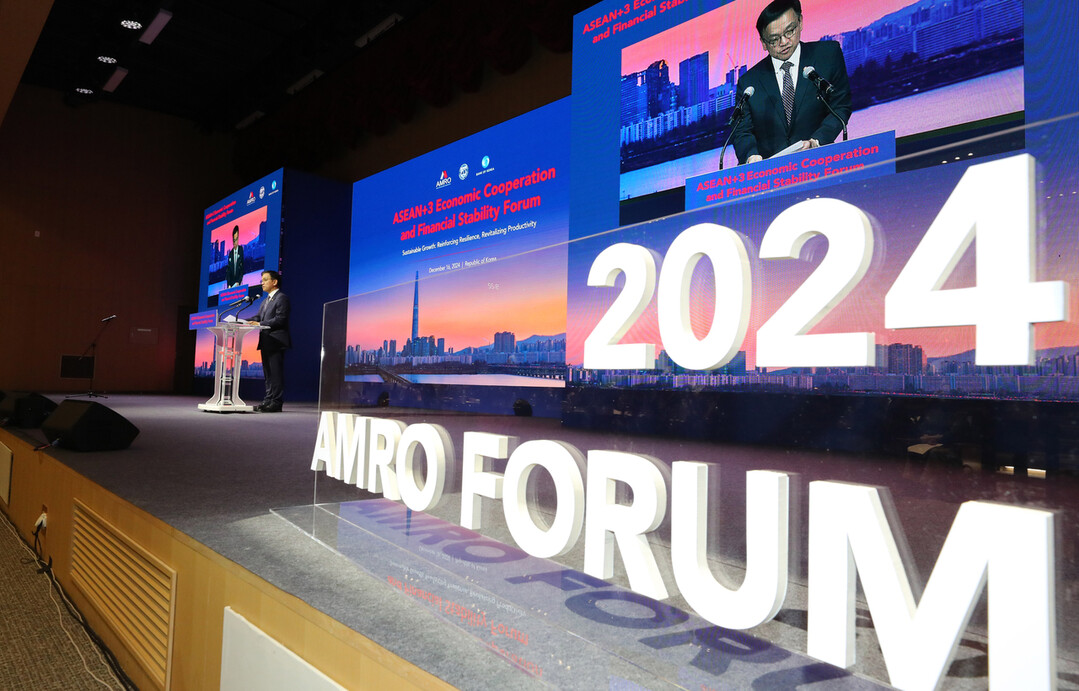
Seoul, South Korea - The ASEAN+3 Macroeconomic Research Office (AMRO) has revised its 2024 economic growth forecast for South Korea downward from 1.9% to 1.6%, citing potential negative impacts from US tariffs and the "December 3rd Martial Law." AMRO also predicts South Korea's inflation rate will decrease to 1.9%, down 0.4 percentage points from the previous year.
In its "2024 South Korea Annual Consultation Report" released on March 21st, AMRO stated, "South Korea's economic growth rate for 2024 is expected to decline to 1.6%, considering the potential impact of future US tariffs." This figure is 0.3 percentage points lower than the 1.9% forecast in their December 6th report. AMRO is an international organization that analyzes and monitors the economic trends of ASEAN+3 (Association of Southeast Asian Nations + South Korea, China, and Japan) and supports the economic and financial stability of its member countries.
This revised forecast is lower than the projections of the International Monetary Fund (IMF, 2.0%) and the South Korean government (1.8%), but higher than those of the Bank of Korea and the Organization for Economic Cooperation and Development (OECD, both 1.5%). It aligns with the forecast of the Korea Development Institute (KDI, 1.6%).
AMRO highlighted the bleak outlook for South Korea's exports due to the sharp increase in US tariffs. The report stated, "While domestic demand is expected to improve, supported by monetary policy easing and a recovery in manufacturing investment, exports are projected to slow down due to the semiconductor cycle downturn and the possibility of US tariff hikes."
The report also pointed to the "December 3rd Martial Law" as a factor negatively impacting the South Korean economy. AMRO warned, "Political uncertainties stemming from the declaration of martial law in December 2024 could dampen corporate and consumer sentiment. It could also act as an additional risk factor, leading foreign investors and tourists to adopt a wait-and-see attitude." The December report did not mention the martial law, indicating it as a new concern.
South Korea's inflation rate is projected to be 1.9%, a 0.4 percentage point decrease from the previous year, due to the stabilization of domestic food prices and the slowdown in global energy prices. However, AMRO identified several upside risks to inflation, including heightened geopolitical tensions in the Middle East and Ukraine, energy and food price increases due to extreme weather conditions, and adjustments in fuel taxes and electricity rates.
The report also raised concerns about fiscal deficits resulting from tax cuts and declining corporate performance. AMRO noted, "The fiscal deficit has widened due to a decrease in corporate tax revenue. The growth rate of fiscal expenditure was lower than expected, largely attributed to the reduction in education grants and local government grants." This refers to the South Korean government's decision to arbitrarily cut legally mandated local government grants and education grants to address last year's tax revenue shortfall.
AMRO warned of the risks to savings bank soundness due to non-performing real estate project financing (PF) loans. They recommended that savings banks and credit unions actively liquidate non-viable PF projects. The report also advised the South Korean government to strengthen risk management and credit evaluation for non-bank financial institutions.
AMRO suggested that South Korea's macroeconomic policy should be recalibrated to support growth while maintaining financial stability. They recommended a gradual easing of monetary tightening to support domestic demand, given the expected continued stability of inflation in the short term. They also urged the government to continue efforts to ensure fiscal sustainability.
This report is based on the annual consultation held in November of last year, when an AMRO mission visited South Korea and met with officials from the Ministry of Economy and Finance and the Bank of Korea.
[Copyright (c) Global Economic Times. All Rights Reserved.]