![[등록] 2026-09-01 15:48:31](/support/_updata/banner2/tl181982910_6749.png)


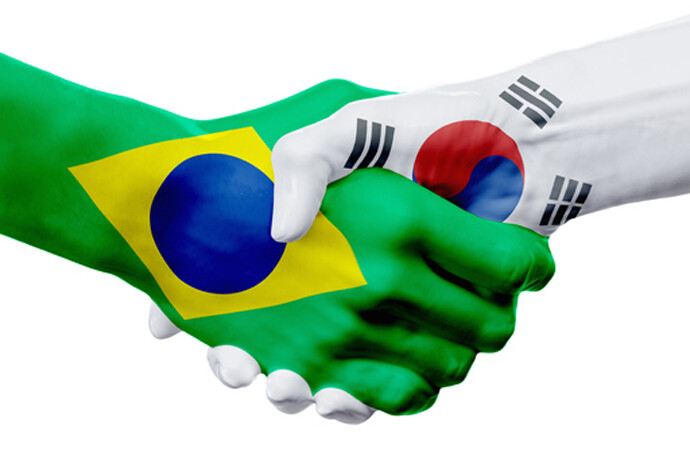
Amidst escalating trade tensions between the United States and China, the South Korean government is seeking to strengthen trade cooperation with Brazil, the largest economy in Latin America. It has been confirmed that the government recently officially proposed a Trade Partnership Agreement (TPA) to the Brazilian government, which, while a step below a Free Trade Agreement (FTA), aims for similar levels of market opening effects. This move is interpreted as part of a strategy to reduce trade dependence on specific countries and diversify export markets amidst an unstable international landscape.
Brazilian Government Begins Internal Review: Signals Cautious Approach
According to relevant government ministries, the South Korean government recently sent a letter to the Brazilian government requesting a review of the TPA negotiation proposal. The Brazilian government is reportedly currently conducting an internal review of the matter. Brazil boasts the largest economic scale in Latin America and possesses abundant natural resources and a vast domestic market, making it a country with significant potential for economic cooperation with South Korea.
Prioritizing Service Market Opening and Supply Chain Cooperation, Excluding Goods Tariffs
The TPA proposed by the South Korean government to Brazil appears to take a differentiated approach from traditional FTAs. Considering Brazil's concerns about industrial competitiveness and domestic market protection, it is understood that negotiations on goods tariffs will be excluded for the time being. Instead, priority will be given to high-level regulatory cooperation and establishing institutional frameworks in areas such as service market opening, strengthening supply chain collaboration, and simplifying customs procedures. This strategy is seen as an attempt to minimize resistance from the Brazilian side while generating substantial economic cooperation benefits.
Relevant ministries, including the Ministry of Trade, Industry and Energy, the Ministry of Foreign Affairs, and the Ministry of Economy and Finance, have reportedly concluded that cooperation with Brazil is essential to improve the export structure, which is currently concentrated on specific countries, and to secure new growth engines in preparation for the strengthening of US protectionism and the potential long-term continuation of US-China trade disputes. Brazil is one of South Korea's major trading partners, with a mutually complementary trade structure, particularly in agricultural products and mineral resources.
Expected Economic Effects and Prospects of TPA Conclusion
If the Brazilian government responds positively to South Korea's TPA proposal and a trade agreement is concluded between the two countries, South Korean companies will be able to enjoy institutional benefits in the Brazilian market, such as simplified translation and quarantine procedures, and secured regulatory transparency. This is expected to act as a catalyst for significantly expanding economic cooperation and trade volume with Brazil. In particular, the opening of the service sector will provide new business opportunities for South Korea's competitive service companies and contribute to the activate of investment between the two nations.
A high-ranking government official stated, "Considering the sensitivity of the Brazilian industrial sector, we are aiming for a phased approach rather than immediate opening in the goods sector. Our priority is to pursue an agreement that solidifies the institutional foundation for trade facilitation, such as simplifying customs procedures and ensuring regulatory transparency." The official added, "Our long-term goal is to build a comprehensive trade cooperation relationship that includes the reduction of goods tariffs."
South Korea's Strategic Move Amid US-China Trade Tensions: Highlighting the Importance of the Latin American Market
South Korea's recent proposal to Brazil for a TPA can be interpreted as a strategic move to reduce excessive dependence on specific countries and diversify export markets amidst the continued uncertainty of the US-China trade war. Brazil, with its vast population and economic size, can serve as a gateway to the Latin American market, and economic cooperation with South Korea is expected to provide new growth momentum for both countries.
The future of South Korea's trade strategy towards Latin America will likely depend on the outcome of the Brazilian government's internal review and the progress of negotiations. It remains to be seen whether the South Korean government can strengthen its resilience against an unstable international trade environment and establish a foundation for sustainable economic growth by building a diversified export portfolio through the propulsion of a TPA with Brazil.
[Copyright (c) Global Economic Times. All Rights Reserved.]