• 2026.03.05 (Thu)
  • All articles
  • LOGIN
  • JOIN
Global Economic Times
fashionrunwayshow2026
  • Synthesis
  • World
  • Business
  • Industry
  • ICT
  • Distribution Economy
  • Well+Being
  • Travel
  • Eco-News
  • Education
  • Korean Wave News
  • Opinion
  • Arts&Culture
  • Sports
  • People & Life
    • International Student Report
    • With Ambassador
  • Column
    • Cho Kijo Column
    • Cherry Garden Story
    • Ko Yong-chul Column
    • Kim Seul-Ong Column
    • Lee Yeon-sil Column
  • Photo News
  • New Book Guide
MENU
 
Home > World

From Table to Space: Japan Unveils Edible Spoons Made of Cookies

Myung Sun Yim Correspondent / Updated : 2026-03-05 06:23:58
  • -
  • +
  • Print


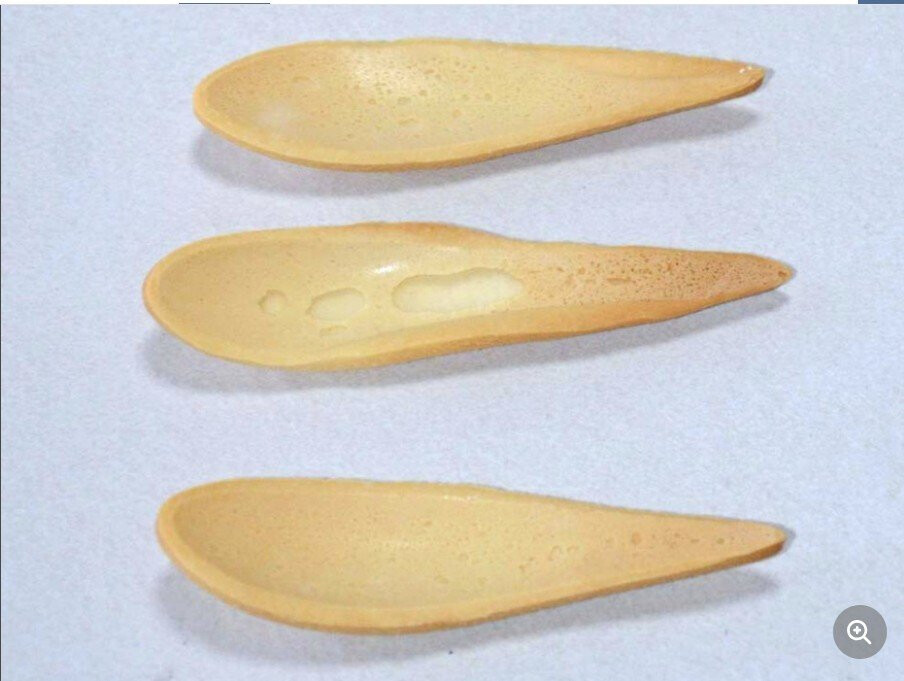
KAGOSHIMA – Imagine finishing your dessert and then eating the spoon you used to scoop it up. This eco-friendly and quirky dining experience is becoming a reality in Kagoshima, Japan.

The Uribo Research Institute, a vocational workshop supporting people with disabilities in Shimizu-cho, Kagoshima City, recently made headlines by unveiling its prototype of an "edible spoon." Since distributing samples in January, the product has garnered enthusiastic responses, particularly from children and the younger generation.

A Sustainable Crunch
Crafted primarily from flour and starch syrup, these spoons boast a firm, biscuit-like texture. Unlike flimsy plastic alternatives, they are sturdy enough to handle various foods before being consumed as a snack.

Beyond its novelty, the edible spoon serves multiple purposes. It is a powerful tool for environmental sustainability, drastically cutting down on single-use plastics. Furthermore, its long shelf life makes it an ideal candidate for disaster relief stockpiles and educational tools to teach children about sustainable eating habits.

Aiming for the Stars
The ambitions of the Uribo Research Institute go far beyond local cafes. The institute has set its sights on the stars—specifically, becoming an officially recognized space food for the Japan Aerospace Exploration Agency (JAXA).

To be sent into orbit, the product must meet rigorous standards, including extreme lightweight requirements, long-term preservation without spoilage, and impeccable quality uniformity.

"Our dream is to see a spoon from Kagoshima travel all the way into space," said Hiroshi Fujiwara, representative of the Uribo Research Institute. "We want to move forward toward this goal together with our staff and the users of our facility."

As the world continues to seek alternatives to plastic, this small, edible invention from a local workshop proves that the most "delicious" solutions to global problems can sometimes be found right in our kitchens.

[Copyright (c) Global Economic Times. All Rights Reserved.]

  • #Korea
  • #Seoul
  • #Hallyu
  • #USA
  • #Economy
  • #Busoness
  • #Global
  • #World
  • #Consumer
  • #Export
  • #Import
  • #Hanguel
  • #Travel
  • #Tour
  • #Food
Myung Sun Yim Correspondent
Myung Sun Yim Correspondent Global Economic Times Correspondent based in Los Angeles, USA

Popular articles

  • Netflix Withdraws Bid for Warner Bros. Discovery: "No Longer Financially Attractive"

I like it
Share
  • Facebook
  • X
  • Kakaotalk
  • LINE
  • BAND
  • NAVER
  • https://globaleconomictimes.kr/article/1065561733097395 Copy URL copied.
Comments >

Comments 0

Weekly Hot Issue

  • The Illusion of a "Stress-Relieving" Smoke: Study Finds Smokers More Prone to Depression
  • Luckin Coffee Shakes Up Global Market with Blue Bottle Acquisition
  • U.S. Private Sector Hiring Hits 7-Month High in February, ADP Reports
  • Self-Employed Loan Delinquency Rates Double in a Decade Amid Economic Headwinds
  • Multi-Homeowner Loan Balance Hits 103 Trillion Won; Half Concentrated in Seoul and Gyeonggi
  • Industrial Output Dips in January Amid Semiconductor Adjustments; Middle East Tensions Loom as Wild Card

Most Viewed

1
2026, The Grand Year of Hangeul Celebration — The River of History Where Five Streams Converge
2
A New Milestone for Ukraine’s Post-War Reconstruction: The Birth of ISVP
3
Mexican currency and the powerful history behind its designs
4
Revised and Expanded Edition of ‘Failure of Negotiations with North Korea: Truth and Solutions’ Published
5
About mexican food 
광고문의
임시1
임시3
임시2

Hot Issue

South Korean Markets Shaken by "Iran Shock": KOSPI Suffers Historic Rout Amid Soaring Oil and FX Rates

Self-Employed Loan Delinquency Rates Double in a Decade Amid Economic Headwinds

U.S. Private Sector Hiring Hits 7-Month High in February, ADP Reports

Industrial Output Dips in January Amid Semiconductor Adjustments; Middle East Tensions Loom as Wild Card

Let’s recycle the old blankets in Jeju Island’s closet instead of incinerating them.

Global Economic Times
korocamia@naver.com
CEO : LEE YEON-SIL
Publisher : KO YONG-CHUL
Registration number : Seoul, A55681
Registration Date : 2024-10-24
Youth Protection Manager: KO YONG-CHUL
Singapore Headquarters
5A Woodlands Road #11-34 The Tennery. S'677728
Korean Branch
Phone : +82(0)10 4724 5264
#304, 6 Nonhyeon-ro 111-gil, Gangnam-gu, Seoul
Copyright © Global Economic Times All Rights Reserved
  • 에이펙2025
  • APEC2025가이드북TV
  • 독도는우리땅
Search
Category
  • All articles
  • Synthesis
  • World
  • Business
  • Industry
  • ICT
  • Distribution Economy
  • Well+Being
  • Travel
  • Eco-News
  • Education
  • Korean Wave News
  • Opinion
  • Arts&Culture
  • Sports
  • People & Life 
    • 전체
    • International Student Report
    • With Ambassador
  • Column 
    • 전체
    • Cho Kijo Column
    • Cherry Garden Story
    • Ko Yong-chul Column
    • Kim Seul-Ong Column
    • Lee Yeon-sil Column
  • Photo News
  • New Book Guide
  • Multicultural News
  • Jobs & Workers