![[등록] 2026-09-01 15:48:31](/support/_updata/banner2/tl181982910_6749.png)


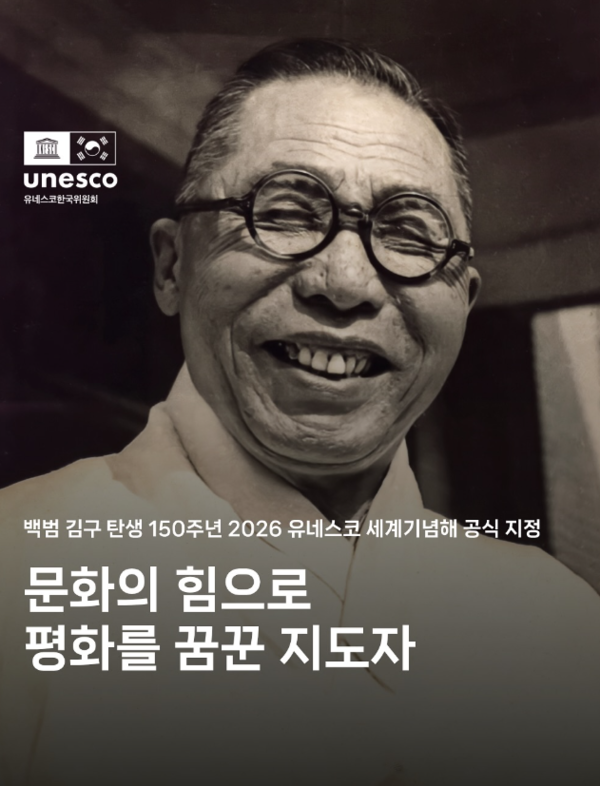
As the 150th anniversary of the birth of Independence Activist and Provisional Government leader Baekbeom Kim Gu approaches on August 29, literary and historical circles in both South Korea and China are revisiting his monumental legacy. Recognized globally by UNESCO as the "Year of Kim Gu's 150th Birth Anniversary," Kim's visionary philosophy—emphasizing the power of culture rather than mere military or economic might to resist imperialism—continues to resonate worldwide. While South Korea proposed this commemorative year, it garnered enthusiastic support from various nations, including China, Thailand, Vietnam, Cameroon, Namibia, Malawi, Zambia, and Côte d'Ivoire.
Amidst this global commemoration, a Chinese author has dedicated nearly three decades of his life to bringing Kim Gu's arduous journey into the spotlight of Chinese literature. Zhang Xinke, a 60-year-old prominent Chinese writer known for historical and spy fiction such as Letters from the Far East, Vast Land, and Crossing the River, published a 600-page, 530,000-character historical novel titled Iron Language (<철어>). Dedicated to the 80th anniversary of the victory in the Anti-Japanese War, the novel chronicles Kim Gu’s harrowing 7,000-li (approx. 2,800 kilometers) journey from Shanghai after the historic Hongkou Park bombing by Yun Bong-gil in April 1932 to his eventual settlement in Chongqing, mirroring the second part of Kim's autobiography, Baekbeomilji.
A Decades-Long Pursuit Born in Germany
Zhang’s fascination with Kim Gu began unexpectedly in the 1990s while he was studying in Hamburg, Germany. During a casual gathering, Korean international students asked him if he knew who Kim Gu was. Zhang initially confused him with Kim Il-sung, prompting an astonished correction from his peers: "Not Kim Il-sung, but Korea's Kim Gu! Don't you even know Kim Gu?" Because South Korea and China established diplomatic relations only in 1992, Zhang’s generation in China had limited exposure to modern Korean history.
Intrigued, Zhang headed to German libraries to investigate. What he discovered profoundly moved him. He learned that Kim Gu’s relentless anti-Japanese resistance galvanized Chinese national sentiment, prompting the Chinese government, local officials, and ordinary citizens to actively protect and shelter the Korean Provisional Government (KPG) from relentless Japanese pursuit.
Upon returning to China in 1999, Zhang immersed himself in research, reading the Chinese translation of Baekbeomilji. Beginning in 2005, he embarked on exhaustive field research, tracing Kim Gu’s footsteps across 11 historical cities, including Shanghai, Jiashing, Hangzhou, Zhenjiang, Nanjing, Wuhan, Changsha, Guangzhou, Liuzhou, Qijiang, and Chongqing. He meticulously visited multiple safe houses within single cities, hospitals where Kim recovered from gunshot wounds sustained during internal nationalist factional disputes, and local markets once frequented by KPG members. Between 2008 and onward, Zhang traveled to Seoul and Busan to cross-reference his findings with South Korean historians. Funding the entire endeavor out of his own pocket, Zhang spent approximately 800,000 yuan (approx. 164.4 million KRW) over two decades on field research alone.
Unsung Heroes: Friendship and Humanity Forged in Crisis
"As I traced Kim Gu's 7,000-li trail, what stood out above all else was 'friendship' and 'humanity,'" Zhang remarked during an interview at his office in the Nanjing University of Science and Technology. He noted that he visited Jiashing—where Kim took refuge immediately after Yun Bong-gil's bombing—more than ten times. At the time, the Japanese colonial authorities placed a massive bounty of 600,000 yuan on Kim Gu's head, an astronomical sum considering an ordinary worker's monthly wage was only 30 yuan.
While Chiang Kai-shek's Nationalist (Kuomintang) government officially promised support to the KPG, actual logistical capabilities were initially limited before the full-scale outbreak of the Second Sino-Japanese War. Consequently, local Chinese citizens stepped into the vacuum. Ordinary civilians provided crucial safe havens, and despite knowing about the staggering bounty, not a single local betrayed Kim Gu. Historical accounts from the period feature extraordinary acts of solidarity, such as Kim Gu disguising himself as a husband alongside a female boat rower, or local tycoon Chu Puchang using bribery to fend off probing local police. Zhang also uncovered poignant oral histories, such as an elderly resident in Shanghai recounting how Korean independence activists visiting local noodle shops were secretly given extra beef hidden beneath their noodles by sympathetic owners.
Zhang emphasizes that both the Kuomintang's Central Daily News and the Chinese Communist Party's Xinhua Daily viewed the Korean Provisional Government as comrades-in-arms, consistently portraying Kim Gu in high regard. This profound mutual respect and grassroots solidarity not only ensured the survival of the provisional government under extreme duress but also deeply shaped Kim Gu’s mature philosophy on cultural autonomy and peace.
Expanding Cultural Bridges Between Korea and China
Iron Language has garnered immense acclaim in China since its release, receiving congratulatory calligraphy scrolls from representatives of 14 provincial calligraphy associations—a high honor among Chinese artists. Reflecting on how far public awareness has come, Zhang recalled that when he first visited the Shanghai Provisional Government Interim Site in 2005, roughly 99% of ordinary Chinese visitors had no idea who Kim Gu was.
As the world marks the 150th birth anniversary of Baekbeom Kim Gu, Zhang plans to share his extensive research with Korean audiences, participating in an upcoming academic conference hosted by the National Memorial Museum of the Korean Provisional Government in Seoul. Expressing his deep admiration for the Korean leader, Zhang hopes that Kim’s life story will be adapted into documentaries or films so that his timeless ideals of peace, resilience, and cross-border human solidarity will endure for generations to come.
[Copyright (c) Global Economic Times. All Rights Reserved.]