![[등록] 2026-09-01 15:48:31](/support/_updata/banner2/tl181982910_6749.png)


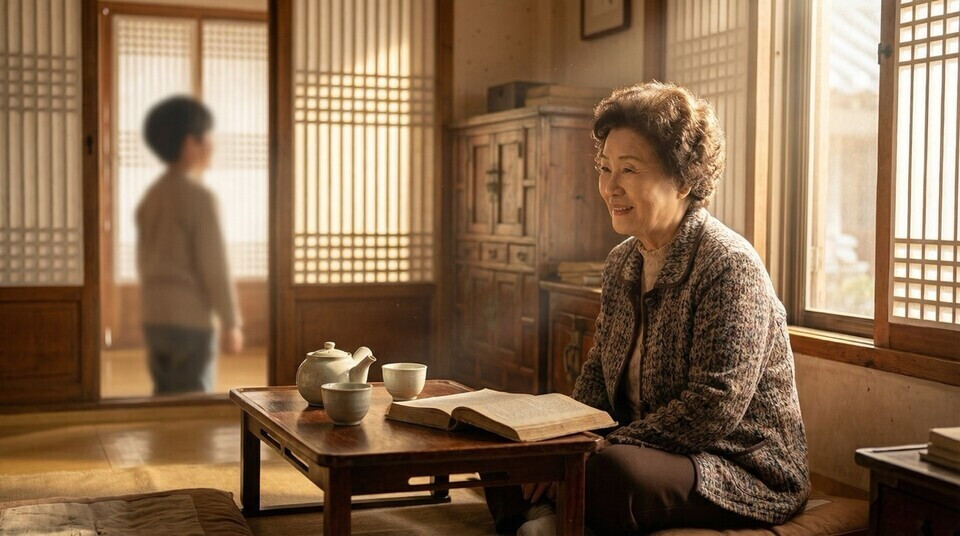
A singer with permed, frizzy hair—a stranger to me—appears on screen and sings, “Don’t give it your absolute best; your life will be too exhausting to live. Eat well; if you starve, your temper will turn sour.” Then, she adds, “Looking back, those words were right...” Intrigued by this somewhat unconventional message, I looked it up and found it was Yang Hye-seung’s song, A Mother’s Nagging. The lyrics continue: “You don’t live in this world alone. Before you fall and break, you’ll realize my words were the answer. You’ll suffer less if you listen to your mother.” Unlike most mothers, hers apparently told her, “Don’t give it your absolute best.” While the standard proverb says, “Never put off until tomorrow what you can do today,” this mother comforts her child’s weary life by saying, “Don’t do today what can be done tomorrow,” insisting that listening to her will lead to less hardship.
Our parents’ generation, who spent their entire lives struggling just to make a living, was born into a truly unfortunate era. They endured the Japanese occupation, and just as they tried to build a better life after liberation, the Korean War swept everything away. They had to worry about every meal and survive the "barley hump" (the spring hunger gap). Everyone struggled back then. Even as young children, we grew up helping with household chores. It wasn't until the 1980s, as factories rose and jobs became plentiful, that circumstances improved. In those days, daughters were taught to be frugal and to manage a household resourcefully. The term "wise mother and good wife" (hyeon-mo-yang-cheo) was a high virtue. It was said that the rise or fall of a family depended on the daughter-in-law who married into it. Thus, raising a daughter well was of utmost importance.
It seems American mothers nag their daughters quite a bit as well. Who is supposed to tidy up the bedding left behind like a snake shedding its skin, or the clothes and socks tossed randomly about? Even if they don’t wash the dishes they used, shouldn’t they at least move them to the sink? No mother can simply ignore a child walking out the door dressed haphazardly. Setting a curfew and requiring a call if plans change is likely universal, whether in the East or the West. “Clean your room! It looks like a tornado hit it.” “Am I your maid?” “Do you think money grows on trees?” “You made this mess, so you take responsibility for it!” “If all your friends jumped off a bridge, would you jump too?” But I wonder, how effective is this nagging, really?
My wife never allowed our daughters to go to a friend’s house to stay up late chatting and sleep over. For my part, if the children sat with a slouch, I would give them a sharp tap on the back. Maintaining good posture while growing up is important. We also had them swim for a long time, believing that physical strength is vital. It was also a way to survive if they ever fell into water. When the body is strong and one exercises, one becomes psychologically stable. Perhaps that is why our children passed through their adolescence without much trouble. To teach someone to ride a bicycle, you have to hold on and give them a push. For that reason, my "nagging" was: “Do what you want to do later, once you have grown up and become independent.” When they were minors, I worried quite a bit about them dating. So, I suggested they wait until graduate school to date. I figured if they were at the same school then, they would likely have similar capabilities.
I once thought about marriage after hearing a young woman say she always had to eat dinner at home with her family, meaning her curfew was before 7 p.m. That is truly an old story now. Today, my children have formed their own families and are raising their own kids. I don't know what kind of nagging they do. I feel sorry for not having done enough for them, yet I am simply grateful they grew up so well. I never once told them, "Don't give it your absolute best." I didn't tell them to be perfect, either. However, since life and cycling are things one must master for oneself, I did hold on and push them so they could ride well. In life, as on a bicycle, the uphill climb is hard, but the downhill is more dangerous. If you try riding a bike, you’ll find that going very slowly is actually quite difficult. Therefore, it is best to run at a moderate pace. If you get tired along the way, the best course of action is to take a rest.
In Korea, "ultra-early" education begins the moment a child is born. They teach English to children who haven't even mastered their own language. It is truly a pity. Seeing how AI and robots are advancing, is it really necessary to invest so much in studying English just for translation and decoding? I always emphasize reading. If you read a lot, your understanding of the principles of language and logic (mun-ri) will naturally open up. If you play by assembling and dismantling toys, you come to understand the laws of physics (mul-ri). That is enough. Children should grow up running around happily and doing what they want to do to be healthy and discover their talents. How can children who have been stressed by studies since infancy grow up to be well-rounded and healthy? Aren't high housing costs and private education expenses the reasons people give up on marriage and children? What a mess this is. As a father, let me say one thing: “Let them play happily. Let them do what they love. Being good at just one thing is enough.”
[Copyright (c) Global Economic Times. All Rights Reserved.]