![[등록] 2026-09-01 15:48:31](/support/_updata/banner2/tl181982910_6749.png)


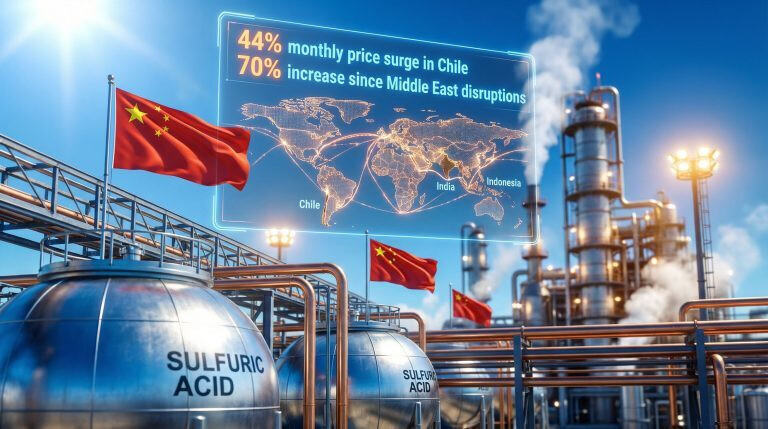
BEIJING – Global metal and fertilizer markets are bracing for a massive supply chain disruption as China, the world's largest exporter of sulfuric acid, has reportedly decided to suspend exports starting this May. Often referred to as the "rice of the chemical industry," the sudden withdrawal of Chinese sulfuric acid is expected to exacerbate an already fragile global economy struggling with Middle East tensions.
A Vital Component in Global Industry
Sulfuric acid is a critical industrial byproduct of copper and zinc smelting. Its applications are vast, serving as a primary raw material for phosphate fertilizers, copper production, oil refining, and the manufacturing of electric vehicle (EV) batteries.
According to reports from the South China Morning Post (SCMP) and industry insiders, the Chinese government recently notified domestic producers to halt all outbound shipments. While an official public decree has yet to be released, the move has already sent ripples through international markets.
Compounding Crisis: War and Supply Chains
The timing of China's move could not be worse. Global sulfuric acid prices have been on a steep upward trajectory since the beginning of the year, fueled by the conflict between the United States and Iran. The Middle East accounts for approximately 25% of global sulfuric acid production. With the Strait of Hormuz—a vital maritime chokepoint—effectively blockaded, supply routes have been severed.
In the spot market, sulfuric acid prices have skyrocketed from around 1,000 yuan per ton in early January to approximately 1,800 yuan by late April. This follows a year where prices had already doubled compared to previous averages. Analysts warn that with China exiting the export market, price volatility will reach unprecedented levels.
China’s Dominance and the "3 Million Ton Gap"
China's role in the market is pivotal. Last year, China accounted for 45% of Asia’s sulfuric acid exports and 23% of the global total. Major importers such as Chile, Indonesia, Saudi Arabia, Morocco, and India—many of which rely on the acid for large-scale mining and agricultural operations—now face a desperate search for alternative suppliers.
Data shows that China’s export volume in the first quarter of 2026 had already dropped by 50% year-on-year to 528,000 tons. If the ban persists until the end of the year, industry experts estimate a global supply deficit of at least 3 million tons, based on last year’s export figures.
Food Security and Resource Weaponization
The rationale behind the export halt appears to be rooted in Beijing’s "Food Security First" policy. By restricting exports, China aims to ensure a stable and affordable domestic supply for its own phosphate fertilizer production, shielding its farmers from global price spikes.
However, this protectionist stance poses a grave threat to global food prices. A shortage of fertilizers could lead to lower crop yields and higher food inflation, potentially triggering food crises in vulnerable regions. Furthermore, the EV battery sector faces rising costs, as sulfuric acid is indispensable for processing battery-grade chemicals.
The Next Domino: Magnesium?
The international community is increasingly concerned that China is expanding its "resource weaponization" strategy, similar to its previous restrictions on rare earth elements. Speculation is mounting that magnesium could be the next target for export controls. China controls nearly 90% of global magnesium production, a metal essential for the automotive, robotics, and electronics industries.
As the "Raw Material Shock" intensifies, global manufacturers are scrambling to secure alternative sources, but with the Middle East in turmoil and China closing its doors, the options remain dangerously limited.
[Copyright (c) Global Economic Times. All Rights Reserved.]