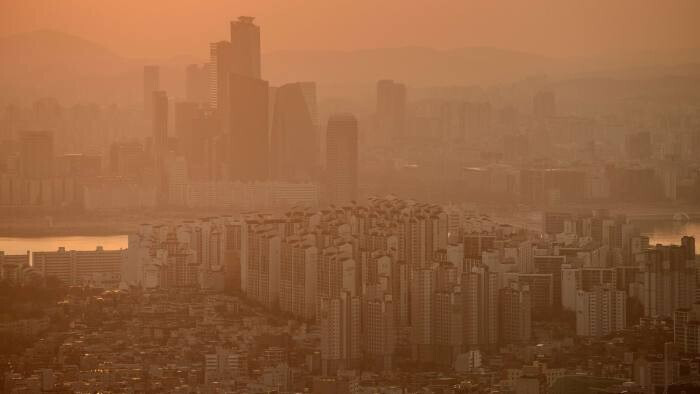
SEOUL, Nov. 24 — South Korea is gearing up for a tougher battle against ultrafine dust this winter, as meteorological forecasts point to higher pollution levels than last year. In response, the government announced comprehensive preventive measures starting next month through March to curb emissions across major sectors.
According to the Ministry of Climate, Energy and Environment on Tuesday, the government has set a target to keep the average concentration of ultrafine dust (PM2.5) at or below 19 micrograms per cubic meter ($mutext{g/m}^3$) during the 8th Seasonal Fine Dust Management Period. This marks a stricter goal compared to the $21.5 mutext{g/m}^3$ recorded during the previous winter season (December 2025 to March 2026). Through these efforts, authorities aim to cut ultrafine dust and its precursor pollutants by approximately 137,000 tons.
Challenging Weather Outlook Data from the National Institute of Environmental Research indicates a 50 percent probability that both the number of "bad" air quality days and the average PM2.5 concentration will exceed last year’s figures.
The Korea Meteorological Administration attributes this outlook to strong El Niño conditions and rising sea surface temperatures in the Bering Sea and Aleutian Islands, which are expected to strengthen high-pressure circulation. This will likely cause stagnant air around the Korean Peninsula and bring in warm, humid southwesterly winds, accelerating the accumulation and secondary formation of fine dust. However, forecasters noted that fluctuations could be significant in January, as melting Arctic sea ice in the Barents-Kara Sea may strengthen the Siberian High, intermittently bringing cleaner air into the region.
Sector-by-Sector Crackdown To achieve its air quality target, the government will implement aggressive reduction policies across energy, industry, and transportation:
Energy & Industry: Depending on power supply conditions, up to 18 coal-fired power plants will be suspended, while up to 46 others will have their maximum output capped at 80 percent. Major industrial emitters within air quality control zones will face a 7.3 percent reduction in their 2027 total allowable emissions, alongside tighter emission standards for high-risk facilities.
Transportation & Ports: Inspections of sulfur content in ship fuel will expand to 1,080 vessels, and participation in the vessel speed reduction program at four major ports—Busan, Incheon, Yeosu-Gwangyang, and Ulsan—will be raised to 79 percent. Next year's budget for electric vehicle (EV) subsidies will increase by 500 billion won to 2.1 trillion won (supporting 430,000 vehicles), with added incentives for commercial taxis and freight trucks. Grade 5 emission vehicles will be restricted from operating in the greater Seoul area and six major metropolitan cities.
Construction & Monitoring: Authorities will strictly enforce bans on aging construction machinery at public sites worth over 10 billion won, while local governments including Seoul, Busan, and Gyeonggi Province will extend these restrictions to smaller sites. Additionally, a new Integrated Air Quality Control Center will be established at the Korea Environment Corporation to cross-analyze real-time smokestack emissions, IoT sensors, and weather forecasts to swiftly pinpoint and inspect suspected illegal emitters.
Daily Living Spaces: The government will designate 751 high-traffic roads near residential areas for intensive cleaning at least three times a day. It will also subsidize the replacement of fossil-fuel heating systems with heat pumps in homes and supply solar-linked heat pumps to social welfare facilities.
"When high concentrations of fine dust occur, we will immediately activate our interagency and local government response systems in accordance with the crisis management manual," said Kim Beom-su, Director of the Air Quality Policy Division at the ministry. "We plan to enforce emergency reduction measures—such as adjusting operations at factories and construction sites and restricting vehicle traffic—tailored to each alert level to protect public health."
[Copyright (c) Global Economic Times. All Rights Reserved.]