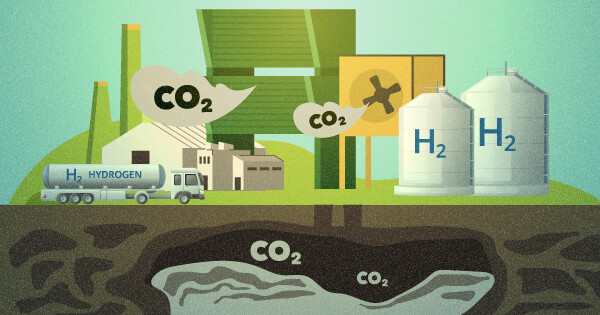
SEOUL — With South Korea introducing carbon capture, utilization, and storage (CCUS) criteria into its general hydrogen power bidding market, fuel cell operators are under mounting pressure not only to capture at least 60 percent of their carbon emissions, but also to prove the technology is financially viable.
During a seminar hosted by the Korea Hydrogen Fuel Cell Industry Association in Seoul on Tuesday, industry experts and technology developers emphasized that winning bids requires slashing capital and operating costs while securing reliable buyers for captured carbon dioxide (CO2).
New Bidding Rules Put CCUS in the Spotlight
Natural gas-reforming fuel cells inherently emit CO2 during operation. To incentivize emission reductions, regulators added a CCUS evaluation category to this year’s general hydrogen power auction. The category accounts for up to 8 out of 100 non-price evaluation points—calculated by multiplying a maximum of 4 points for capture plans by up to 2 points for utilization and storage plans. Given the 60-to-40 split between price and non-price scoring, CCUS represents up to 3.2 percent of the total bid score. To earn the maximum 4 points in the capture segment, operators must achieve a capture rate of 60 percent or higher.
Compact Technologies Target Space-Constrained Plants
Because urban fuel cell plants often lack physical space, speakers highlighted modular and downsized capture technologies tailored to specific generator types:
Cryogenic Capture: Park Sung-ho, a principal researcher at the Institute for Advanced Engineering (IAE), proposed a phased cryogenic approach that freezes CO2 into a solid state without chemical solvents or steam. Installing units downstream of the reformer or anode can achieve a 60 percent capture rate in the short term, scaling up to 90 percent in a second phase.
Polymer Membranes: Astroma CEO Jang Jin-seok introduced a membrane-based capture and liquefaction system that eliminates solvent regeneration. The modular setup reduces energy consumption to roughly 35–39 percent of conventional wet-scrubbing methods and cuts footprint requirements in half.
Rotating Packed Beds (RPB): CarbonValue CEO Koh Deok-soo showcased an RPB system that uses centrifugal force to atomize liquid absorbents, shrinking traditional 48-meter absorption towers down to 2.6-meter units that fit inside 40-foot shipping containers. In a November pilot with SK ecoplant, Korea Southern Power, and Bloom Energy, the firm achieved over 85 percent capture and 99.9 percent liquid CO2 purity from a 300kW solid oxide fuel cell (SOFC).
Dynamic Flow Reactors (DFR): Victecs Managing Director Lim Chang-hwan presented a modular wet-capture system powered by exhaust gas discharge pressure rather than external motors, replacing bulky towers with compact multi-stage columns.
Bidding Bonus Alone Cannot Offset High Costs
Despite technological breakthroughs, panelists warned that auction bonus points alone will not cover the steep costs of CCUS deployment. Lowering energy expenses and monetizing captured CO2 are essential for profitability.
For cryogenic systems, utilizing waste cold energy from liquefied natural gas (LNG) regasification can lower levelized capture costs from roughly 129,000–141,000 won per ton down to 90,000–100,000 won per ton, according to Park’s analysis. Meanwhile, Koh noted that wet-scrubbing systems can cut costs by reusing waste heat from fuel cell exhaust.
Financial models presented at the event underscored the thin margins:
CarbonValue’s 10MW SOFC Model: Capturing 62 percent of emissions (about 17,800 tons annually) requires an initial investment of 15 billion won and operating costs of 100,000 won per ton. Factoring in a 6-point non-price CCUS score, the net capture cost is 6.3 won per kWh against a bidding price advantage of 9.6 won per kWh—meaning the project only breaks even if liquid CO2 is sold for at least 125,000 won per ton.
Victecs’ Wet-Amine Model: Capturing 90 percent of emissions (100 tons per day) demands 30 billion to 35 billion won in capital expenditure. While the model generates 4.68 billion won in annual revenue and 1.29 billion won in EBITDA, depreciation pushes it to an annual operating loss of 230 million won.
Securing Long-Term Offtakers and Policy Support
To bridge the economic gap, experts urged operators to lock in long-term sales contracts for liquid CO2 and dry ice in the near term, while linking up with mineralization projects, underground storage, and shared CO2 transport hubs over the long haul.
Koh also suggested establishing separate special purpose companies (SPCs) for capture facilities and expanding government subsidies for carbon-reduction equipment. Finally, speakers stressed that operators must not treat the 60 percent capture threshold merely as a paper target for bidding, noting that maintaining and verifying annual capture and utilization performance throughout plant operations will be critical.
[Copyright (c) Global Economic Times. All Rights Reserved.]