Gunpo City has won the grand prize in the Consumer-Friendly Administration category, driven by the success of the "Gyeonggi Hope Eco Village" project—which combines improvements to citizens' living environments with a transition to renewable energy—and citizen-participatory climate crisis response policies.
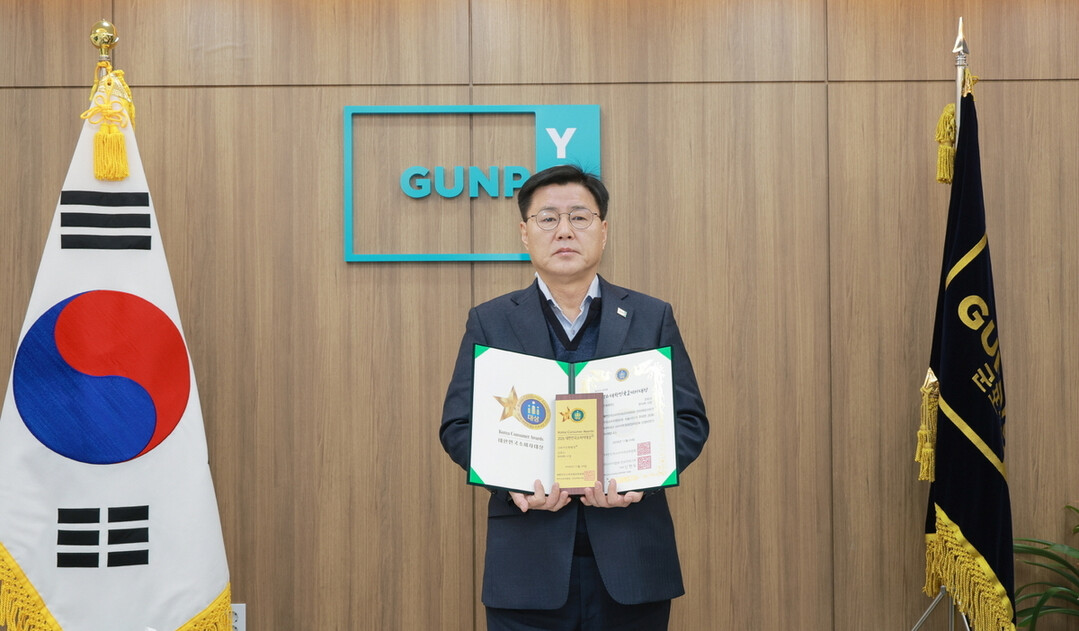
Gunpo City announced on the 25th that Mayor Han Dae-hee received the grand prize in the Consumer-Friendly Administration category at the "2026 Korea Consumer Awards" ceremony held at the Korea Press Center on the 24th.
This award is the result of high praise for resolving residents' long-standing traffic noise issues while simultaneously building a foundation for new and renewable energy production, and integrating resource circulation and climate crisis response across overall administration.
A representative example is the "Gyeonggi Hope Eco Village" project. Pursued since the 7th popularly elected administration, this project focused on resolving noise complaints from Samseong Village residents that had persisted for over 10 years, while utilizing soundproofing facilities as eco-friendly energy production spaces.
In particular, replacing the existing flammable soundproof panels of the Daeya Underpass with solar soundproof panels is the first case of its kind nationwide. A total of 1,329 kW of solar power generation facilities were installed at the Daeya and Samseong underpasses. Through this, the city laid the foundation to produce 1,490 MWh of electricity annually and reduce greenhouse gas emissions by 819 tons.
The city also achieved financial results. During the project, it secured 8.6 billion KRW in external funding, saved 2.2 billion KRW in municipal funds, and expects to generate 23 million KRW in annual revenue by leasing the upper part of the facilities.
Policies for efficiently utilizing waste and water resources were also cited as reasons for the award. The city built a wastewater reuse facility with a capacity of 750 tons per day and promoted cross-incineration at public incinerators with Gwangmyeong City, saving approximately 240 million KRW in annual budget.
The method of direct citizen participation in policy-making also drew attention. Without separate external consulting services, the city gathered opinions from 583 citizens to independently establish the 3rd Climate Crisis Adaptation Plan, consisting of 40 tasks across 11 departments.
The Korea Consumer Awards, co-hosted by the Korea Consumer Association and the Dongguk University Digital Asset Center, selects and awards individuals and organizations that have contributed to promoting consumer rights and interests.
Mayor Han Dae-hee said, "Our efforts to realize the values of expanding renewable energy and responding to the climate crisis while resolving daily inconveniences for residents have been recognized," adding, "We will continue citizen-centered administration so that improvements in citizens' daily environments lead to a sustainable future."
[Copyright (c) Global Economic Times. All Rights Reserved.]