![[등록] 2026-09-01 15:48:31](/support/_updata/banner2/tl181982910_6749.png)


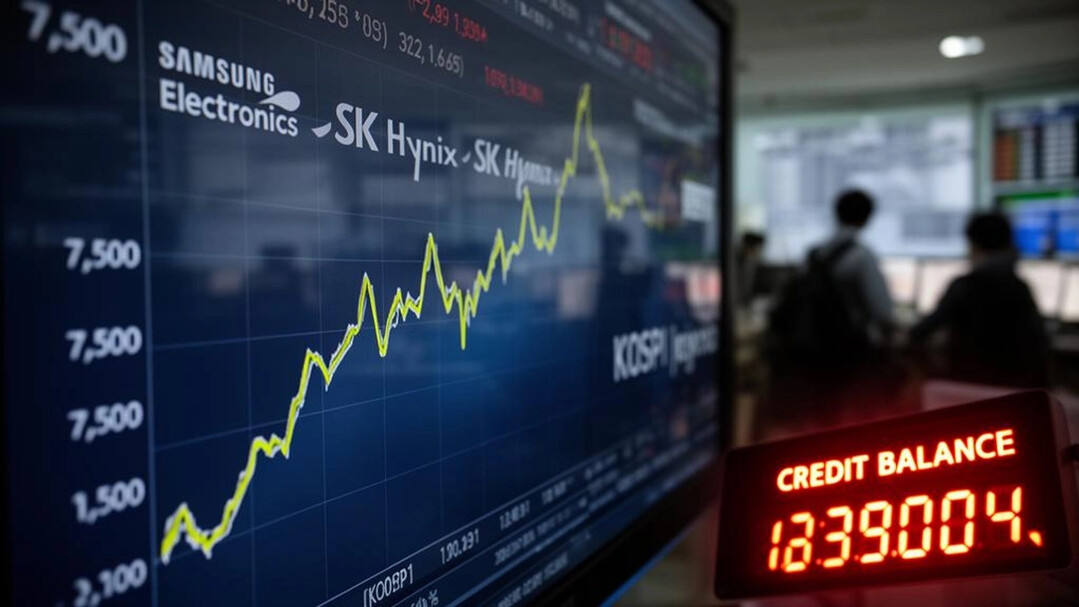
The scale of leveraged stock investments, commonly known as "Bit-too" (debt-driven investment), has surpassed 36 trillion won in the domestic stock market, emerging as a major time bomb that could severely shake financial stability. As the KOSPI index recently breached the historic 8,000-point milestone, retail investors aggressively poured borrowed capital into the market. However, with global interest rates poised to rise and market volatility reaching extreme levels, expert warnings are mounting over a potential domino effect of forced liquidations (margin calls).
According to the Korea Financial Investment Association and Yonhap Infomax on May 24, the outstanding balance of credit loans for stock purchases across the KOSPI and KOSDAQ markets stood at 36.4724 trillion won as of May 21. Although this is slightly down from the record 36.5675 trillion won logged on May 15—the day the KOSPI hit 8,000—it remains at an alarmingly precarious high. Concurrently, the credit loan balance on the main KOSPI board rewrote history by hitting an all-time high of 26.3644 trillion won.
The most critical concern lies in the heavy concentration of borrowed funds in giant semiconductor shares. The credit balances for Samsung Electronics and SK Hynix reached 4.2751 trillion won and 3.0437 trillion won, respectively. Their combined leveraged investment surpassed the 7 trillion won threshold for the first time, landing at 7.3189 trillion won. Notably, on May 20, the day Samsung Electronics reached a labor-management agreement, its credit balance broke the 4 trillion won mark for the first time, continuing its climb to 4.3404 trillion won by May 22 amid overheating buying sentiment.
Making matters worse, stock market volatility has surged to levels reminiscent of the 2008 global financial crisis. This month, the average daily intraday fluctuation rate of the KOSPI reached 4.323%, marking the highest figure in 17 years and 7 months since October 2008 (6.111%). Reflecting this instability, the KOSPI 200 Volatility Index (VKOSPI), widely dubbed Korea’s "fear gauge," closed at 66.97 on May 22, skyrocketing 23.2% within a single month. It even peaked intraday at 82.23 on May 18.
Against this backdrop of extreme volatility, the looming prospects of interest rate hikes at home and abroad pose a lethal threat to leveraged investors. Driven by the U.S. Federal Reserve's hawkish minutes signaling further tightening, the 30-year U.S. Treasury yield recently spiked to 5.20%, hitting its highest point in 19 years since 2007. Domestically, the Bank of Korea is widely expected to deliver hawkish signals at its upcoming Monetary Policy Committee meeting on May 28, with macroeconomists projecting a rate hike as early as October. Higher rates inevitably increase interest burdens on loans and drive capital out of equities, accelerating downside pressure on stock prices.
Signs of distress are already surfacing. When the KOSPI underwent a brief correction after touching 8,000, margin calls triggered by retail investors' failure to repay short-term credit transactions exceeded 300 billion won over just three days (May 18–20). This underscores the danger of a vicious cycle where falling prices trigger forced liquidations, which in turn dump massive selling volume back into the market, dragging prices lower. Lee Hyo-seob, a senior research fellow at the Korea Capital Market Institute, warned, "With the scale of debt-driven investments expanding too rapidly, margin calls are now bleeding out at a rate of 10 billion won per day. Regulators must closely monitor whether forced liquidations from specific brokerages cascade into a broader systemic risk across the financial system."
In response, financial authorities have kicked off emergency risk management operations, convening monitoring meetings and summoning brokerage executives to strictly oversee leverage flows. On the other hand, some analysts advise against excessive panic. Lee Kyeong-min, an analyst at Daishin Securities, noted, "The current market rally is backed by robust corporate fundamentals. Given that the ratio of credit balance to total market capitalization is relatively low, it is unlikely to destabilize the entire system." Nevertheless, a consensus is forming among experts that retail investors must urgently restrain themselves from high-risk, debt-fueled trading and proactively brace for the upcoming interest rate shocks.
[Copyright (c) Global Economic Times. All Rights Reserved.]