![[등록] 2026-09-01 15:48:31](/support/_updata/banner2/tl181982910_6749.png)


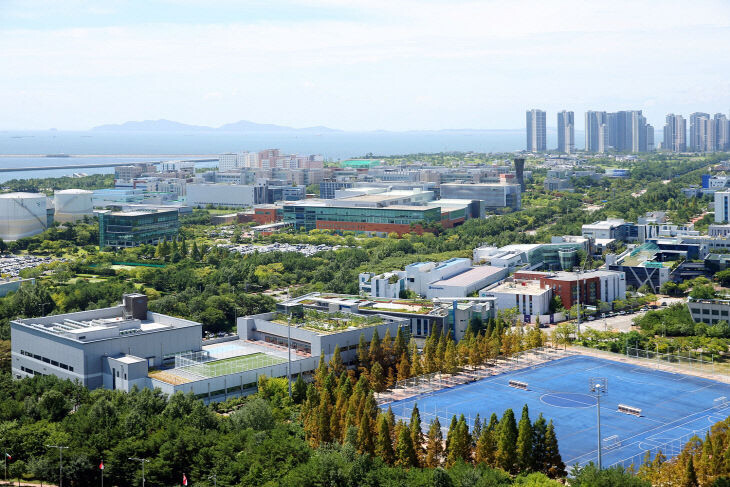
INCHEON — The Incheon Free Economic Zone (IFEZ) Authority announced on Wednesday that Songdo International City’s biopharmaceutical production capacity is projected to reach approximately 1.16 million liters by the end of this year, solidifying its position as a global leader in the life sciences sector.
The rapid expansion marks a monumental leap from a mere 50,000 liters in 2010. The capacity grew to 330,000 liters in 2015 and 560,000 liters in 2020. This exponential trajectory is now being fueled by aggressive, multi-billion-dollar investments from South Korea’s "Big Three" bio-tech giants: Samsung Biologics, Celltrion, and Lotte Biologics.
A Surge in Production Power
According to the IFEZ report, the current milestones are as follows:
Samsung Biologics: Following the operational launch of its Plant 5 (180,000 liters) last year, the company has secured a total production capacity of 785,000 liters.
Celltrion: With the completion of its Plant 3, the company now boasts a 250,000-liter scale, further integrating its research and manufacturing facilities in Songdo’s District 4.
Lotte Biologics: The newcomer is completing its first plant (120,000 liters) this year, with full-scale commercial production slated to begin in 2027.
Looking ahead to 2030, Songdo’s total capacity is expected to soar to 2.14 million liters. Samsung Biologics plans to expand its second bio-campus to a staggering 1.325 million liters by 2032, while Lotte Biologics is already moving forward with plans for additional manufacturing facilities.
Building a "K-Bio" R&D Ecosystem
Beyond mass production, Songdo is evolving into a comprehensive Research and Development (R&D) hub. SK Bioscience is currently establishing its Global R&PD Center to strengthen vaccine research and process development. Simultaneously, Germany’s Sartorius is constructing facilities for the production and research of essential bio-materials and equipment.
The human capital infrastructure is also being bolstered. The Bio-Process Talent Training Center at Yonsei University’s Songdo Campus is expected to produce 2,000 specialized professionals annually. Furthermore, Songdo has been designated as the site for the "K-Bio Lab Hub," a project modeled after Boston’s biotech cluster designed to nurture startups and high-potential ventures.
Vision for a Global Mega-Cluster
The Incheon FEZ Authority aims to transcend Songdo’s image as a "simple production base" to become a "Global Mega Bio Cluster."
"Incheon is evolving beyond the world’s largest production base into a global hub for bio-innovation," said Jun-ho Hong, Acting Commissioner of the Incheon Free Economic Zone Authority. "By leveraging both our intellectual R&D assets and our unparalleled manufacturing capabilities, we will leap forward as a premier global mega-cluster."
[Copyright (c) Global Economic Times. All Rights Reserved.]