![[등록] 2026-09-01 15:48:31](/support/_updata/banner2/tl181982910_6749.png)


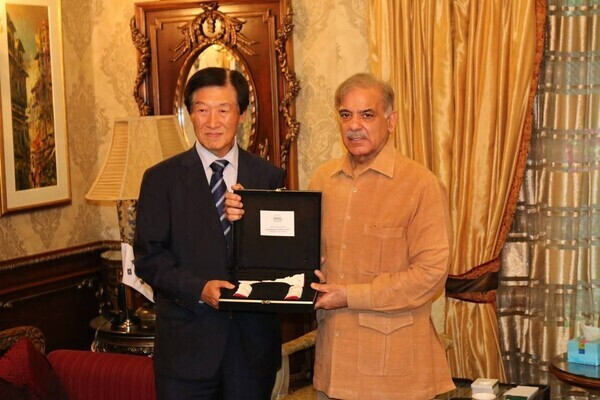
Song Jong-hwan, former Korean Ambassador to Pakistan(left) meeting with Shehbaz Sharif, then Chief Minister of Punjab, Pakistan (currently the Prime Minister of Pakistan) (C) Song Jong-hwan
On June 17, the United States and Iran signed a Memorandum of Understanding (MOU) ending the war that began on February 28, marking a historic turning point after 109 days of conflict.
The two countries had originally planned to meet face-to-face on June 19 at the Bürgenstock Resort beside Lake Lucerne in Switzerland to sign the “Islamabad Memorandum” and begin 60 days of talks on detailed implementation. However, to address urgent issues such as the early reopening of the Strait of Hormuz, the signing was moved forward. The document was concluded by having each leader receive and sign it in his own office.
On June 17, while on a European tour to attend the G7 summit, President Donald Trump signed the 14-point document at the Palace of Versailles near Paris. A photographed copy was then delivered to Iran and to Pakistan, the mediator. Iranian President Masoud Pezeshkian also formally signed the document the same day.
The final page of the bilingual English and Persian MOU bears the signatures of President Trump, President Pezeshkian, and Pakistani Prime Minister Shehbaz Sharif, who served as mediator. While the world’s media focused on President Trump and Iran’s leadership, there was another country behind this peace agreement that played a role as important as that of the parties to the war: Pakistan.
Pakistan is a major security partner of the United States and, at the same time, a neighboring country that shares a border of more than 900 kilometers with Iran. As an Islamic country, it is also one of the few countries capable of maintaining dialogue with both Washington and Tehran. This unique position was the most important background that enabled Pakistan to serve as mediator in this conflict.
Division of Roles Between the Prime Minister and the Chief of Defence Forces
The division of roles between Prime Minister Shehbaz Sharif and Chief of Defence Forces Asim Munir was also striking.
Prime Minister Sharif, who handled the political and diplomatic channel, declared that he would assume the role of mediator as the armed conflict between the United States and Iran intensified. He then engaged in shuttle diplomacy, serving as both a formal and informal communication channel between Washington and Tehran, which found direct dialogue difficult. He closely conveyed letters and messages containing ceasefire conditions to both sides.
After the war broke out on February 28, Prime Minister Sharif helped induce a two-week ceasefire. On April 11–12, he also arranged the first face-to-face ceasefire talks in Islamabad, attended by U.S. Vice President J. D. Vance and Iranian Parliament Speaker Mohammad Bagher Ghalibaf.
Later, from May 23 to 26, marking the 75th anniversary of diplomatic relations between Pakistan and China, Prime Minister Sharif visited Beijing. There, he discussed not only the advancement of Pakistan-China relations but also mediation efforts for U.S.-Iran ceasefire negotiations, securing the support of Chinese President Xi Jinping.
Prime Minister Sharif also consulted closely with leaders of major Middle Eastern countries and made diplomatic efforts to persuade both the United States and Iran to return to the negotiating table. In cooperation with Qatar, a co-mediator, he helped reconcile the demands of both sides and brought about the conclusion of the MOU.
Chief of Defence Forces and Army Chief Asim Munir handled the security and military channel. As Pakistan’s first Chief of Defence Forces from a nuclear-armed country, he is the supreme commander effectively overseeing the army, navy, and air force. He also holds the rank of Field Marshal, only the second such appointment in Pakistan’s military history.
From April 15 to 18, Chief of Defence Forces Munir led a high-level military delegation to Tehran, helping create the atmosphere for U.S.-Iran negotiations that had begun in Islamabad. He visited Iran again on May 22–23 and played an important role in enabling the stalled negotiations between the United States and Iran to resume.
At present, Pakistan’s two leaders are in Lucerne, Switzerland, and their continued mediation efforts are expected.
Kissinger’s Secret Visit to China Also Began in Pakistan
Pakistan’s mediating role is by no means new. In July 1971, Henry Kissinger, then U.S. National Security Adviser and later Secretary of State, secretly visited Beijing with the cooperation of the Pakistani government. This so-called “secret Kissinger visit to China” became the starting point for President Richard Nixon’s historic visit to China in February 1972 and the normalization of U.S.-China relations.
Half a century later, Pakistan again played a key role in resolving a major international conflict. The U.S.-Taliban peace agreement signed in Doha, Qatar, in 2020 would also have been difficult to achieve without Pakistan’s sustained support and mediation. At the time, Pakistan served as a bridge so that both the United States and the Taliban could remain at the negotiating table.
Thus, from U.S.-China reconciliation during the Cold War, to the Doha peace agreement aimed at ending the war in Afghanistan, and now to the U.S.-Iran ceasefire MOU, Pakistan has quietly but decisively played diplomatic roles in major conflict-resolution moments in the international community.
This MOU is not a final peace agreement ending the war, but a document containing a broad framework of agreement. The details are to be finalized through follow-up negotiations over the next 60 days.
Among the 14 provisions, the MOU reportedly states that if Iran reopens the Strait of Hormuz, freezes its nuclear activities, and accepts monitoring of its nuclear facilities, the United States will gradually ease sanctions, release frozen assets, and support a $300 billion urban reconstruction program. However, President Trump has warned that if Iran fails to implement the agreed terms, the two countries could return to a state of war.
Nevertheless, this U.S.-Iran ceasefire MOU is a representative example of how quiet diplomacy by a middle power can change the course of history.
Having long been involved in negotiations with North Korea, I served as the Republic of Korea’s ambassador to Pakistan from 2013 to 2016 and had several opportunities to meet Prime Minister Shehbaz Sharif. At the time, he was the chief minister of Punjab, the province where half of Pakistan’s population lives, and he was leading Pakistan’s economic development. The Shehbaz Sharif I met was a pragmatic politician and a leader who approached the resolution of complex problems on the basis of reality.
In particular, he possessed outstanding ability and leadership in solving problems step by step. In this mediation process as well, those abilities and leadership were fully demonstrated. I believe that Prime Minister Shehbaz Sharif’s persistent mediation efforts and political resolve, which brought about the start of U.S.-Iran ceasefire negotiations and led the two countries to agree on the MOU, constitute a historic achievement worthy of consideration for this year’s Nobel Peace Prize.
[Song Jong-hwan, former Korean Ambassador to Pakistan and Chair Professor at Kyungnam University]
[Copyright (c) Global Economic Times. All Rights Reserved.]