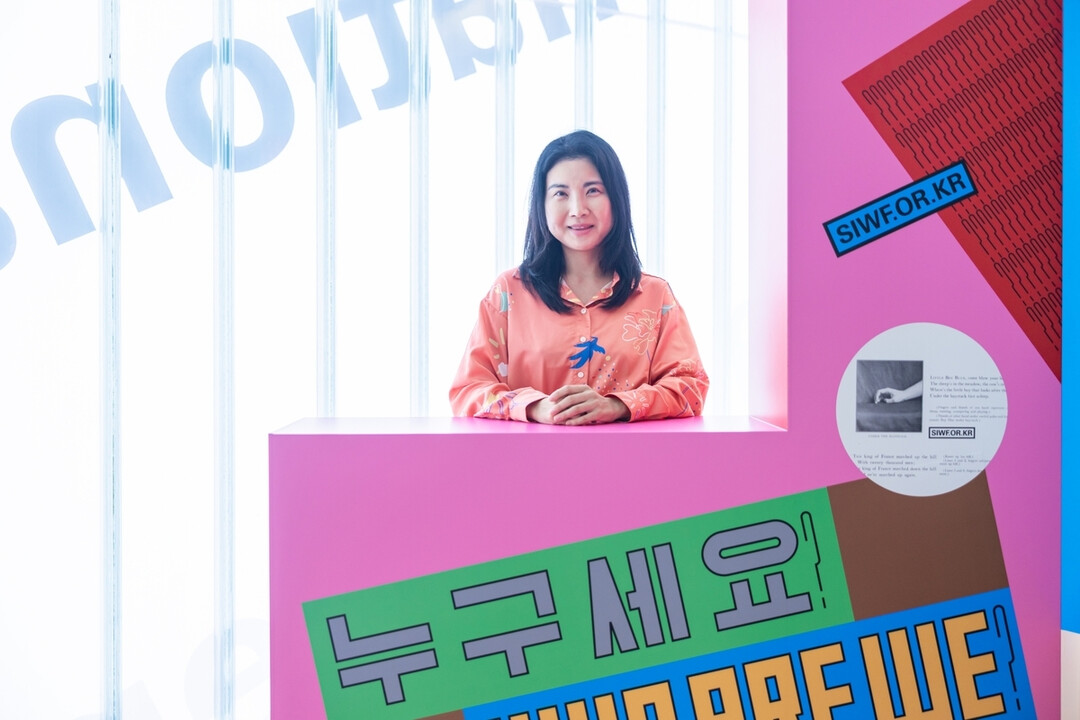
In an age dominated by fast-paced content, where short-form videos like TikTok shorts and Instagram reels constantly vie for human attention, poetry offers a radical resistance. "Poetry is an act of slowing down time," says poet Emily Jungmin Yoon. "It is a genre that cannot be speed-read and demands that we sharpen our senses to contemplate deeply. Although it is hard to deeply experience our senses in an era flooded with stimulating content, poetry makes it impossible to do otherwise."
Born in South Korea and raised primarily in North America—having immigrated to Canada in elementary school—Yoon (35) does not anchor herself to a fixed world. Her ongoing quest to explore her identity as a woman, an immigrant, and a person of color deeply intersects with her craft. Writing predominantly in English, she has steadily built a bridge back to her homeland through translated Korean editions of her works, including A Cruelty Special to Our Species (Yolimwon) and Find Me as the Creature I Am (Chaumgwa Moeum).
Visiting South Korea for the 2026 Seoul International Writers Festival, Yoon sat down for an interview at the Ara Art Center in Jongno-gu, Seoul.
Her debut collection translated into Korean, A Cruelty Special to Our Species, originally published in English in 2018, tackles the harrowing history of the Japanese military's "comfort women" survivors. Grounded in historical testimonies, the book drew widespread acclaim in the Anglophone world before its Korean release in 2020. "To explain my own identity, I felt I needed to understand Korea," Yoon reflected. "As I delved into history books, the testimonies of the comfort women deeply resonated with me. I wanted to bring global awareness to this historical tragedy in the United States, which is why I chose it as a subject."
Her second Korean-translated collection, Find Me as the Creature I Am (published in the U.S. by Knopf in 2024), further expands her literary footprint in Korea. This time, Yoon took on the translation herself. Because English and Korean poetic phrasings do not always map onto one another identically, she describes the process as essentially "rewriting the poetry collection from scratch."
A prime example is the opening line of her poem "What Carries Us"—originally written as "First, there was a horse," which she rendered in Korean as "태초에 말이 있었다" (In the beginning was the Word/Horse, playfully invoking biblical cadence). What she had initially imagined as a clever translation concept while writing in English was finally brought to life when she stepped into the role of translator.
Many pieces in the collection lean into prose poetry, blurring conventional boundaries. For instance, the piece "I Became Asian When I Left Asia" began as an essay before finding its home in the poetry book. "Poetry is a genre where ambiguity and conciseness are usually emphasized," Yoon noted, "but rather than relying on those tropes, I wanted to show raw honesty."
The concept of the "creature" or "beast," embedded in her collection's English title, encapsulates its core identity. "The word 'creature' encompasses women, immigrants, people of color, and flora and fauna," she explains. "It is used as a metaphor for the ultimate other and the most primal aspect of humanity. Even if the world were to perish and I were to reincarnate as some creature—a earthworm or dirt—I hope the person I love could find me. That is the kind of hope I wanted to capture."
Through these two collections, which serve as personal mappings of her identity, Yoon interrogates the cruelty and inhumanity embedded within the worlds she inhabits. Noted literary critic Shin Hyeong-cheol praised her second collection as "beautiful and political modern poetry."
Responding to this praise, Yoon expressed deep gratitude, adding, "I believe poetry itself is an inherently ethical genre. Poetry determines the attitude we take toward certain objects or people by describing them in unique ways. Therefore, it can never be separated from ethics."
[Copyright (c) Global Economic Times. All Rights Reserved.]