• 2026.11.20 (Fri)
  • All articles
  • LOGIN
  • JOIN
Global Economic Times
한인동포뉴스(상단)
  • Synthesis
  • World
  • Business
  • Industry
  • ICT
  • Distribution Economy
  • Well+Being
    • Pet Life
    • Halal Horizon
  • Travel
  • Eco-News
  • Education
  • Korean Wave News
  • Opinion
  • Arts&Culture
  • Sports
  • People & Life
    • International Student Report
    • With Ambassador
  • Column
    • Cho Kijo Column
    • Cherry Garden Story
    • Ko Yong-chul Column
    • Kim Bong-seon's Photo Column
    • Kim Seul-Ong Column
    • Lee Yeon-sil Column
    • Professor Lee Soo-young’s Life Essays
  • Photo News
  • New Book Guide
MENU
 
Home > Eco-News

Warming Waters Drive Venomous Marine Life Northward Along South Korea’s Coasts

Kim Young Min Reporter / Updated : 2026-11-19 07:32:50
  • -
  • +
  • Print

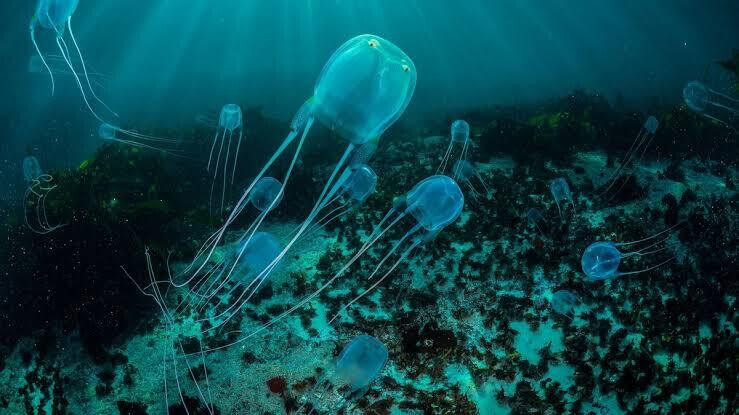
SEOUL, Nov. 19 — Dangerous marine creatures once largely confined to the warm waters off South Korea’s southern resort island of Jeju are increasingly appearing along the country’s southern and eastern coastlines, raising new public safety concerns as ocean temperatures climb.

A new data analysis by the Korea Institute of Ocean Science and Technology (KIOST) reveals that the variety of hazardous marine species documented in the East Sea more than tripled over the past decade. Reviewing records of 36 dangerous species logged in global biodiversity databases (GBIF and OBIS), researchers found that confirmed species in the East Sea rose from just five between 2006 and 2015 to 16 between 2016 and 2025. Over the same timeframe, the count doubled from 10 to 20 in the Southern Sea.

Tropical Invaders Push North

Oceanographers point to the gradual subtropicalization of waters around the Korean Peninsula—driven by warming seas and stronger warm currents—as the primary catalyst behind the migration.

Several highly venomous species have steadily expanded their geographic footprint:

Blue-lined Octopus: Known for its potent venom, the species was spotted in Jeju in 2003 before reaching the Southern Sea in 2019 and eventually appearing off the eastern industrial city of Ulsan.
Sea Kraits and Lionfish: The neurotoxic blue-lipped sea krait, first logged in Jeju in 2015, was later confirmed in the southern port city of Tongyeong, while venomous red lionfish have been tracked moving progressively from Jeju into the East Sea.

Rising Incidents and Identification Hurdles

The ecological shift has coincided with a sharp spike in marine safety hazards. Nationwide jellyfish sting incidents jumped nearly sixfold in a single year, from 744 in 2023 to 4,224 in 2024. Meanwhile, sightings and accidental catches of large sharks in the East Sea climbed from a single case in 2022 to 46 reported incidents by mid-year.

Despite the growing risks, marine authorities face significant gaps in tracking and species identification. Historical sighting logs remain sparse, and public reports frequently suffer from misidentification. According to KIOST, 60 percent of photo and video tips submitted as sea snakes over a multi-year period turned out to be ordinary fish or land snakes. Similarly, when a large shark appeared in Busan’s North Port in September, marine biologists needed 18 days and close-up footage to confirm it was a dusky shark.

Calls for an AI-Driven Early Warning Network

Because Jeju sits directly in the path of incoming warm currents—where tropical species have outnumbered native temperate marine life every year since 2023—scientists view the island as an essential early-warning buffer for the rest of the peninsula.

"Because Jeju serves as the primary gateway for incoming hazardous species, detecting them there first buys crucial preparation time for coastal communities and fisheries along the southern and eastern coasts," said Kim Tae-hoon, a principal researcher at KIOST’s Tropical and Subtropical Research Center.

To close the response gap, KIOST is advocating for an artificial intelligence-based marine surveillance network. The proposed system would pair AI-assisted species recognition from citizen photos with autonomous underwater drones to monitor beaches, aquaculture farms, and diving zones, broadening South Korea’s current jellyfish alert system into a comprehensive marine hazard warning network.

[Copyright (c) Global Economic Times. All Rights Reserved.]
  • #Cherry Garden
  • #HalalFood
  • #Halal
  • #Petlife
  • #Halalhorizone
  • #Hormuz Impasse
  • #Joseon
  • #globaleconomictimes
  • #micore
Kim Young Min Reporter
Kim Young Min Reporter 前 환경데일리 발행인, mkTaiwan 편집인.

Popular articles

  • Global Credit Spreads Widened to 17-Month High Amid AI Investment Concerns

  • Stepping into the Shoes of a Joseon Scholar: Daejeon Museum Launches Immersive 'Life Game' Exhibition

  • Bitcoin Slumps for a Second Day Amid Record Binance Hack, Tech Sell-Off, and Rising Oil Prices

I like it
Share
  • Facebook
  • X
  • Kakaotalk
  • LINE
  • BAND
  • NAVER
  • https://globaleconomictimes.kr/article/1065565889183424 Copy URL copied.
Comments >

Comments 0

Weekly Hot Issue

  • Seoul Housing Rally Cools as Price Drops Spread to Seven Districts and Listings Top 82,000
  • Pyongyang’s True Intentions as U.S.-North Korea Talks Fizzle Again Despite Trump’s Repeated Overtures
  • Putin Shakes Hands with a Smiling Trump... Behind Him Was the 'Black Nuclear Briefcase'
  • Nvidia Offers Early Pay Reviews to Calm Staff After Jensen Huang’s Exit
  • Health Insurer Proposes "Subscription-Plus-Bonus" Model to Curb Skyrocketing Weight-Loss Drug Costs
  • Massive Women’s Safety Network ‘Are We Dating the Same Guy?’ Halts New Posts Amid Legal and Platform Pressures

Most Viewed

1
South Korea and Ethiopia Sign Trilateral MOU to Introduce Liquid-Based Cytology (LBC) Technology for Cervical Cancer Diagnosis
2
Meeting Christmas Early!… Busan Dessert Sales Event "Daldal The Market" Held
3
World Citizens are Flying Directly to Busan... The Era of 4 Million Foreigners is Just Around the Corner
4
Eating 100g of Baechu Kimchi Daily Linked to Lower High-Cholesterol Risks
5
First Snow and Freeze Hit Korea as Winter Officially Begins on 'Ipdeong'
체리가든 스토리
nutri huevos
로타리
동포저널

Hot Issue

Historic US-China-Russia Summit Yields Grand Rhetoric, Few Concrete Results

KOSPI Clings to 5,000-Point Mark Amid Heavy Foreign Selling; Year-End Rally Seen as Unlikely

Commuters Face Potential Delays as Seoul Subway Workers Launch Work-to-Rule Action

Fashion Runway Show 2026

Let’s recycle the old blankets in Jeju Island’s closet instead of incinerating them.

Global Economic Times
korocamia@naver.com
CEO : LEE YEON-SIL
Publisher & Editor : KO YONG-CHUL
Registration number : Seoul, A55681
Registration Date : 2024-10-24
Youth Protection Manager: KO YONG-CHUL
Singapore Headquarters
5A Woodlands Road #11-34 The Tennery. S'677728
Korean Branch
Phone : +82(0)10 4724 5264
#304, 6 Nonhyeon-ro 111-gil, Gangnam-gu, Seoul
Copyright © Global Economic Times All Rights Reserved
  • News K
  • 반달곰 프로젝트
  • 광고문의
Search
Category
  • All articles
  • Synthesis
  • World
  • Business
  • Industry
  • ICT
  • Distribution Economy
  • Well+Being 
    • 전체
    • Pet Life
    • Halal Horizon
  • Travel
  • Eco-News
  • Education
  • Korean Wave News
  • Opinion
  • Arts&Culture
  • Sports
  • People & Life 
    • 전체
    • International Student Report
    • With Ambassador
  • Column 
    • 전체
    • Cho Kijo Column
    • Cherry Garden Story
    • Ko Yong-chul Column
    • Kim Bong-seon's Photo Column
    • Kim Seul-Ong Column
    • Lee Yeon-sil Column
    • Professor Lee Soo-young’s Life Essays
  • Photo News
  • New Book Guide
  • Overseas Koreans
  • Multicultural News