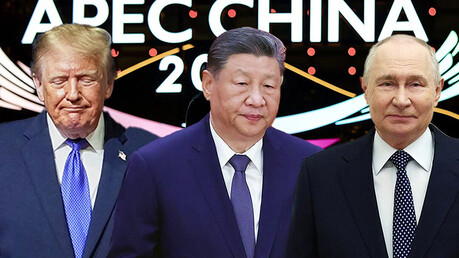


U.S. President Donald Trump, attending the Asia-Pacific Economic Cooperation (APEC) summit in Shenzhen, China, held separate bilateral meetings on the 19th with Chinese President Xi Jinping and Russian President Vladimir Putin to discuss pressing issues including the Ukraine and Iran wars, as well as trade imbalances. Following a crushing defeat to the Democrats in the midterm elections on the 3rd, Trump appeared to highlight his diplomatic achievements through back-to-back summits with the Chinese and Russian leaders.
Meeting with President Xi at the Qilin Villa in Shenzhen—their third encounter this year following Beijing in May and Washington in September—Trump placed the greatest emphasis on resolving trade imbalances. Trump stated, "During my visit to Beijing, we established a trade commission, which brought greater balance to a relationship that had been very imbalanced." He added, "We have made it a fair relationship, and that is all we want," before requesting, "Please do more for our farmers." In response, President Xi remarked, "We must address each other's concerns and promote mutual benefit."
President Xi emphasized "equality" in relations with the United States. According to China's Ministry of Foreign Affairs, Xi highlighted that through the May and September summits, the two nations had established a "China-U.S. constructive, strategic, and stable relationship," adding a new phrase: "based on respect, fairness, and equality."
International issues, including the Iran war, were also on the table. President Trump said, "Both the United States and China share an interest in ensuring the smooth flow of energy supplies through the Strait of Hormuz and preventing Iran from acquiring nuclear weapons." Regarding the Taiwan issue, Xi demanded that "the U.S. must prevent major turbulence in China-U.S. relations by adhering to doing the right thing." According to Xinhua News Agency, Trump reaffirmed his stance of not supporting "Taiwan independence." Whether issues concerning the Korean Peninsula were discussed was not disclosed.
Earlier, President Trump also met with President Putin for an informal summit. Although the White House had initially announced there would be "no U.S.-Russia summit," the Russian side reportedly pushed aggressively for the meeting. This marked the first encounter between the two leaders in one year and three months, since their summit in Alaska last August.
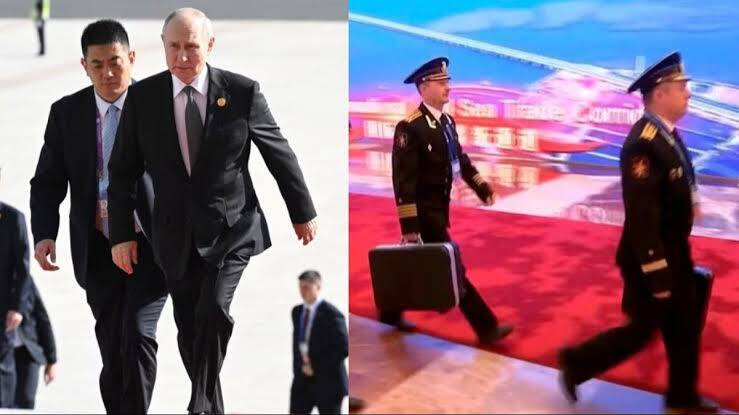
At the venue, an unusual scene was captured: Putin, notorious for arriving late to official diplomatic events, arrived ahead of Trump and waited for him. Before the meeting, Trump extended his hand to Putin, joking, "Who is that guy?" before calling him "my friend," displaying warmth. Standing side-by-side with Putin afterward, Trump said, "We have maintained a very good relationship for many years and have known each other for a long time." Following the roughly 40-minute meeting, Kremlin foreign policy aide Yuri Ushakov stated, "The main agenda item was the Ukraine conflict," adding that "President Putin left the meeting room in a good mood."
Around the time of the summit, President Putin also made moves to showcase his country's military might. At the venue, a Russian military officer was spotted carrying a black briefcase. CNN assessed it as "the 'nuclear briefcase' containing Russia's nuclear weapons control devices," noting it was "an unusual public display and a demonstration of Russia's nuclear prowess." Carried by an accompanying military aide whenever the president, as supreme commander-in-chief, is away from his office, the nuclear briefcase serves as a symbolic instrument illustrating the "nuclear balance of terror" among nuclear superpowers.
[Copyright (c) Global Economic Times. All Rights Reserved.]