• 2026.10.23 (Fri)
  • All articles
  • LOGIN
  • JOIN
Global Economic Times
[등록] 2026-09-01 15:48:31
  • Synthesis
  • World
  • Business
  • Industry
  • ICT
  • Distribution Economy
  • Well+Being
    • Pet Life
    • Halal Horizon
  • Travel
  • Eco-News
  • Education
  • Korean Wave News
  • Opinion
  • Arts&Culture
  • Sports
  • People & Life
    • International Student Report
    • With Ambassador
  • Column
    • Cho Kijo Column
    • Cherry Garden Story
    • Ko Yong-chul Column
    • Kim Seul-Ong Column
    • Lee Yeon-sil Column
  • Photo News
  • New Book Guide
MENU
 
Home > New Book Guide

Beyond the Shadow of Hitler: How the World Listened to Wagner

KO YONG-CHUL Reporter / Updated : 2026-10-23 07:08:57
  • -
  • +
  • Print
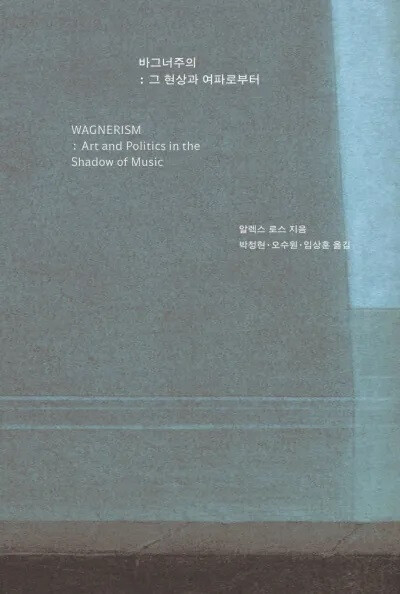
A monumental study by Alex Ross explores 'Wagnerism,' revealing how a single composer's work became a mirror for anti-Semites, civil rights pioneers, and revolutionaries alike.

In 1882, the premiere of Richard Wagner’s final music drama, Parsifal, took place in Bayreuth, Germany. Stepping up to the conductor’s podium was Hermann Levi, a Jewish man. This presented a profound historical irony: Wagner himself was a notoriously virulent anti-Semite, yet he entrusted his ultimate masterwork—steeped in Christian themes of salvation—to a Jewish conductor. Despite Wagner’s prejudices, Levi was deeply captivated by the music, embodying the complex, often contradictory relationship between the composer and his audiences.

To W.E.B. Du Bois, the pioneer of the American civil rights movement, Wagner was also a unique source of resonance. In his seminal work The Souls of Black Folk, Du Bois described a moment where a young Black man, listening to Wagner’s Lohengrin, briefly transcends racial barriers. Separated by oceans and ideologies from Wagner’s personal bigotry, marginalized individuals still found solace, beauty, and a wellspring of inspiration within his sweeping scores.

Richard Wagner (1813–1883) remains one of music history's greatest innovators and most controversial figures. To many modern observers, his legacy is inextricably linked to Adolf Hitler, who famously idolized the German composer. But is this dark association the full story of Wagner’s impact on human history?

Alex Ross, the eminent music critic for The New Yorker, addresses this very question in his monumental 1,120-page exploration, Wagnerism. Rather than presenting a traditional biography or a technical musicology book, Ross investigates the lesser-known faces of Wagner’s legacy, tracking what writers, artists, philosophers, and politicians discovered and forged through his music.

The phenomenon known as "Wagnerism" reveals that while Wagner was a single man, the Wagner perceived by the world was infinitely plural. George Bernard Shaw, the brilliant Irish playwright and essayist, interpreted Wagner’s epic The Ring of the Nibelung not as a mythic fairy tale, but as a sharp, socialist critique of capitalism and corrupt political power. Early feminist activists and sexual minorities drew upon his works as a imaginative catalyst to challenge rigid Victorian social orders. The philosopher Friedrich Nietzsche initially worshipped Wagner before staging a dramatic intellectual break, while the French poet Charles Baudelaire saw in Wagner’s chromatic harmonies the dawn of a revolutionary modern art.

Ross’s critical achievement lies in his refusal to engage in simple moral flattening. He does not sweep Wagner’s severe anti-Semitism under the rug, nor does he reduce his sweeping artistic achievements to a mere precursor to Nazism. Instead, Wagnerism traces how a massive cultural ecosystem was formed as generations took Wagner’s music and ideas, filtered them through their own historical struggles, and reinvented them.

Ultimately, Wagnerism demonstrates that great art often escapes the boundaries of its creator’s intentions. Whether viewed as an instrument of totalitarian worship or an anthem of liberation, Wagner's music transcended its maker to become a universal mirror reflecting the deepest aspirations and darkest contradictions of modern humanity.

[Copyright (c) Global Economic Times. All Rights Reserved.]

  • #Cherry Garden
  • #HalalFood
  • #Halal
  • #Petlife
  • #Halalhorizone
  • #Hormuz Impasse
  • #globaleconomictimes
  • #micorea
  • #mykor
KO YONG-CHUL Reporter
Reporter Page

Popular articles

  • Guitarist Kim Ji-hee to Hold Storytelling Concert 'The Guitar is Happiness'

  • Busan’s Representative Startup Festival, “BOUNCE 2026,” Marks Its 10th Anniversary in October

  • Chungnam Shifts Corporate Attraction Strategy from 'Subsidy Competition' to 'Industrial Ecosystem Competition'

I like it
Share
  • Facebook
  • X
  • Kakaotalk
  • LINE
  • BAND
  • NAVER
  • https://globaleconomictimes.kr/article/1065564475530389 Copy URL copied.
Comments >

Comments 0

Weekly Hot Issue

  • Chungnam Accelerates Removal of Pine Wilt Disease-Infected Trees
  • Chungnam Province Hosts 'Excellent Traditional Markets Fair' to Boost Local Vitality and Promote Market Appeal
  • Gyeryong to Bolster Defense Institution Recruitment, Expand Industrial & Transportation Infrastructure
  • Sejong City Successfully Operates Healing Program at Healing Forest for Civil Service Workers
  • Forest Tending Byproducts Turned into Firewood to Share Neighborly Love
  • From Waste to Worth: The 8th Sejong Resource Circulation Festival Opens

Most Viewed

1
Samsung Electronics Enters the 100 Trillion Won Quarterly Operating Profit Era
2
US Pushes to Deploy Special Task Force to the Korean Peninsula—Is It Also Targeting China?
3
HMM Relocates Headquarters to Busan: A New Era for South Korea's Flagship Carrier
4
McDonald's Korea Expands and Relocates Headquarters to Booyoung Taepyeong Building in Taepyeong-ro
5
Cheonan Secures 'Excellence' Award at South Chungcheong Province's 13th Cadastral and Drone Surveying Competition
체리가든 스토리
nutri huevos
로타리
동포저널

Hot Issue

US Eighth Army Commander Signals Shift: US Forces in South Korea Ready for Regional Deployments Beyond Peninsula

"Too Popular for Our Own Good": Japan's Matcha Boom Brings Surging Exports and Looming Industry Crises

Democrats Lead GOP by 10 Points Ahead of Midterms as Trump’s Approval Hits Record Low 

Fashion Runway Show 2026

Let’s recycle the old blankets in Jeju Island’s closet instead of incinerating them.

Global Economic Times
korocamia@naver.com
CEO : LEE YEON-SIL
Publisher : KO YONG-CHUL
Registration number : Seoul, A55681
Registration Date : 2024-10-24
Youth Protection Manager: KO YONG-CHUL
Singapore Headquarters
5A Woodlands Road #11-34 The Tennery. S'677728
Korean Branch
Phone : +82(0)10 4724 5264
#304, 6 Nonhyeon-ro 111-gil, Gangnam-gu, Seoul
Copyright © Global Economic Times All Rights Reserved
  • 향기네무료급식
  • APEC2025
  • 반달곰 프로젝트
Search
Category
  • All articles
  • Synthesis
  • World
  • Business
  • Industry
  • ICT
  • Distribution Economy
  • Well+Being 
    • 전체
    • Pet Life
    • Halal Horizon
  • Travel
  • Eco-News
  • Education
  • Korean Wave News
  • Opinion
  • Arts&Culture
  • Sports
  • People & Life 
    • 전체
    • International Student Report
    • With Ambassador
  • Column 
    • 전체
    • Cho Kijo Column
    • Cherry Garden Story
    • Ko Yong-chul Column
    • Kim Seul-Ong Column
    • Lee Yeon-sil Column
  • Photo News
  • New Book Guide
  • Overseas Koreans
  • Multicultural News