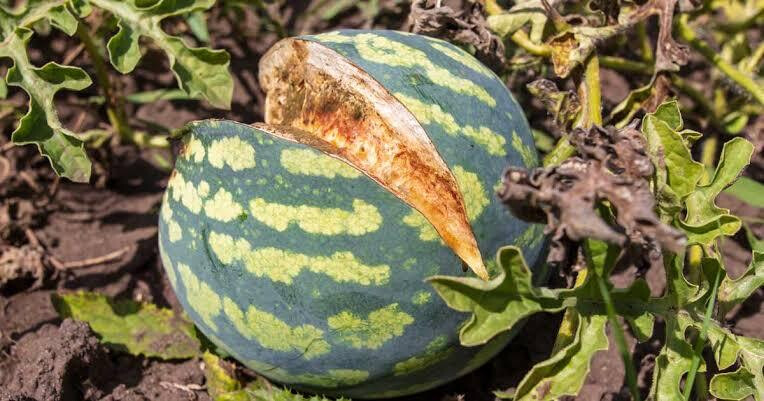
On the morning of the 18th, inside a greenhouse in Wolchon-ri, Gunbuk-myeon, Haman-gun, South Gyeongsang Province, Kim Hoe-seop, head of the Gunbuk Watermelon Producers Association, sighed repeatedly as he threw stunted watermelons onto the ground. The greenhouse, which in a normal year would be packed with watermelons ready for shipment at the end of this month, was full of empty spaces where plants had been uprooted. Even the watermelons that did grow were less than half their usual size.
All four of Kim’s greenhouses (totaling 5,200㎡, or about 1,573 pyeong) were in a similar state. He transplanted about 1,700 watermelon seedlings into the greenhouses at the end of August, but fewer than 400 grew properly.
Haman is the primary production region accounting for over 70% of the nation's winter watermelon shipments, where around 220 farms cultivate watermelons across 105 hectares (about 320,000 pyeong). This year, a viral outbreak has forced a wave of farmers to discard watermelons right before shipment. Kim said, “All 30 or so farms around Gunbuk-myeon are in the same boat. This year's harvest is completely ruined, and I’m worried about next year. The future feels even bleaker.”
Watermelons Discarded Due to Viruses; Spinach Suffers Waterlogging Damage
The aftermath of summer heatwaves and droughts, followed by torrential autumn rains, is persisting into late-autumn crop harvesting and shipping sites. Watermelons are being discarded due to viral infections, while pears are suffering consecutive losses in marketability as the fruit splits or the flesh turns mushy.
Testing conducted by the Gyeongsangnam-do Agricultural Research and Extension Services confirmed infections from three types of viruses: Cucurbit chlorotic yellows virus (CCYV), Zucchini yellow mosaic virus (ZYMV), and Watermelon mosaic virus (WMV). While these viruses were detected in tiny numbers annually, the institute estimates that incidence rates surged roughly tenfold this year. Observers suggest that elevated temperatures prolonged the activity of vector pests such as aphids and whiteflies into late autumn, worsening the damage. Lee Un-hak, head of the watermelon team at the Haman-gun Agricultural Technology Center, stated, “For now, we are supplying pesticides to curb the spread and proposing to the government and insurance companies the creation of a special compensation rider to expand crop disaster insurance coverage to include viral damage.”
Farms in Namhae-gun, a major production hub for winter open-field spinach, are also plunged into despair. Due to frequent rainfall last month and the impact of Typhoon Chaba (Champi), waterlogging damage occurred across 660 hectares (about 2 million pyeong)—more than half of the roughly 1,100 hectares (about 3.33 million pyeong) sown. Namhae's cumulative rainfall last month reached 238.1mm, with nearly 100mm falling over just four days from the 23rd to the 26th. As roots rotted and leaves wilted, the crops lost their market value, with damages tallied at 18 billion won.
Major Pear-Producing Regions Also Hit by Heatwaves and Drought
Pear farms in Cheonan and Asan, South Chungcheong Province, suffered widespread fruit splitting and flesh softening due to autumn rainfall following summer heatwaves and droughts. According to a survey conducted by South Chungcheong Province ahead of this year's pear harvest season (September to early November), 426 out of 1,163 farms reported damage. The affected area reached 530 hectares (about 1.6 million pyeong), equivalent to roughly 742 soccer fields. Yoon Hong-gi, head of the Digital Fruit Tree Team at the Chungcheongnam-do Agricultural Research and Extension Services, explained, “The trees were already stressed from this year's heatwaves and droughts when sudden heavy rains hit. As the pear trees rapidly absorbed moisture, the fruit skin could not withstand the expansion and burst open in many places.”
Yoo Ha-yeol (45), who has farmed pears in Cheonan for 11 years, sighed, “Less than 40% of our pears are marketable this year. What’s even more worrying is that pear trees with weakened branch growth will take the next two to three years to recover, meaning we won't be able to get proper fruit during that time.”
Lee Mun-ho, a research fellow at the Gyeongnam Institute, emphasized, “Local governments alone can no longer cope with agricultural damage caused by climate change. Systematic government responses for primary industries—such as transitioning to smart farming methods less affected by climate—are becoming increasingly critical.”
[Copyright (c) Global Economic Times. All Rights Reserved.]