• 2026.04.25 (Sat)
  • All articles
  • LOGIN
  • JOIN
Global Economic Times
fashionrunwayshow2026
  • Synthesis
  • World
  • Business
  • Industry
  • ICT
  • Distribution Economy
  • Well+Being
  • Travel
  • Eco-News
  • Education
  • Korean Wave News
  • Opinion
  • Arts&Culture
  • Sports
  • People & Life
    • International Student Report
    • With Ambassador
  • Column
    • Cho Kijo Column
    • Cherry Garden Story
    • Ko Yong-chul Column
    • Kim Seul-Ong Column
    • Lee Yeon-sil Column
  • Photo News
  • New Book Guide
MENU
 
Home > World

Panama Canal Transit Fees Skyrocket to Record Highs Amidst Hormuz Strait Crisis

Ana Fernanda Reporter / Updated : 2026-04-25 04:40:38
  • -
  • +
  • Print


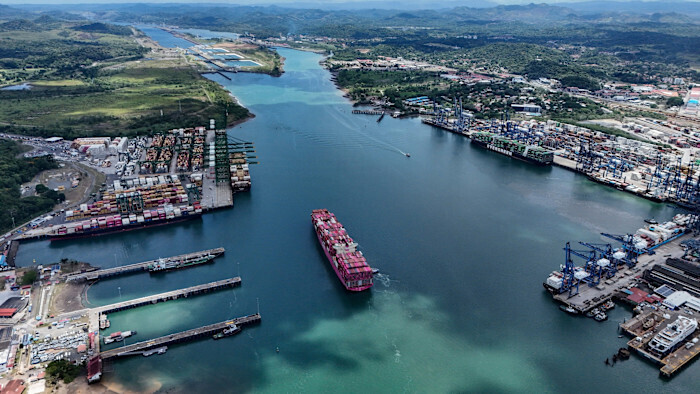
PANAMA CITY — The ongoing conflict in the Middle East, and the resulting closure of the Strait of Hormuz, has triggered a seismic shift in global maritime logistics, sending transit fees at the Panama Canal to unprecedented record highs. As one of the world’s most vital trade arteries, the canal has become a bottleneck for global energy markets, as Asian nations scramble to secure alternative sources of oil and gas.

With the Persian Gulf effectively paralyzed, countries such as South Korea and Japan have drastically increased their imports from the U.S. Gulf Coast. Given that the Panama Canal serves as the shortest maritime route connecting the Gulf of Mexico to the Asian market, it has experienced a sudden and overwhelming influx of traffic.

Data from the region indicates that daily auctions for canal passage slots are now attracting five times the number of bids compared to pre-war levels. The price surge is staggering: the average cost for a transit slot for a Panamax-class vessel has climbed to approximately $837,500. According to energy data analysts at Argus Media, this figure represents a tenfold increase in costs since the conflict began.

While many shipping companies manage to secure transit slots through pre-arranged, lower-cost reservations, these only account for about 70% of total traffic. The remaining 30% are handled through daily auctions, which have become a battleground for urgency. In desperate efforts to bypass the rising congestion, some shipping firms have paid as much as $4 million for a single transit slot.

The logistical strain is becoming increasingly evident on the water, where tanker waiting times have reached an average of 4.25 days—a six-week high. For major container ships and LPG carriers that rely on the canal for their operations, these delays represent not just a financial burden, but a critical threat to the stability of energy supply chains across the Pacific. As the geopolitical situation remains volatile, the Panama Canal continues to bear the heavy burden of being the primary lifeline for global energy, with experts warning that transit costs may remain elevated as long as the crisis in the Middle East persists.

[Copyright (c) Global Economic Times. All Rights Reserved.]

  • #Hormuz Impasse
  • #globaleconomictimes
  • #micorea
  • #mykorea
  • #nammidonganews
  • #singaporenewsk
  • #Samsung
  • #Daewoo
  • #Hyos
Ana Fernanda Reporter

Popular articles

  • Republican Party Faces "Total Crisis" as War and Inflation Cloud Midterm Outlook

  • Iran’s New Supreme Leader Signals Escalation: "New Level" of Hormuz Control and Demands for "Blood Money"

  • The Rise of "Elon Inc.": Speculation Swirls Over Potential Tesla-SpaceX Merger Following IPO

I like it
Share
  • Facebook
  • X
  • Kakaotalk
  • LINE
  • BAND
  • NAVER
  • https://globaleconomictimes.kr/article/1065555581894276 Copy URL copied.
Comments >

Comments 0

Weekly Hot Issue

  • South Korea Expands Child Allowance: 2017-born Children to Receive Up to ₩480,000 this Month
  • K-Food’s New Frontier: aT Opens Houston Branch to Conquer the American South and Central America
  • Coffee and Pay Vouchers Take Center Stage: KT Alpha Reports 65% Surge in Mobile Gifting for Labor Day
  • Diesel Prices Surpass ₩2,000 Milestone Amid Middle East Tensions and Price Cap Implementation
  • “Learn from China”: Hyundai Motor’s Top Brass Descend on Beijing Auto Show to Regain Edge
  • Hyundai and CATL Forge "Global Alliance": Battery Swapping and Beyond

Most Viewed

1
“Printing Lenses Like Newspapers”: Korean Researchers Unveil Game-Changing Mass Production for Metalenses
2
ASML Sees Surge in South Korean Revenue as Samsung and SK Hynix Accelerate Next-Gen Fab Operations
3
IMO Chief Denounces Tolls on International Straits as "Illegal" and a "Dangerous Precedent"
4
Comedian Lee Jin-ho Saved by Former Super Junior Member Kangin After Brain Hemorrhage
5
Meta Set to Dethrone Google as Digital Advertising King, Driven by AI-Powered Reels
광고문의
임시1
임시3
임시2

Hot Issue

Pentagon’s Arsenal Drained by Iran Conflict: Mounting Fears Over Deterrence Gaps in Korea and Taiwan

Korea and Vietnam Forge Strategic Partnership in Science, Technology, and Innovation

University of Utah Asia Campus Hosts ‘2026 Film Festival,’ Showcasing Student Cinematic Excellence

South Korea Fines Paper Cartel $245M for Systematic Price Fixing

Fashion Runway Show 2026

Global Economic Times
korocamia@naver.com
CEO : LEE YEON-SIL
Publisher : KO YONG-CHUL
Registration number : Seoul, A55681
Registration Date : 2024-10-24
Youth Protection Manager: KO YONG-CHUL
Singapore Headquarters
5A Woodlands Road #11-34 The Tennery. S'677728
Korean Branch
Phone : +82(0)10 4724 5264
#304, 6 Nonhyeon-ro 111-gil, Gangnam-gu, Seoul
Copyright © Global Economic Times All Rights Reserved
  • 에이펙2025
  • APEC2025가이드북TV
  • 반달곰 프로젝트
Search
Category
  • All articles
  • Synthesis
  • World
  • Business
  • Industry
  • ICT
  • Distribution Economy
  • Well+Being
  • Travel
  • Eco-News
  • Education
  • Korean Wave News
  • Opinion
  • Arts&Culture
  • Sports
  • People & Life 
    • 전체
    • International Student Report
    • With Ambassador
  • Column 
    • 전체
    • Cho Kijo Column
    • Cherry Garden Story
    • Ko Yong-chul Column
    • Kim Seul-Ong Column
    • Lee Yeon-sil Column
  • Photo News
  • New Book Guide
  • Multicultural News
  • Jobs & Workers