• 2026.04.25 (Sat)
  • All articles
  • LOGIN
  • JOIN
Global Economic Times
fashionrunwayshow2026
  • Synthesis
  • World
  • Business
  • Industry
  • ICT
  • Distribution Economy
  • Well+Being
  • Travel
  • Eco-News
  • Education
  • Korean Wave News
  • Opinion
  • Arts&Culture
  • Sports
  • People & Life
    • International Student Report
    • With Ambassador
  • Column
    • Cho Kijo Column
    • Cherry Garden Story
    • Ko Yong-chul Column
    • Kim Seul-Ong Column
    • Lee Yeon-sil Column
  • Photo News
  • New Book Guide
MENU
 
Home > Distribution Economy

Diesel Prices Surpass ₩2,000 Milestone Amid Middle East Tensions and Price Cap Implementation

Kim Sungmoon Reporter / Updated : 2026-04-25 04:52:44
  • -
  • +
  • Print


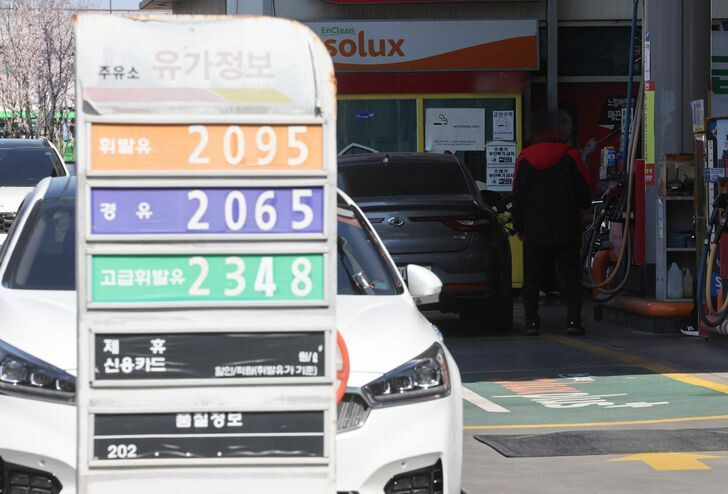
SEOUL – South Korea’s energy market faced a historic milestone on Friday as domestic diesel prices breached the 2,000-won-per-liter mark for the first time in nearly four years. This surge coincides with the first day of the government’s "4th Petroleum Price Cap Policy," highlighting a growing tension between soaring international crude markets and domestic regulatory efforts to curb inflation.

The Return of High Oil Prices
According to Opinet, the oil price information service operated by the Korea National Oil Corporation (KNOC), the national average price of diesel stood at 2,000.1 won per liter as of 9:00 AM on April 24. This represents the first time diesel has traded above the 2,000-won threshold since July 27, 2022 (2,006.7 won), during the height of the energy crisis triggered by the war in Ukraine.

Gasoline prices are following a similar upward trajectory. Having already entered the 2,000-won range on April 17, the national average for gasoline rose to 2,006.2 won on Friday. In the capital city of Seoul, the situation is even more acute, with gasoline and diesel averaging 2,043.6 won and 2,030.6 won, respectively.

Geopolitical Turbulence
The primary driver behind this price spike is the lingering instability in the Middle East. Negotiations for a ceasefire between the United States and Iran have stalled, leading to a "risk premium" being baked into global oil prices.

On April 23 (local time), Brent crude futures for June delivery jumped 3.1% to settle at $105.07 per barrel on the ICE Futures Exchange. Similarly, West Texas Intermediate (WTI) rose 3.11% to end at $95.85 per barrel. Given that international price fluctuations typically manifest at domestic pumps with a two-to-three-week lag, experts warn that the peak may not yet have been reached.

The Price Cap Dilemma
In an attempt to shield consumers from the full brunt of global volatility, the South Korean government officially launched its 4th Petroleum Price Cap on the 24th. Under this mandate, the "ceiling prices" have been frozen at the same levels as the previous 3rd period:

Gasoline: 1,934 won/L
Diesel: 1,923 won/L
Kerosene: 1,530 won/L

However, a significant discrepancy has emerged. With the actual market average for diesel already at 2,000.1 won, the government-mandated cap of 1,923 won sits nearly 77 won below the market reality. This gap raises concerns regarding the sustainability of the policy.

"If the gap between the official price cap and the actual cost of importing and refining crude oil continues to widen, we could see supply disruptions," warned an industry analyst. "Gas station owners may be reluctant to sell at a loss, or we may see a surge in government subsidies to bridge the difference, which places a heavy burden on the national treasury."

Impact on the Economy
The return of 2,000-won diesel is particularly painful for the logistics and construction sectors, which rely heavily on the fuel. Logistics companies, already struggling with high labor costs, face narrowing margins that could eventually lead to higher consumer prices for delivered goods—a phenomenon often referred to as "greenflation."

As the Middle East remains a tinderbox and global supply chains remain fragile, South Korean consumers are bracing for a prolonged period of energy-driven economic pressure. All eyes are now on the next diplomatic moves in the Middle East, as they will likely dictate whether the 2,000-won era is a temporary spike or a grueling new normal.

[Copyright (c) Global Economic Times. All Rights Reserved.]

  • #Hormuz Impasse
  • #globaleconomictimes
  • #micorea
  • #mykorea
  • #nammidonganews
  • #singaporenewsk
  • #Samsung
  • #Daewoo
  • #Hyos
Kim Sungmoon Reporter

Popular articles

  • Google Gemini to Import Rival AI Chat Histories: Battle for User Retention Intensifies

  • South Korean Automakers Defy Middle East Tensions with Robust March Sales Growth

  • SK Hynix CEO Targets 100 Trillion Won Net Cash to Fuel "Uninterrupted" AI Investment

I like it
Share
  • Facebook
  • X
  • Kakaotalk
  • LINE
  • BAND
  • NAVER
  • https://globaleconomictimes.kr/article/1065556302363291 Copy URL copied.
Comments >

Comments 0

Weekly Hot Issue

  • South Korea Expands Child Allowance: 2017-born Children to Receive Up to ₩480,000 this Month
  • K-Food’s New Frontier: aT Opens Houston Branch to Conquer the American South and Central America
  • Coffee and Pay Vouchers Take Center Stage: KT Alpha Reports 65% Surge in Mobile Gifting for Labor Day
  • “Learn from China”: Hyundai Motor’s Top Brass Descend on Beijing Auto Show to Regain Edge
  • Hyundai and CATL Forge "Global Alliance": Battery Swapping and Beyond
  • Global Energy "Panic Buying" Escalates as Nations Enter Survival Mode Amid Middle East Conflict

Most Viewed

1
“Printing Lenses Like Newspapers”: Korean Researchers Unveil Game-Changing Mass Production for Metalenses
2
ASML Sees Surge in South Korean Revenue as Samsung and SK Hynix Accelerate Next-Gen Fab Operations
3
IMO Chief Denounces Tolls on International Straits as "Illegal" and a "Dangerous Precedent"
4
Comedian Lee Jin-ho Saved by Former Super Junior Member Kangin After Brain Hemorrhage
5
Meta Set to Dethrone Google as Digital Advertising King, Driven by AI-Powered Reels
광고문의
임시1
임시3
임시2

Hot Issue

Pentagon’s Arsenal Drained by Iran Conflict: Mounting Fears Over Deterrence Gaps in Korea and Taiwan

Korea and Vietnam Forge Strategic Partnership in Science, Technology, and Innovation

University of Utah Asia Campus Hosts ‘2026 Film Festival,’ Showcasing Student Cinematic Excellence

South Korea Fines Paper Cartel $245M for Systematic Price Fixing

Fashion Runway Show 2026

Global Economic Times
korocamia@naver.com
CEO : LEE YEON-SIL
Publisher : KO YONG-CHUL
Registration number : Seoul, A55681
Registration Date : 2024-10-24
Youth Protection Manager: KO YONG-CHUL
Singapore Headquarters
5A Woodlands Road #11-34 The Tennery. S'677728
Korean Branch
Phone : +82(0)10 4724 5264
#304, 6 Nonhyeon-ro 111-gil, Gangnam-gu, Seoul
Copyright © Global Economic Times All Rights Reserved
  • 에이펙2025
  • APEC2025가이드북TV
  • 반달곰 프로젝트
Search
Category
  • All articles
  • Synthesis
  • World
  • Business
  • Industry
  • ICT
  • Distribution Economy
  • Well+Being
  • Travel
  • Eco-News
  • Education
  • Korean Wave News
  • Opinion
  • Arts&Culture
  • Sports
  • People & Life 
    • 전체
    • International Student Report
    • With Ambassador
  • Column 
    • 전체
    • Cho Kijo Column
    • Cherry Garden Story
    • Ko Yong-chul Column
    • Kim Seul-Ong Column
    • Lee Yeon-sil Column
  • Photo News
  • New Book Guide
  • Multicultural News
  • Jobs & Workers