![[등록] 2026-09-01 15:48:31](/support/_updata/banner2/tl181982910_6749.png)


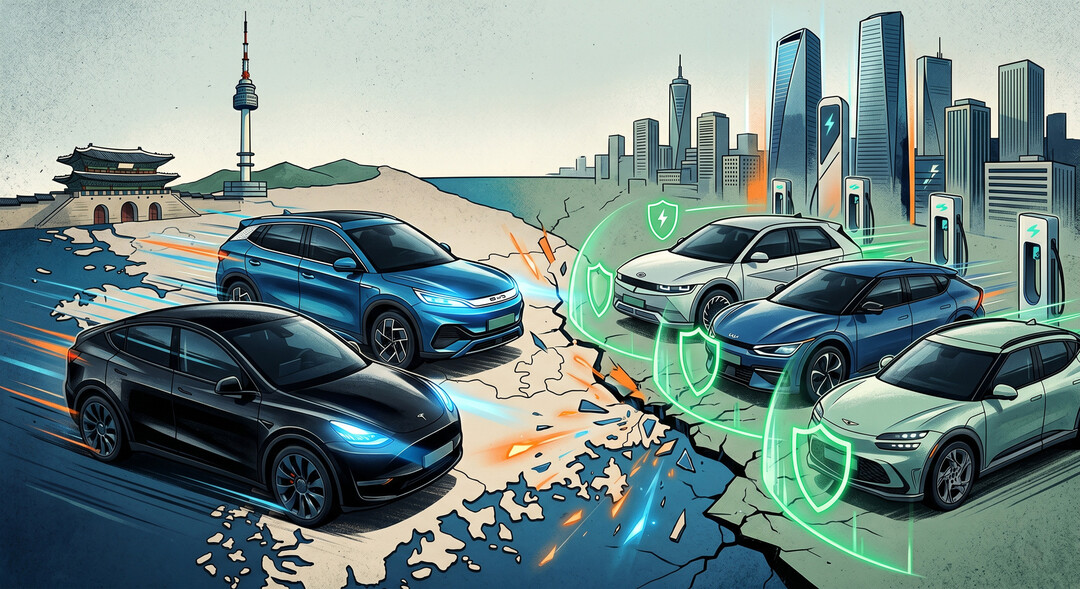
SEOUL — South Korea’s once-impregnable domestic automotive market is facing a profound disruption. Long dominated by powerful homegrown giants, the local industry is witnessing an aggressive realignment as foreign electric vehicle (EV) manufacturers leverage competitive pricing and advanced technology to capture substantial market share, triggering warning lights for local auto brands.
According to data released by the Korea Imported Automobile Association (KAIDA), new imported passenger car registrations reached 29,860 units last month, marking a 5.9 percent increase compared to the 28,189 units recorded during the same period last year. Driving this growth is an explosive demand for imported electric vehicles, which accounted for 14,520 units sold. This figures out to a staggering 48.6 percent market share within the import segment, signifying that nearly one out of every two imported vehicles purchased was fully electric.
The most historic milestone in this shift belongs to Tesla's Model Y, which established a commanding monopoly over the charts. The Model Y registered a total of 8,762 units in May—comprising 7,195 premium variations and 1,513 LFP-battery equipped models. With these robust numbers, Tesla's crossover comfortably secured the title of the overall best-selling car in South Korea, outperforming both foreign and domestic competitors alike.
This achievement marks the first time in South Korean automotive history that a single imported model has dethroned mainstream domestic volume models to claim the unified top spot. Perennial domestic powerhouses, including the Kia Sorento (7,836 units) and the Hyundai Grandeur (5,183 units), were forced to yield to Tesla’s rapid advance. On a brand level, Tesla seized the industry crown by selling 10,866 vehicles, translating to an overwhelming 36.39 percent market share within the import arena.
Concurrently, Chinese EV juggernaut BYD continued to manifest a strong competitive presence. Although its sales dipped by 49.0 percent compared to the previous month due to deliberate supply chain and inventory adjustments, BYD successfully delivered 1,032 vehicles. This performance allowed the company to defend its position as the seventh-largest imported brand in the country, reinforcing the formidable threat posed by Chinese electric powertrains.
Conversely, the aggregate performance of South Korea’s five domestic automakers painted a bleak picture. Total domestic sales for the five manufacturers plummeted to 97,110 units, suffering a sharp 14.3 percent contraction compared to the previous year. Crucially, this downturn caused the industry’s combined monthly home-turf sales to crash below the psychologically significant benchmark of 100,000 units.
Industry leader Hyundai Motor Company bore the brunt of this slowdown, experiencing a severe 23.1 percent drop with domestic sales falling to 45,364 units. Smaller domestic manufacturers faced even harsher realities: Renault Korea saw sales tumble by 31.2 percent, GM Korea plummeted by 42.6 percent, and KG Mobility registered a 6.8 percent decline. Kia managed to mitigate the damage relatively well, but still recorded a minor 0.9 percent drop to 44,727 units, failing to completely insulate itself from the broader contraction in consumer demand.
“Prolonged high interest rates and persistent inflation have severely frozen domestic consumer sentiment,” noted Professor Kim Pil-soo of Daelim University. “In this economic climate, consumer demand has temporarily migrated toward imported LFP-equipped electric vehicles that offer an undeniable price advantage, culminating in this unprecedented phenomenon where an imported vehicle leads the entire national market.”
Analysts suggest that unless domestic automakers accelerate the deployment of cost-competitive electric models and adjust to shifting consumer preferences, their long-standing hegemony over the local market will face intensifying vulnerabilities.
[Copyright (c) Global Economic Times. All Rights Reserved.]