![[등록] 2026-09-01 15:48:31](/support/_updata/banner2/tl181982910_6749.png)


ULAANBAATAR, Mongolia - Recent archaeological investigations in the Tsakhir Hotgor (also known as Tsakhir Uul or Flint Valley) region of Mongolia have yielded groundbreaking insights into early human occupation and the timeline of pottery emergence in the region. A team of Polish archaeologists, led by Dr. Przemysław Bobrowski, has published new radiocarbon dating results from a Holocene (approximately 11,700 years ago to the present) site in the international journal 'Radiocarbon', garnering significant attention within the scientific community.
Tsakhir Hotgor, situated within the Arts Bogdyn Nuruu mountain range roughly 700 kilometers south of Mongolia's capital, Ulaanbaatar, gained prominence in the late 20th and early 21st centuries following extensive discoveries of prehistoric sites associated with the Early, Middle, and Late Paleolithic periods by joint Mongolian-Russian-American expeditions. The area's abundance of flint outcrops and numerous flint artifacts earned it the moniker "Flint Valley," establishing it as a notably extensive prehistoric landscape in Central Asia.
Dr. Bobrowski emphasized the limited prior archaeological research in the Tsakhir Hotgor region despite its rich Stone Age heritage. He stated, "The aim of our research project, conducted in recent years, is to analyze the long-term patterns of prehistoric settlement around Tsakhir Hotgor. Through environmental reconstruction, dating of settlement phases, and raw material economy studies, we aim to understand the overall picture of human activity in this area spanning hundreds of thousands of years."
Prior to intensive excavations, the research team conducted comprehensive surface surveys around Flint Valley. This process led to the identification of several ancient paleolakes situated a few kilometers south of the Arts Bogdyn Nuruu range. Notably, these lake margins revealed diverse archaeological sites inhabited by hunter-gatherer groups not only during the Pleistocene but also into the early Holocene period following the Last Glacial Maximum.
Among the surveyed paleolakes, Baruun Khuree (Lake V) became the focal point of this particular study. Excavations at three distinct sites (FV 133, FV 134A, and FV 139) within this area unearthed a variety of artifacts, including lithic tools, ostrich eggshell artifacts, pottery fragments, and hearths.
Dr. Bobrowski highlighted the significance of the discovered artifacts, stating, "In addition to the assemblages of stone tools, the excavated sites yielded fragments of ostrich eggshells, ostrich eggshell beads, and an ostrich eggshell pendant. The East Asian ostrich, Struthio anderssoni, an extinct species of ostrich, inhabited China and Mongolia during the Pleistocene and Holocene."
Eleven radiocarbon dates obtained from the Baruun Khuree sites indicate two distinct phases of human occupation in the area. The younger occupation phase dates to approximately 10,620 to 10,535 cal BP (calibrated years Before Present) and was identified at the FV 133 and FV 134A sites. Evidence for an older occupation phase, dating to around 11,251 to 11,196 cal BP, was found at the FV 139 site.
These findings potentially establish the Baruun Khuree sites as some of the earliest securely dated evidence of early Holocene hunter-gatherer activity in the Gobi Desert region.
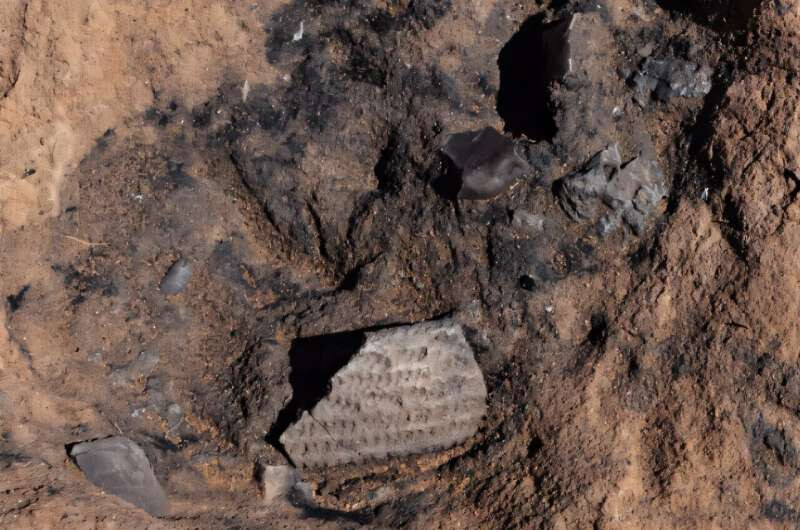
Furthermore, the research offers new insights into the initial appearance of pottery in Mongolia. Previous studies suggested that the earliest pottery in Mongolia emerged around 9,600 cal BP. However, pottery fragments discovered directly adjacent to a hearth at the Baruun Khuree site have been dated to approximately 2,000 years earlier than previously estimated.
While the overall corpus of early pottery from Mongolia remains limited, hindering direct comparative studies, the pottery from Baruun Khuree presents crucial evidence for the initial introduction of pottery technology into the region. The recovered pottery typically exhibits gray to dark gray or reddish-brown hues and does not exceed 7-8 mm in thickness, characteristics that differ from previously known early Mongolian pottery.
Dr. Bobrowski emphasized the implications of this finding, stating, "The dating results we obtained indicate that pottery-making technology reached the Gobi-Altai region almost 2,000 years earlier than previously known. Chronologically, this aligns with the dates of early pottery found in regions such as northern China."
The research team is currently undertaking detailed analyses of the recovered lithic artifacts and ostrich eggshell ornaments. Further research papers focusing specifically on the pottery and ostrich eggshell artifacts are reportedly in preparation. This research is anticipated to significantly enhance our understanding of early human activity and cultural development in the Mongolian region.
[Copyright (c) Global Economic Times. All Rights Reserved.]