![[등록] 2026-09-01 15:48:31](/support/_updata/banner2/tl181982910_6749.png)


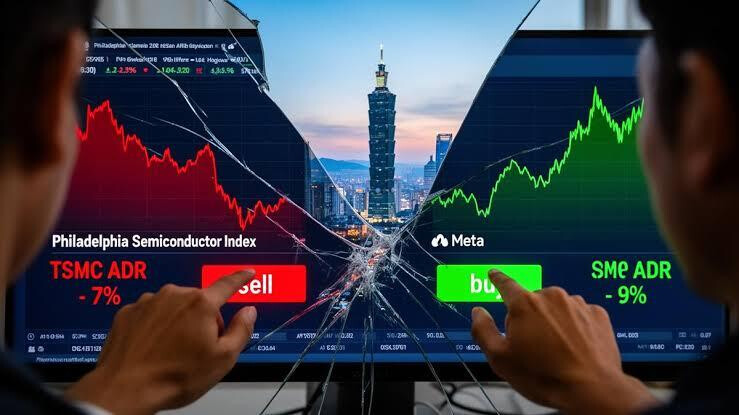
Following a severe global equity market correction last month centered on artificial intelligence (AI) technology heavyweights, international institutional investors are executing a notable reallocation of capital across East Asia. Capital flows reveal a sharp divergence: foreign funds are retreating from South Korea’s highly erratic equity market and redirecting their focus toward the relative structural stability of Taiwan.
According to market data compiled by Bloomberg, Taiwan’s benchmark Taiex Index attracted approximately $1.7 billion in net foreign inflows during the current month, effectively snapping a six-week streak of net capital flight. In stark contrast, South Korea’s benchmark KOSPI suffered a brutal wave of foreign divestment, with offshore investors unloading a staggering $6.2 billion worth of domestic equities over the same period. While global market appetite for AI-related technology equities has begun to stabilize and recover, international asset managers are increasingly prioritizing low-volatility structural environments—a preference that currently heavily favors Taipei over Seoul.
Both South Korea and Taiwan are globally recognized as primary hardware beneficiaries of the ongoing boom in artificial intelligence and next-generation computing infrastructure. However, market analysts emphasize that the fundamental structural compositions of the two equity markets diverge significantly in terms of risk exposure and concentration.
The Korean stock market suffers from extreme single-stock concentration. Tech behemoths Samsung Electronics Co. and SK Hynix Inc.—both highly sensitive to global memory chip cycles—collectively account for roughly 40 percent of the total market capitalization of the KOSPI. This intense weight renders the entire national index hyper-vulnerable to corporate-specific headlines and cyclical swings in consumer memory demand. Conversely, while Taiwan’s market is dominated by semiconductor giant Taiwan Semiconductor Manufacturing Co. (TSMC), its broader market architecture is supported by a comprehensive, diversified hardware ecosystem. Taiwan hosts a multi-tiered array of specialized electronics manufacturers, component makers, and packaging suppliers, offering a more resilient shock absorber against single-sector downturns.
Reinforcing this perspective, Warren Chiang, portfolio manager at Boston-based asset management firm Grantham, Mayo, Van Otterloo & Co. (GMO), highlighted the sheer ubiquity of Taiwan’s manufacturing footprint. He noted that nearly every key component embedded within Apple's flagship iPhone originates from Taiwanese supply chains, providing the island nation with a deeply entrenched competitive moat that transcends localized market noise.
Market structure experts point to another factor aggravating foreign investor anxiety in Seoul: the proliferation of single-stock leveraged Exchange Traded Funds (ETFs) tied to major South Korean tech names. Designed to multiply daily returns through derivative contracts and cash equities, these financial instruments require aggressive daily portfolio rebalancing. In periods of market stress, this mechanic acts as a force multiplier, triggering cascading sell-offs or artificial rallies.
This mechanical feedback loop drastically exacerbated volatility across the domestic market, dragging down unleveraged long-term shareholders alongside speculative traders. The broader fallout was drastic: from its peak in June, the KOSPI plunged by nearly 40 percent, while South Korea’s market volatility index exploded to a record-high reading of 96.9. The market experienced its most violent single-day fluctuation on July 31, when the KOSPI surged by an astonishing 18 percent in a single session—marking the largest one-day jump in Korean stock market history.
Despite the rebound in AI investment sentiment, foreign capital remains reluctant to re-enter South Korea at scale, even as valuations fall to deep discount levels. The KOSPI’s 12-month forward Price-to-Earnings (PER) multiple has compressed to an unprecedented historic low of 5.1 times earnings.
However, bargain-hunting foreign investors are looking past low valuation multiples toward earnings growth trajectories. Forecasts for 12-month forward corporate earnings growth in Taiwan rose to 9.5 percent last month, outpacing South Korea’s projected 7.4 percent growth rate. This marks the first time in approximately a year that Taiwanese earnings revisions have outstripped those of South Korean firms, reflecting greater institutional confidence in Taiwan’s profit delivery.
Nevertheless, financial observers urge caution regarding long-term sector calls. Bloomberg highlighted that given the short duration since July’s severe market drop, recent capital flows should not yet be interpreted as a permanent secular migration. Frank Benzimra, head of Asia equity strategy at Société Générale, noted that the ultimate determinant for sustained equity performance across both markets will be the degree to which artificial intelligence investments translate into tangible, scalable corporate earnings over the coming quarters.
[Copyright (c) Global Economic Times. All Rights Reserved.]