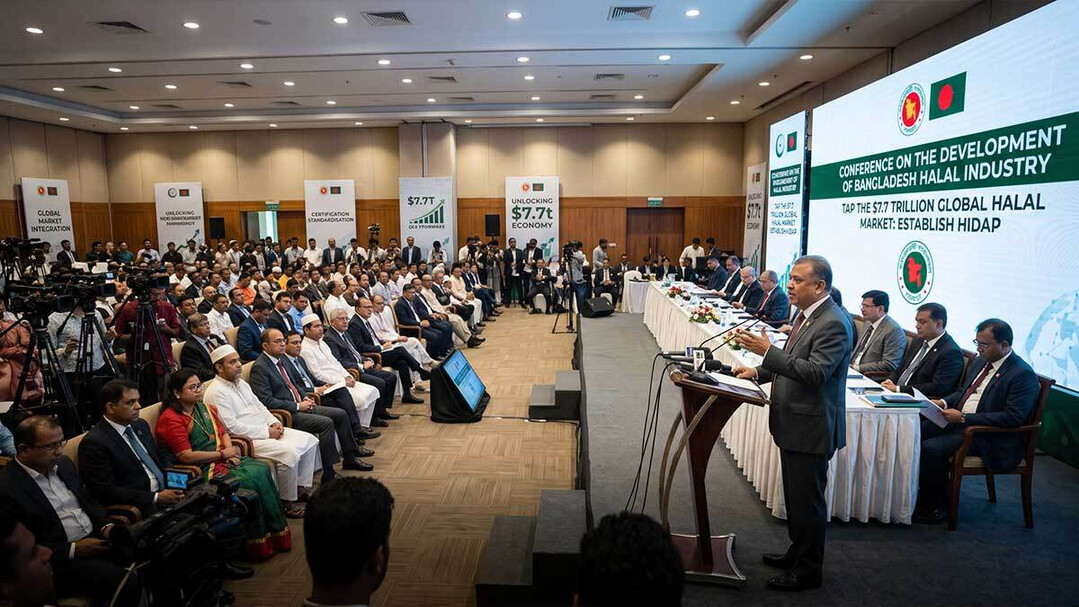
Dhaka, November 8, 2026 — Industry leaders and researchers are calling upon the government to create a specialized regulatory body—tentatively named the Halal Industry Development Authority of Bangladesh (HIDAB)—to unlock the country’s massive potential in the international halal economy.
The appeal was voiced during the "Investors Meet Up 3.0" conference in Dhaka. Jointly hosted by BDFairs and JCI Dhaka Achievers, the event brought together prominent trade organizations including the Bangladesh Chamber of Industries (BCI), the Leather Foundation of Bangladesh, and the Japan-Bangladesh Chamber of Commerce and Industry.
Delivering the keynote address, Daffodil International University’s Md Mominul Islam pointed out that the global halal marketplace valued at $7.7 trillion in 2024 is projected to skyrocket to $12.6 trillion by 2034, expanding at an annual clip of 6.2 percent. Food dominates this market at $3.36 trillion, followed by modest-fashion, tourism, pharmaceuticals, and cosmetics.
Despite having a population that is roughly 91 percent Muslim, Bangladesh recorded $943 million in halal exports during the 2025–26 fiscal year, supported by just 301 certified producers. BCI President Anwar Ul Alam Chowdhury Parvez noted that while the nation exports substantial processed goods under the assumption that local manufacturing in a Muslim-majority nation suffices, global importers strictly mandate certified validation.
According to Parvez, addressing testing bottlenecks, compliance guidelines, and supply chain traceability could inject an additional $8 billion to $10 billion into the national economy without requiring heavy new capital outlays. He emphasized that restrictive mindsets and information gaps remain far greater hurdles to sector growth than financial shortages.
Speakers at the forum also addressed structural hurdles, pointing out conflicting regulatory criteria between the Bangladesh Standards and Testing Institution (BSTI) and the Islamic Foundation, alongside a shortage of globally accredited testing facilities. To overcome these barriers, experts recommend adopting modern supply-chain technologies like QR-code traceability, blockchain, and Islamic financing models (such as mudarabah and murabahah) to capture a larger share of both OIC and non-Muslim markets, where halal goods are increasingly favored for safety, hygiene, and ethical traceability.
[Copyright (c) Global Economic Times. All Rights Reserved.]