![[등록] 2026-09-01 15:48:31](/support/_updata/banner2/tl181982910_6749.png)


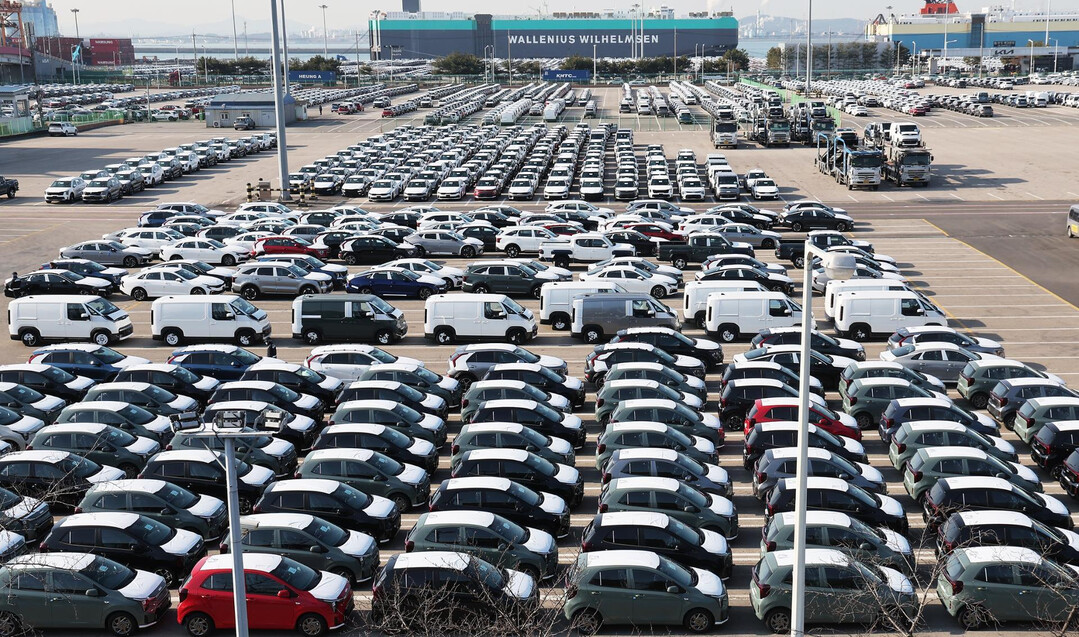
SEOUL — South Korea’s five major domestic automakers experienced a coordinated downturn in performance last month, reporting a contraction across both domestic sales channels and international export markets. According to corporate performance data released on Monday, June 1, 2026, a prolonged slowdown in consumer sentiment severely restricted domestic sales, while an overarching deceleration in outbound shipments further exacerbated the decline, precipitating a noticeable slump in total global delivery volumes.
According to the official May sales figures compiled individually by Hyundai Motor Company, Kia Corporation, GM Korea, Renault Korea, and KG Mobility (KGM), the aggregate global sales volume for the five manufacturers reached 664,370 vehicles. This performance represents a 4.0% decline compared to the corresponding period last year, reinforcing industry anxieties regarding sustained macroeconomic pressure and intensifying cross-border competition.
A granular review of the market segments reveals that the domestic arena suffered the steepest contraction. Combined domestic transactions plummeted to 97,096 units, marking a sharp 14.2% double-digit retrenchment relative to May of the previous year. Meanwhile, international sales showed greater relative resilience but still logged an aggregate contraction, decreasing by 2.0% year-on-year to settle at 567,023 units.
When analyzed by individual corporate entities, the performance metrics unveiled starkly disparate trajectories, with Kia Corporation emerging as the singular bright spot in an otherwise bearish monthly summary. Kia's overall global shipments expanded by 2.7% year-on-year to reach 277,715 units, successfully charting positive territory despite generalized market pressures.
Conversely, the remaining four manufacturers experienced multi-tiered contractions. Industry leader Hyundai Motor reported a total global volume of 325,473 units, slipping 7.7% from the previous year. GM Korea registered a 5.9% decline with 47,081 units, while KG Mobility dropped 10.0% to finish at 8,188 units. Renault Korea experienced the most severe setback among the group, with its global footprint shrinking by a steep 40.0% to just 5,913 units during the one-month period.
The internal South Korean marketplace proved to be uniquely challenging, as every single one of the five major domestic manufacturers posted negative growth metrics. Although Hyundai Motor and Kia continued to anchor the market—each passing the 40,000-unit threshold—they were entirely unable to insulate themselves from the systemic deceleration in macro-level consumer demand.
Hyundai Motor led the domestic segment in absolute volume, delivering 45,364 vehicles; however, this represents a significant 23.1% collapse compared to the same month last year. Kia managed to defend its position with relative stability, recording 44,713 units, a marginal contraction of 0.6%. Beyond the top two, the tier-two manufacturers endured much harsher downward corrections. KG Mobility managed a total of 3,318 domestic deliveries, yielding a 6.8% decline. Renault Korea registered 2,893 units, which translates into a 31.2% drop. GM Korea suffered the most acute domestic downturn, with deliveries shrinking by 42.6% to arrive at a mere 808 units. Collectively, the combined domestic volume for the big five contracted by 16,043 vehicles compared to twelve months prior.
The international export environment closely mirrored the domestic weakness, with Kia again acting as the sole counterbalance. Driven by durable brand equity and a highly sought-after lineup of recreational vehicles, Kia shipped 232,781 units to overseas markets, locking in a 3.4% growth rate.
In contrast, the broader export ecosystem recorded clear deficits. Hyundai Motor's international shipments fell 4.6% to 281,093 units. GM Korea saw a 4.8% decrease, reporting 46,273 overseas units. KG Mobility recorded a 9.7% decline, finishing the month at 4,840 units. The most pronounced international contraction occurred at Renault Korea, whose exports plummeted by 46.6% to a modest 3,020 units, underlining structural challenges in their global supply pipeline.
Industry specialists point out that a confluence of negative variables—ranging from heightened global macroeconomic volatility to aggressive pricing strategies by foreign competitors—has fundamentally constrained export performance. Furthermore, for minor domestic manufacturers outside of the dominant Hyundai-Kia umbrella, the absence of fresh vehicle rollouts alongside shrinking export allocations has become an enduring structural burden on their corporate balance sheets.
As the second half of 2026 approaches, market analysts suggest that these companies must accelerate their transition toward electrification and secure a steady supply of new models to reverse the current slump. Without a significant rebound in domestic consumer confidence or a breakthrough in emerging overseas markets, South Korean automakers may face a challenging road ahead.
[Copyright (c) Global Economic Times. All Rights Reserved.]