![[등록] 2026-09-01 15:48:31](/support/_updata/banner2/tl181982910_6749.png)


Amid growing concerns over teacher rights and workplace harassment, governments in Japan and South Korea are stepping up efforts to protect educators from abusive parent behaviors.
Recently, the Japanese Ministry of Education, Culture, Sports, Science and Technology (MEXT) introduced a comprehensive guideline aimed at preventing malicious complaints and harassment from parents and guardians. According to reports from major Japanese media outlets such as the Asahi Shimbun and Yomiuri Shimbun, the new guidelines explicitly outline specific examples of misconduct and provide practical countermeasures for schools and teachers.
The Japanese guidelines state that any speech or behavior that imposes excessive burdens or psychological pressure on school staff beyond socially accepted norms requires a "firm response." Specific examples of such misconduct include demanding class reassignments or teacher changes for unjustified reasons, repeatedly making lengthy phone calls or lingering at the school premises for extended periods, and threatening to post malicious reviews on social media.
To tackle these issues, the guidelines advise schools and teachers to ensure staff members avoid handling difficult situations alone. If unreasonable demands persist, educators are encouraged to request visitors to leave or hang up the phone after a certain period of time. Furthermore, schools are recommended to record conversations after giving prior notice to secure evidence of harassment and to consult with legal professionals such as lawyers when necessary.
Crucially, the guideline emphasizes that parents are not "customers," but rather "partners" who support the growth of children together with schools. Viewing parents as customers can lead to the misconception that schools and teachers must accommodate every single demand they make.
The Asahi Shimbun noted that these guidelines were prepared in alignment with a newly revised law taking effect in October, which mandates corporate measures against "kasuhara"—a Japanese term combining "customer" and "harassment." Under the amended Comprehensive Labor Measures Promotion Act, companies and organizations will be legally required to set up consultation desks and protect employees from harassment.
Data highlights the severity of the issue in Japan. A MEXT survey conducted last year across 11 local governments showed that about 40% of 563 surveyed schools had experienced excessive complaints or unreasonable demands. Moreover, over 90% of teachers reported feeling burdened by parent interactions. To address this proactively, some regional governments have already implemented localized rules. For instance, Tokyo introduced a policy in February capping parent-teacher meetings at 30 minutes, requiring experts like lawyers to accompany sessions starting from the fourth or fifth meeting.
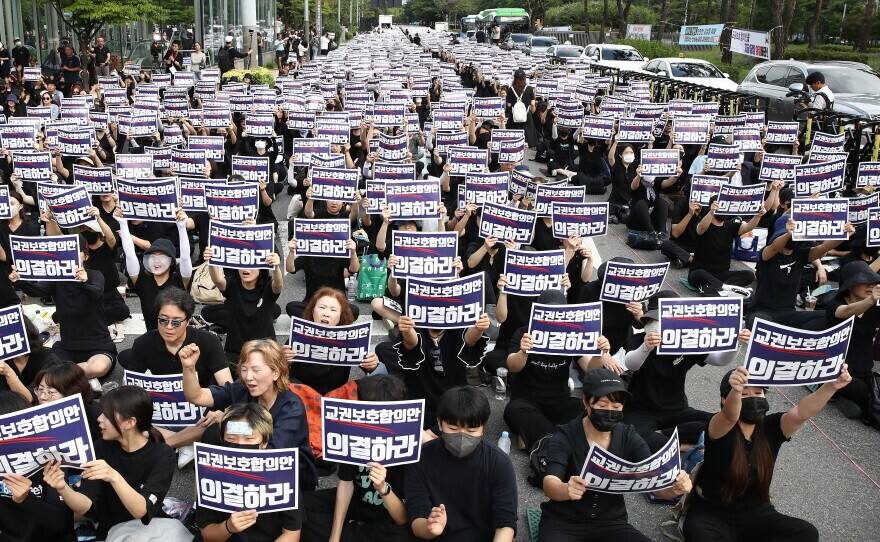
Similar challenges regarding teacher rights have surfaced in South Korea, prompting comparable administrative responses. Following the tragic death of a young elementary school teacher in Seoul's Seocho district in September 2023, public demand for institutional safeguards has surged. Following the popularity of the Netflix series "True Education" released in June, the Gyeonggi Provincial Office of Education officially launched dedicated "Teacher Rights Protection Officers" modeled after the fictional teacher protection bureau depicted in the show. These officers provide one-on-one comprehensive support for victimized teachers, assisting them from the initial incident stage through final resolution.
Experts point out that redefining the boundaries between parents and educational institutions is essential for restoring classroom authority. As both nations implement these robust legal frameworks and administrative guidelines, policymakers hope to foster a safer educational environment where teachers can focus on instruction without the constant threat of malicious harassment.
[Copyright (c) Global Economic Times. All Rights Reserved.]