JAKARTA, Indonesia — Beauty retailers, perfume boutiques, drugstores, and online marketplaces operating in Indonesia now face formal halal compliance requirements for their sales operations, following a sweeping regulatory update from the nation’s Halal Product Assurance Organizing Agency (BPJPH).
Under BPJPH Head Decree No. 376 of 2026, issued on October 12, 2026, retail sales services involving cosmetics and personal care goods are officially integrated into Indonesia’s Halal Product Assurance System (SJPH), with sector-specific obligations taking effect on October 18, 2026. The decree forms part of a broader package of eight sector-specific guidelines (Decrees No. 370–377/2026) released alongside BPJPH Decree No. 370/2026, which governs halal assurance for cosmetic manufacturing itself.
Bridging Retail Operations and Product Certification
While Indonesia’s overarching halal mandate stems from Law No. 33 of 2014, Decree No. 376/2026 closes a critical compliance gap at the point of sale. Rather than focusing solely on factory formulas, regulators are now scrutinizing how beauty and personal care products are received, stored, displayed, and sold to end consumers.
The mandate applies to direct-to-consumer retail channels handling cosmetics, drugs, food, or beverages, specifically targeting:
Specialty Beauty & Fragrance Outlets: Dedicated cosmetics stores, health and beauty chains, and perfume shops.
Pharmacies & General Retail: Drugstores, convenience stores, supermarkets, and hypermarkets.
Digital Marketplaces: Electronic trading systems (PMSE), where compliance duties are divided among platform operators, merchant sellers, and logistics/delivery partners.
Core Operational Mandates and Exemptions
To secure sales-service certification, covered retailers must establish formal internal controls. These include publishing a written halal policy, appointing a trained halal supervisor, maintaining traceability records, and enforcing strict physical segregation—and purification protocols when necessary—between halal and non-halal merchandise across receiving, warehousing, shelf display, and checkout stages. Retailers that bundle storage, packaging, or delivery into their retail operations can cover those auxiliary functions under a single sales-service certification.
However, regulators carved out specific exemptions to prevent redundant compliance burdens:
Single-Brand Sealed Retail: Brand-owned flagship stores or counters selling exclusively their own group’s products are exempt from separate sales-service certification, provided every item already holds a valid Indonesian halal certificate or a registered foreign halal certificate number (RSHLN) and remains in intact, tamper-evident original packaging with zero repacking, decanting, or blending on-site.
Exempt Goods & Incidental Sellers: Businesses selling only products exempt from mandatory halal rules—as well as non-core stores (such as bookstores or electronics shops) that sell personal care items only incidentally—do not require sales-service certification, though incidental sellers must still maintain procedures for handling non-compliant goods.
Strategic Context: Retail Rules Tighten as Product Deadline Shifts to 2028
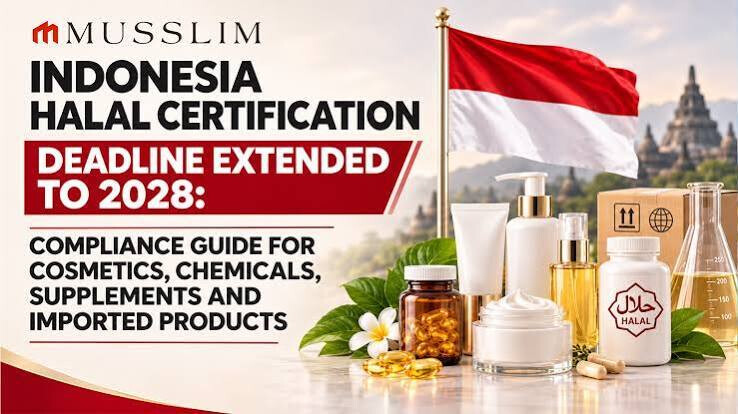
The rollout of retail-level guidelines coincides with a pivotal timeline adjustment for beauty brands. Just days after BPJPH issued Decree No. 376/2026, the Indonesian government enacted Government Regulation No. 40 of 2026 (GR 40/2026), extending the mandatory halal certification phase-in deadline for cosmetic products—alongside natural medicines, health supplements, chemical products, and specified consumer goods—from October 17, 2026, to October 17, 2028.
Industry analysts note that while GR 40/2026 grants domestic and foreign beauty manufacturers an extra two years to certify product formulations and secure mutual recognition agreements, it does not suspend Indonesia's broader halal ecosystem build-out. Furthermore, halal certification remains distinct from pre-market cosmetic product notification with Indonesia’s Food and Drug Authority (BPOM), meaning brands must continue satisfying both safety and halal tracks.
Action Plan for Beauty Brands and Retailers
To navigate the dual-track timeline effectively, cosmetic companies and retail partners should prioritize four steps:
Audit Channel Exposure: Brands operating mono-brand stores in Indonesia should verify that no in-store decanting, tester refilling, or multi-brand cross-selling invalidates their single-brand retail exemption. Multi-brand retailers and department stores must prepare for full SJPH sales-service certification.
Align E-Commerce Disclosures: Online merchants and cross-border sellers must audit product listings item by item—ensuring certified items display verified halal credentials and uncertified items made from non-halal ingredients carry explicit non-halal disclosures, as silent omission is prohibited.
Build Store-Level SOPs: Retail operators should formalize standard operating procedures covering shelf segregation, cross-contamination cleanup, and non-conforming product disposal.
Leverage the 2028 Window: Manufacturers should use the extended transition period under GR 40/2026 to audit raw materials (especially animal-derived, fermented, or alcohol-based ingredients), register foreign halal certificates, and align Indonesian-language packaging labels ahead of the October 2028 cutoff.
[Copyright (c) Global Economic Times. All Rights Reserved.]