GENEVA — Global deaths and injuries from landmines and explosive remnants of war surged to their highest level in five years during 2025, driven largely by ongoing conflicts in Myanmar and post-war hazards in Syria, a new international monitoring report revealed on Tuesday.
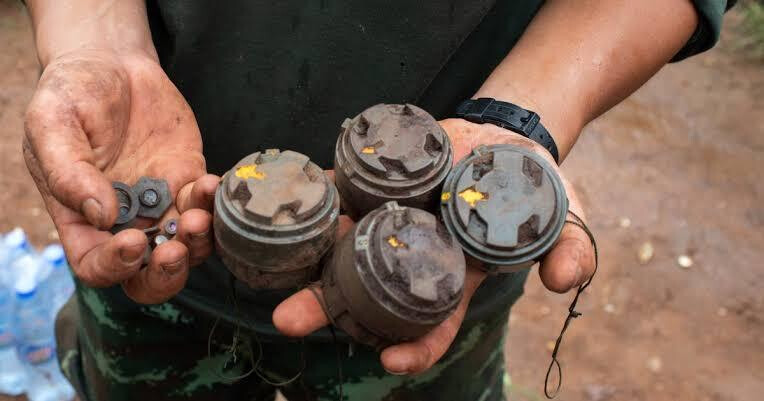
According to the Landmine Monitor 2026 report, published by the International Campaign to Ban Landmines (ICBL), 6,929 people were killed or injured by such devices last year. Civilians accounted for roughly 84% of all recorded victims, and alarmingly, half of those civilian casualties were children. Researchers noted that young people are disproportionately at risk because they often mistake unexploded ordnance for toys out of curiosity or a lack of danger awareness.
Southeast Asia and Syria Lead Global Toll
Despite making up just over 8% of the global population, Southeast Asia accounted for 27% of worldwide fatalities in 2025 due to extensive contamination across Cambodia, Laos, Vietnam, and particularly Myanmar.
For the third consecutive year, Myanmar recorded the highest number of casualties globally, with 1,891 victims—an average of five people killed or wounded every day. Both military junta forces and resistance militias have heavily deployed the weapons, leaving nearly two-thirds of the country's administrative regions contaminated. Yeshua Moser-Puangsuwan, a co-author of the report, warned that the situation in Myanmar has escalated "beyond crisis to catastrophe."
In the Middle East, Syria experienced a dramatic spike in casualties, with deaths jumping by more than 50% to 1,602 in 2025. The surge coincided with massive waves of displaced civilians returning home following the collapse of the Assad government in late 2024, underscoring how explosive remnants continue to claim lives long after active combat subsides.
Erosion of Global Ban Treaties
The report also highlighted a troubling geopolitical shift away from the 1997 Anti-Personnel Mine Ban Convention. While the ICBL called on nations to halt production and adhere to the treaty, several countries bordering or near Russia—including Finland, Poland, Estonia, Latvia, and Lithuania—have formally withdrawn from the pact, citing heightened regional security threats. Ukraine similarly informed the United Nations of its intent to suspend compliance, a move prohibited under the treaty's provisions.
Monitoring data confirmed active deployment of anti-personnel mines by both Russia and Ukraine amid their ongoing conflict, alongside new usage by Myanmar, North Korea, and Iran. Unidentified groups were also linked to mine incidents in Sudan, Bangladesh, and along the Thai-Cambodian border.
Additionally, the Landmine Monitor cited findings from the Dutch investigative collective Bellingcat, whose analysis of satellite imagery indicated that the United States—a non-signatory to the 1997 convention—may have utilized aircraft to scatter landmines inside Iran during the initial phase of the U.S.-Iran conflict. The White House has declined to comment on the allegations.
[Copyright (c) Global Economic Times. All Rights Reserved.]