![[등록] 2026-09-01 15:48:31](/support/_updata/banner2/tl181982910_6749.png)


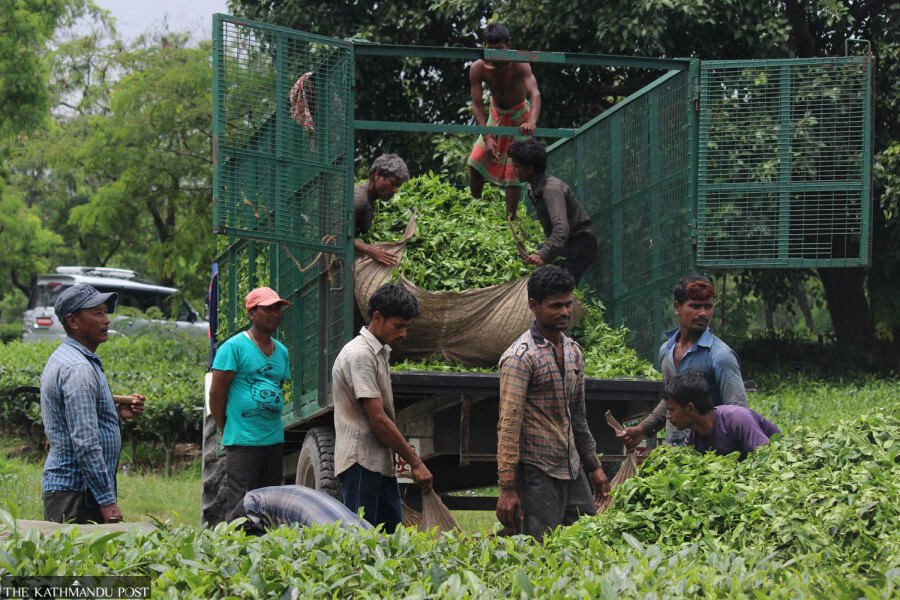
Darjeeling, India – Tea workers in Darjeeling have called for a ban on Nepali tea imports, claiming that it is harming the reputation of Darjeeling tea.
For several years, calls for a ban or import duty on tea from Nepal have been growing louder in Darjeeling.
West Bengal Chief Minister Mamata Banerjee, during a recent visit to Darjeeling, promised to halt the import of tea from Nepal.
Earlier in June, Santosh Kumar Sarangi, director-general of India’s foreign trade, while interacting with the Federation of Indian Export Organisations in Kolkata, said that Darjeeling Tea and Nepal tea should be sold separately. While tea imports from Nepal could not be banned, mixing should be checked, he said.
According to media reports, Sarangi said it was not possible to ban the import of Nepal tea due to geopolitical reasons. “As far as trade with Nepal is concerned, some flexibility is required,” he was quoted as saying.
He also suggested that there could be some collusion in the mixing of Darjeeling Tea and Nepal tea. Sarangi, a former chairman of the Tea Board, said the board had developed a traceability app for Darjeeling Tea.
Shanta Chhetri, a former Rajya Sabha member, has demanded a 40% import duty on tea from Nepal.
Sunil Rai, joint secretary of the Darjeeling Terai Dooars Chia Kaman Mazdoor Union, during a function in Siliguri demanding a bonus hike for Darjeeling tea laborers, said that Nepali tea sold in the name of Darjeeling tea should be banned.
“Both the West Bengal and the central government [of India] should take this initiative,” he said.
The function was organized to demand bonus hikes for Indian tea laborers but focused primarily on the issue of Nepali tea.
Speakers at the function also called for serious testing of the quality of Nepali tea.
Rai said, “Initially, we raised the issue of restricting Nepali tea. But the government has not paid attention to it. This will complicate the issue more in the future.”
In 2016, Indian tea entrepreneurs and labor unions submitted a memorandum to then-Indian President Pranab Mukherjee, demanding a ban on Nepali tea.
The government did not take the demand seriously, and as a result, Indian tea entrepreneurs and labor unions are still upset, according to reports.
Labor leaders believe that Nepali tea has directly impacted Darjeeling tea.
Rai said, “To protect the tea industry, the central government needs to ban Nepali tea immediately.”
Nepali tea is mainly exported to India. According to Rai, opportunistic trade groups export the same tea to third countries with a ‘Darjeeling tea’ label.
Another labor union leader said, “Once Nepali tea is stopped, the demand for Darjeeling tea will increase sharply.”
“Or else we are sure that the brand of Darjeeling tea will be tarnished gradually.”
Labor unions believe that both the state and central governments need to take urgent action to protect the pride of the Darjeeling brand in the global market.
Udaya Chapagain, director of Gorkha Tea Estate in Ilam, said that since the topography of Ilam and Darjeeling is similar, Nepali tea closely resembles Darjeeling tea. “This has caused many Indian tea entrepreneurs to fear losing global market share.”
“India has a strategy to limit Nepali tea under different pretexts. For this, the Nepal government needs to pay attention on time.”
In April, trucks laden with tonnes of tea destined for the southern neighbor got stuck at the Panitanki Customs across the Nepal-India border, as India asked its customs authorities to test the quality of Nepali tea bound for India.
This halt came after India’s Commerce Ministry issued a circular to its customs offices to test the quality of all tea imports from Nepal.
In 2005 and 2015, the Commerce Ministry of India had issued a similar circular to its customs to conduct mandatory lab tests on Nepali tea.
Nepali tea samples are tested at the National Food Laboratory, Kolkata, India.
Around 92 percent of Nepal-produced tea is exported to India through the eastern border point, while 6 percent is exported from Biratnagar and 2 percent from Birgunj.
According to the Trade and Export Promotion Center, Nepal exported 13,916 tonnes of tea worth Rs3.62 billion in the last fiscal year that ended in mid-July.
Nepal’s tea exports sharply jumped by 44.3 percent to Rs1.86 billion in the first three months of the current fiscal year, which ended in mid-October.
During the review period, Nepal exported 6,495 tonnes of tea, which accounted for 4.87 percent of the country's total trade.
Demand for Nepali tea has been rising as the bushes in Darjeeling have aged. Therefore, Nepali traders say the tea leaves have become a valuable input for the factories in and around Darjeeling.
For years, Indian buyers have been alleging that Nepali tea is substandard and, as a result, offer lower prices. Nepali tea is often stopped at different border points under various pretexts.
[Copyright (c) Global Economic Times. All Rights Reserved.]