On the 20th (local time) on the Champs-Élysées in Paris, workers at the Chanel boutique were busy installing steel panels on the shop windows and entrances before opening for the day.
A 58-year-old worker said, "We are doing this to prevent protesters from smashing the display windows," adding that the store would open as usual. Notices stating that the store was open for business were attached to the steel panels as well.
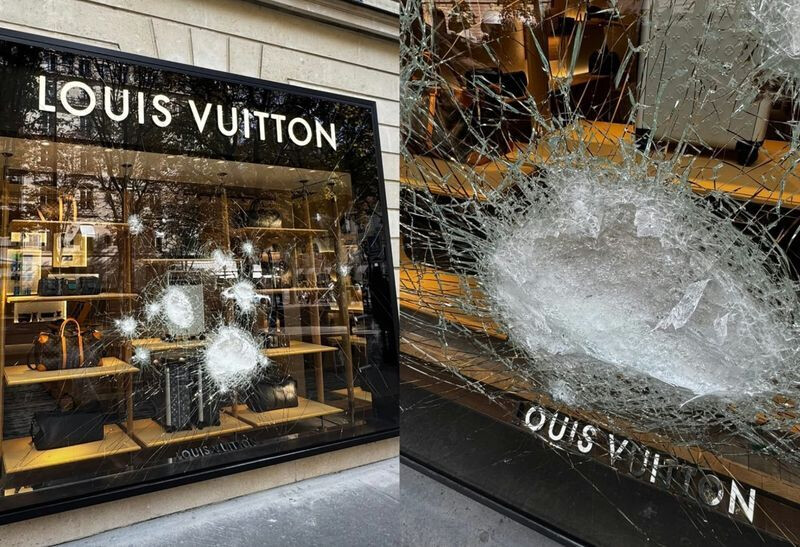
At the nearby Dior boutique, steel panels were installed at the entrance, and one side of the inner doorway was reinforced with what appeared to be plywood coverings. At the Lacoste store, where the display window glass was broken, workers were busy enclosing the entire building with an oversized white steel structure.
The Levi's store had its entire storefront covered with large wooden plywood, making it hard to tell at a glance whether it was open or under construction. A notice reading "Open" was posted on the plywood. The Calvin Klein store completely blocked off its front with thick steel plates. Adama (35), a Calvin Klein employee, said, "We took protective measures because there seem to be more protests this week," adding that the steel protective shields could only be removed after the protests end.
The situation was similar at some luxury boutiques around Vendôme Square, located within a 25-minute walk from the Champs-Élysées. Stores like Louis Vuitton had large steel panels surrounding their luxurious display windows, giving them a fortress-like appearance. Although the streets of Paris, swept by massive protests and violent incidents such as looting protesting poor educational conditions and soaring living costs, were generally calm, a sense of tension still lingered around stores equipped with large protective barriers.
Paris police imposed a curfew from 11 PM the previous night to 6 AM that day on the loot-damaged République Square area and the commercial district of Les Halles. Renée Gamboa (27), an American tourist from Texas, said she knew about the curfew but that it didn't look as dangerous as reported in the media, adding, "There are a lot of similar protests in the US, but it's more dangerous and the tension is higher there because of guns."
On the 17th, more than 500,000 people, including students, workers, and citizens, poured into the streets across France, including Paris. What started as peaceful protests turned violent with arson of public buildings and looting of shops, pushing the Macron government into its biggest crisis of its term. In a national address on the 18th, President Emmanuel Macron announced plans to establish a council involving students, teachers, lawmakers, trade union representatives, and entrepreneurs, but appeasing angry students and workers appears difficult.
The "Yellow Vests" movement, which shook the first term of Macron's presidency for months starting in late 2018, reportedly announced another round of protests to open "Act 2" on the 24th. Major labor unions have also announced a general strike for next month on the 5th. The French government stated it would deploy a massive security force, including military troops, for the protests on the 24th.
The British weekly magazine The Economist pointed out that while President Macron had the leeway to calm the situation through government spending during past Yellow Vest protests, state finances are now in serious condition and the bond market is also nervous. France's budget deficit this year is projected to reach 5.4% of its gross domestic product (GDP), one of the highest levels in the eurozone (the 21 countries using the euro).
France's 10-year government bond yield rose as high as 4.96% during trading on the 20th. The Economist noted, "France is now borrowing money at higher interest rates than Italy or Greece." A hairdresser at a salon on Rue du Faubourg Saint-Honoré near the Élysée Palace said, "The French economy is suffering heavy losses, and students need to make their demands heard."
Concerns are also rising that budget deficits, high inflation, low growth, generational conflicts over pension and wealth disparities, and immigration debates could erupt ahead of next presidential election, leading to repeated radical protests. Unverified information or fake news posted on social media following these massive protests and violence could also add fuel to the social conflict.
Some analyses suggest that these massive protests and violence, occurring six months ahead of the presidential election, could plunge French society into deeper division and work to the advantage of the far-right. Marine Le Pen, the presidential candidate of the far-right National Rally (RN), vowed to restore "law and order" in a video speech released a few hours before President Macron's national address on the 18th, the day after the protests.
Le Pen is currently leading in the polls among presidential candidates. Jordan Bardella, leader of the National Rally, also visited a police station in central Paris on the 18th to express support for police officers. The New York Times published an article titled "As Riots Shock the Country, the French Far Right Seizes the Moment," reporting that "the National Rally, which is already ahead in the polls, has positioned itself as the party best suited to restore law and order." Yann (54), a taxi driver, said, "I support peaceful protests, but unfortunately, looters are now mixing in to break into and rob shops. It will definitely have an impact on the presidential election."
[Copyright (c) Global Economic Times. All Rights Reserved.]