![[등록] 2026-09-01 15:48:31](/support/_updata/banner2/tl181982910_6749.png)


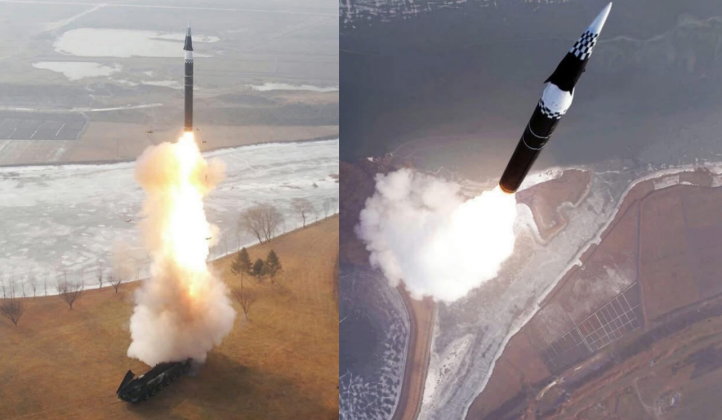
In a provocative move just days before the commencement of the world’s largest multinational maritime exercise, RIMPAC (Rim of the Pacific), China has officially released footage of its advanced DF-17 hypersonic missile being fired for the first time. The broadcast, aired by China Central Television (CCTV) on June 20, is being interpreted by military experts as a calculated “military demonstration” aimed at the United States, Japan, and Taiwan.
The footage shows the DF-17, a next-generation strategic weapon, being launched vertically from a mobile transporter-erector-launcher (TEL) hidden in a roadside environment. This marks the first time the Chinese military has shared actual combat-readiness footage of the missile with the public since its initial debut at the 70th-anniversary military parade in 2019.
The DF-17 is a formidable piece of hardware, boasting a maximum range of 1,500 to 2,500 kilometers. Equipped with a hypersonic glide vehicle (HGV), it travels at ten times the speed of sound. Most significantly, its ability to alter its trajectory mid-flight makes it capable of evading existing U.S. missile defense (MD) systems, rendering them largely ineffective.
Du Wenlong, a prominent Chinese military commentator, noted that the footage demonstrates the Rocket Force’s high level of operational readiness. “It proves that the Rocket Force can stand up, launch, and precisely strike targets in complex terrain and under electronic interference, all within a designated timeframe,” Du stated.
Beyond the DF-17, the CCTV broadcast also highlighted preparations for the launch of the DF-26 intermediate-range ballistic missile, frequently dubbed the “Guam Killer.” With a range of up to 4,000 kilometers, the DF-26 is capable of striking U.S. strategic assets in the Western Pacific, including the core hub on Guam.
The timing of this release has drawn intense scrutiny from global defense observers. The 2026 RIMPAC exercise is scheduled to run from June 24 to July 31 near Hawaii, featuring a historic mobilization of 31 nations, over 25,000 personnel, 45 naval ships, 5 submarines, and approximately 140 aircraft. Concurrently, the U.S. Marine Corps and the Japan Ground Self-Defense Force are conducting their annual joint exercise, “Resolute Dragon,” in Okinawa and Kyushu.
Political analyst Zhang Bin interpreted the move as a clear warning: “Beijing is sending a message that no matter how many warships or aircraft the U.S. and its allies assemble in the Pacific, the People’s Liberation Army has the capacity to conduct long-range, precision strikes on these targets should a conflict arise.”
Furthermore, some analysts believe this display serves as a precursor to the 60th-anniversary celebration of the founding of the PLA Rocket Force, which occurs on July 1. By showcasing these cutting-edge strategic weapons, China is signaling its evolving dominance in the East Asian theater and its determination to neutralize Western military presence in the region.
As tensions rise in the Pacific, this rare glimpse into China’s arsenal highlights the intensifying strategic rivalry between the world’s two largest powers, turning the upcoming military exercises into a high-stakes arena of power projection and deterrence.
[Copyright (c) Global Economic Times. All Rights Reserved.]