![[등록] 2026-09-01 15:48:31](/support/_updata/banner2/tl181982910_6749.png)


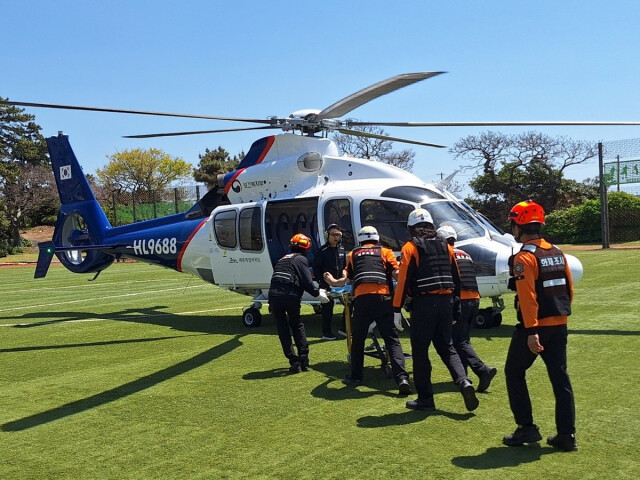
(C) Seoul Economic Daily
SEOUL — The Ministry of Health and Welfare (MOHW) announced on Sunday that South Korea’s critical patient transport systems—comprising Air Ambulances (Doctor Helicopters) and Mobile Intensive Care Units (MICU)—successfully transported 1,414 critically ill patients last year, significantly contributing to higher survival rates.
Life-Saving Missions in the Air and on the Ground
For severe trauma and cardiovascular diseases, the "golden hour" is the most critical factor for survival. To ensure patients reach specialized medical centers quickly, the MOHW operates specialized transport systems that bring hospital-level care to the scene.
Doctor Helicopters: These flying emergency rooms are staffed with medical specialists who can perform advanced emergency procedures mid-flight. Last year alone, they transported 1,075 patients, including 515 trauma cases and 163 patients with cardiovascular conditions. Since their debut in 2011, Doctor Helicopters have saved a cumulative total of 16,057 lives.
Mobile Intensive Care Units (MICU): Launched as a pilot program in Gyeonggi Province in late 2024, these ambulances are specialized for transferring critical patients between hospitals. Last year, the MICU at Hallym University Sacred Heart Hospital—staffed with a dedicated 24-hour medical team—safely transported 339 patients, including newborns requiring constant oxygen monitoring.
Real-World Impact
The ministry highlighted two key cases that demonstrate the necessity of these services:
Island Rescue: A woman in her 30s who fell 3 meters off a coastal cliff on a remote island was reached by a Doctor Helicopter in just 27 minutes. The medical team provided immediate care during the 87km flight, stabilizing her before she was admitted to the ICU.
Inter-hospital Transfer: A patient in a semi-comatose state with pneumonia was safely transferred to a larger hospital via MICU. The onboard medical team performed intubation and central line insertion while en route, ensuring the patient’s stability during transport.
Expanding the Safety Net
In response to the growing demand, the government plans to further strengthen the transport infrastructure this year.
"We will add one more Doctor Helicopter to our fleet and upgrade two small helicopters to medium-sized models to improve operational capacity," said Lee Jung-kyu, Director General for Public Health Policy at the MOHW. "We also plan to add another specialized ambulance to ensure a more robust transport system for our most vulnerable patients."
[Copyright (c) Global Economic Times. All Rights Reserved.]