

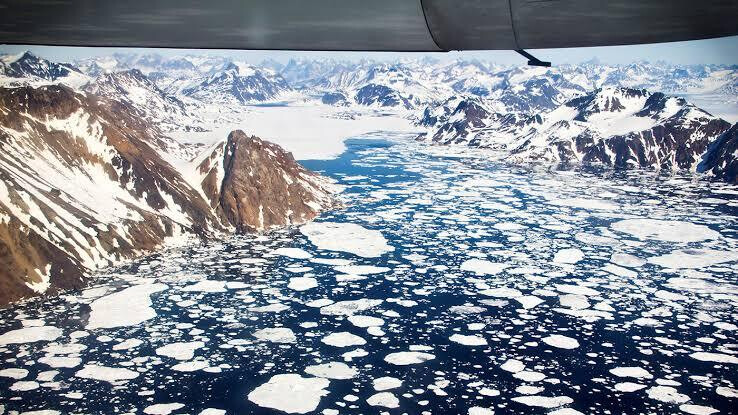
SEOUL — New research reveals that critical underwater foundations supporting ice flows in West Antarctica are rapidly eroding, triggering accelerated glacial melt equivalent to more than 10 times the total water volume of South Korea’s largest reservoir.
A multi-institutional research team—including the Korea Polar Research Institute (KOPRI), Chonnam National University, the State University of New York (SUNY), and Seoul National University—analyzed a 5,900-square-kilometer region (roughly ten times the size of Seoul) around Carney and Duncan Islands at the edge of the West Antarctic Getz Ice Shelf. Their findings indicate that local "pinning points"—submerged topographical anchors that grip the underside of ice shelves to slow their seaward descent—have drastically deteriorated.
Ice shelves act as natural stabilizing barriers that restrain land-based glaciers from spilling rapidly into the ocean. When the base of a shelf runs aground on shallow seabed ridges or minor islands, these friction points regulate the flow and trajectory of the ice. The loss of these anchors invariably leads to severe ice mass loss.
Satellite observations tracking the Getz Ice Shelf from July 2010 to March 2026 showed an annual volume reduction of approximately 2.1 cubic kilometers, totaling more than 30 cubic kilometers over 16 years. To put this into perspective, this melted volume exceeds 30 billion cubic meters—more than ten times the total storage capacity of South Korea's Soyanggang Dam. This rapid deterioration concentrated heavily along the narrow trough separating Carney and Duncan Islands.
Long-term satellite analysis spanning from 1973 to 2025 indicated that these vital anchoring points began shrinking sharply after 2002. Consequently, the velocity of glacial ice surging through the local valley increased by over 50 percent. Researchers attribute this destabilization to incursions of warm ocean currents melting the ice shelf from underneath.
"This study provides clear observational proof that small pinning points, spanning only a few kilometers, play a massive role in regulating the stability of an entire ice shelf," noted Dr. Kim Byung-hoon of Chonnam National University, the paper's lead author. He emphasized that advanced satellite monitoring successfully captured micro-topographical details previously missed by standard climate models.
Dr. Lee Won-sang, a principal researcher at KOPRI, highlighted South Korea's leadership in polar exploration: "The Getz Ice Shelf serves as a vital hub for our international collaborative research. By combining satellite telemetry with on-site fieldwork, we can map these shifting pinning points more accurately and integrate them into global ice-sheet models to reduce uncertainties in future sea-level rise projections."
[Copyright (c) Global Economic Times. All Rights Reserved.]