

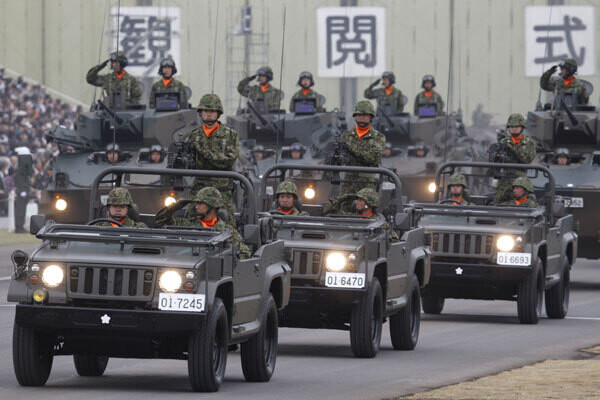
Japan is accelerating its path toward becoming a military power, dismantling core tenets of its post-war pacifist constitution—such as the "exclusive defense" principle (limiting the use of defense capabilities strictly to armed attacks) and the "Three Non-Nuclear Principles" maintained for nearly six decades. The possibility of introducing nuclear-powered submarines (SSNs), officially raised by Japanese Defense Minister Shinjiro Koizumi, threatens to create a serious fracture in the Northeast Asian security architecture.
Targeting the "Three Non-Nuclear Principles": The Cabinet Breaking Security Taboos
In a recent interview with the Yomiuri Shimbun, Defense Minister Koizumi stated regarding the potential acquisition of nuclear submarines, "We must not exclude them from our options from the outset simply because they are nuclear-powered." While framing the move as necessary for protecting Self-Defense Forces (SDF) personnel, improving onboard living conditions, and securing overwhelming mobility, the statement effectively formalizes nuclear submarine acquisition as a strategic option.
This announcement has drawn intense scrutiny because the entire Japanese cabinet is simultaneously moving to shatter established security taboos. Addressing the Three Non-Nuclear Principles—pledged in 1967 by then-Prime Minister Eisaku Sato, which prohibit possessing, producing, or introducing nuclear weapons into Japanese territory—Koizumi remarked that discussions should not be confined to these three principles, but should instead examine global and regional nuclear dynamics more broadly.
Previously, Prime Minister Sanae Takaichi also fueled the breakdown of taboos during the ongoing revision of the three security documents slated for later this year, suggesting that the "introduction" ban clause of the Three Non-Nuclear Principles is unrealistic.
Accelerating Re-armament Leveraged on China-Russia-North Korea Threats
The Japanese government’s primary justification for expanding its defense capabilities is the military threat posed by neighboring nations. Regarding the objective of the upcoming December revision of the three security documents, Defense Minister Koizumi emphasized that "the military activities of China, Russia, and North Korea are intensifying, and their cooperation is deepening." Leveraging this severe security environment—marked by the alignment of Beijing, Moscow, and Pyongyang, escalating North Korean nuclear capabilities, and rising tensions in the Taiwan Strait—Tokyo intends to fundamentally expand the operational radius and striking power of its Self-Defense Forces.
The push to increase defense spending has also shifted from mere numerical targets to tangible military enhancement. Responding to U.S. pressure for defense expenditures equivalent to 3.5% of Gross Domestic Product (GDP), Koizumi drew a clear line, stating, "We must not inflate budgets just to meet a target figure, but rather allocate funds so that the SDF can effectively carry out operations."
This indicates an intrinsic resolve to secure advanced weapons systems and long-range operational capabilities tailored to Japan’s own strategic needs, rather than expanding budgets under external pressure.
Intensifying Regional Arms Race and Remaining Challenges
North Korea criticized South Korea's pursuit of a nuclear-powered submarine through the Korean Central News Agency on the 18th, condemning the South Korea-U.S. summit fact sheet and calling it a "grave development that destabilizes the regional military security situation and leads to uncontrollable nuclear proliferation."
The concern is that Japan's trajectory could act as a catalyst for an intense regional arms race in Northeast Asia. Unlike conventional diesel-electric submarines, nuclear-powered submarines can operate underwater for months, dramatically expanding their stealth and operational range. If Japan realizes its plans to acquire nuclear submarines alongside counter-strike capabilities (enemy base strike capabilities), it will effectively secure strategic weaponry targeting neighboring nations.
Some analysts predict that with the December revision of the three security documents as a turning point, Japan will completely overhaul the framework of its post-war security regime. As Tokyo accelerates its rearmament under the banner of countering China, Russia, and North Korea, all eyes are on how these shifts will impact Korean peninsula security, South Korea's own nuclear submarine discourse, and the regional military balance.
[Copyright (c) Global Economic Times. All Rights Reserved.]