![[등록] 2026-09-01 15:48:31](/support/_updata/banner2/tl181982910_6749.png)


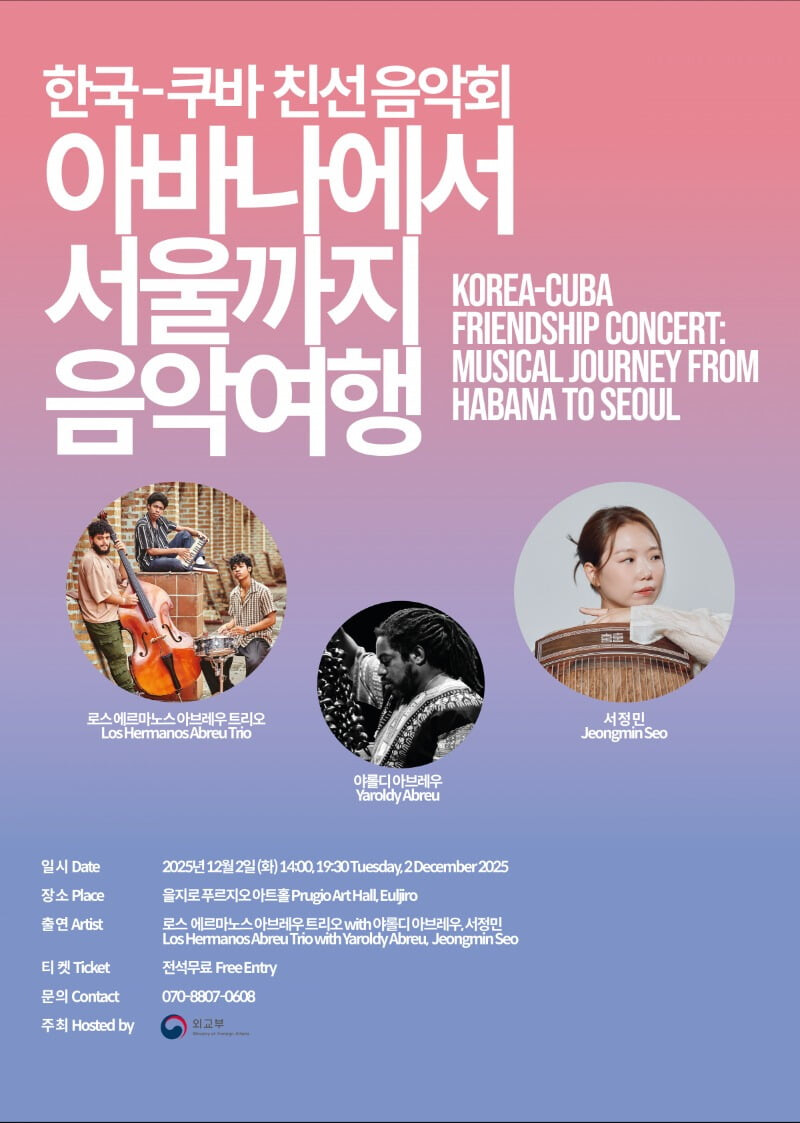
While geography and language often act as barriers between nations, music remains the universal bridge capable of collapsing thousands of miles into a single rhythmic heartbeat. This sentiment was vividly realized on December 2nd at a special diplomatic concert titled "Musical Journey from Havana to Seoul," hosted by the Ministry of Foreign Affairs to celebrate the burgeoning diplomatic ties between South Korea and Cuba.
The event served as a historic milestone, marking the first major cultural exchange since the formal establishment of diplomatic relations in February of last year. For decades, Cuban music—characterized by the legendary sounds of the Buena Vista Social Club and Chucho Valdés—remained a distant curiosity for many Koreans. However, this concert brought the "soul and breath" of Cuba directly to the heart of Seoul, blending the fiery passion of Afro-Cuban jazz with the deep, resonant "Han" (sorrowful longing) of Korean traditional music (Gugak).
A Legacy in Motion: The Abreu Family
The spotlight of the evening belonged to the Los Hermanos Abreu Trio, featuring the prodigious brothers Diego (piano) and Fabio (drums), alongside Roberto Alvarez (contrabass). Despite their youthful appearance, the brothers are rising stars in the global jazz scene, having recently clinched the Cuban Disco New Artist Award for their debut album, Tributo.
The trio was joined by a living legend: their father, Yaroldy Abreu. A master of Latin percussion and a Latin Grammy winner, the elder Abreu has shared stages with jazz titans such as Herbie Hancock and Wynton Marsalis. Seeing the father and sons perform together offered the audience a rare glimpse into the "authentic" Afro-Cuban tradition—one where rhythm is not just studied, but inherited.
The Dialogue of Traditions
The performance was structured to highlight both the distinctiveness and the surprising similarities between the two cultures. The concert opened with the evocative sounds of Korean traditional instruments: the 25-string gayageum (played by Seo Jung-min), the ajaeng and taepyeongso (Kim Seong-geun), and the janggu (Yoo Byung-wook). The modern interpretation of Gugak showcased a melodic richness that mirrored the emotional depth found in Cuban compositions.
As the Los Hermanos Abreu Trio took the stage, the atmosphere shifted toward the romantic and the rhythmic. Their original piece, "Vinos y Bicicletas," began with a sophisticated, modern swing, gradually introducing the audience to their world. This evolved into a high-energy rendition of the jazz standard "Take the ‘A’ Train," where traditional swing seamlessly fused with intoxicating Cuban rhythms. The "call-and-response" vocalizations—a staple of authentic Cuban music—added a layer of raw sincerity that resonated throughout the hall.
One of the night’s technical highlights occurred during "Conga Desertica." The synchronization between Fabio’s drums and Yaroldy’s percussion was nothing short of miraculous, as if the father and son were sharing a single musical mind. Their performance transcended intellectual interpretation, manifesting instead as a primal, joyous expression of life.
A Grand Finale of Friendship
The climax of the evening occurred during the third act, where the Cuban jazz trio and the Korean traditional musicians performed in unison. Despite their vastly different technical origins, the artists communicated through eye contact, smiles, and shared timing.
The piercing, triumphant melody of the taepyeongso (Korean double-reed horn) danced atop the intricate layers of Latin percussion and piano. The fusion was so infectious that members of the Cuban community in the audience rose from their seats to dance salsa in the aisles. It was a literal manifestation of the concert’s title—a journey where the spirit of Havana finally arrived in Seoul.
Looking Toward the Future
The "Musical Journey from Havana to Seoul" was more than just a concert; it was a testament to the power of cultural diplomacy. As Korea and Cuba continue to expand their exchanges in youth, culture, and economy, events like this serve as the emotional foundation for a long-lasting friendship.
For the jazz aficionados in attendance, it was a rare opportunity to witness "authentic" Afro-Cuban performance on Korean soil. For the diplomats and citizens, it was a reminder that while our histories of struggle and resilience are unique, the joy we find in rhythm and melody is identical. This concert marks the beginning of a new era of harmony, promising that the distance between Havana and Seoul will only continue to shrink through the shared language of art.
[Copyright (c) Global Economic Times. All Rights Reserved.]