SEOUL, South Korea — The ongoing conflict in the Middle East is reshaping South Korea’s approach to energy security. Rather than relying solely on direct overseas oil and gas exploration, policymakers and industry experts are increasingly emphasizing the need to diversify import sources, procurement methods, and maritime transport routes to ensure stable domestic supply during sudden geopolitical crises.
While geopolitical tensions pose short-term risks to fossil fuel supplies, the medium- to long-term outlook points toward a potential global oversupply of liquefied natural gas (LNG) driven by aggressive facility expansions. Coupled with the accelerating global transition toward electrification, critics are questioning the effectiveness of the South Korean government's plan to merge the Korea National Oil Corporation (KNOC) and the Korea Gas Corporation (KOGAS) to boost overseas resource development.
Short-Term Price Pressures vs. Long-Term LNG Glut
According to data released by KOGAS on November 28, the wholesale natural gas rate for power generation will drop by 0.22% next month to 25,666 won per gigajoule (GJ), down from 25,724 won. This marks the first decline since the Middle East conflict erupted in March, which had driven rates up by roughly 60.3% from 16,048 won per GJ. A recent dip in the foreign exchange rate helped offset the surge in global oil prices.
Because natural gas prices heavily influence the System Marginal Price (SMP)—the wholesale electricity rate—the state-run Korea Electric Power Corporation (KEPCO) remains under financial strain as SMP recently surpassed 150 won per kilowatt-hour (kWh), well above KEPCO’s 140-won break-even threshold.
However, the International Energy Agency’s (IEA) World Energy Outlook 2026 projects a dramatically different landscape over the coming years. Between 2025 and 2030, global LNG export capacity is expected to expand by a record 345 billion cubic meters annually, fueled by massive U.S. and global investments following the Russia-Ukraine war. Analysts anticipate that around 2028, the global LNG market will pivot from a seller’s market to a buyer’s market.
Prioritizing Supply Chain Flexibility Over Ownership
Recognizing that overseas equity stakes mean little if shipping lanes are blockaded during a crisis, Seoul is pivoting toward supply chain agility.
"Securing overseas resources is not enough; what truly matters is whether those resources can actually be brought into the country," an official from the Ministry of Trade, Industry and Energy noted, stressing the need to diversify crude oil grades, origins, and shipping routes.
To reduce reliance on Middle Eastern crude, the government extended temporary relief measures through December, refunding up to 100% of the freight cost differential for non-Middle Eastern oil imports—up from the previous 25%—while waiving minimum volume and long-term contract requirements.
In the natural gas sector, diversification has already buffered the economy from severe physical shortages. KOGAS is actively expanding its LNG trading capabilities, having recently established a dedicated trading division. During a November 18 press briefing, KOGAS President Hong Eui-rak outlined plans to secure flexible trading capacity for 15 million tons of LNG—half of the corporation's annual import volume of 30 million tons—to better navigate market volatility and avoid costly spot-market purchases.
Doubts Over the KNOC–KOGAS Merger
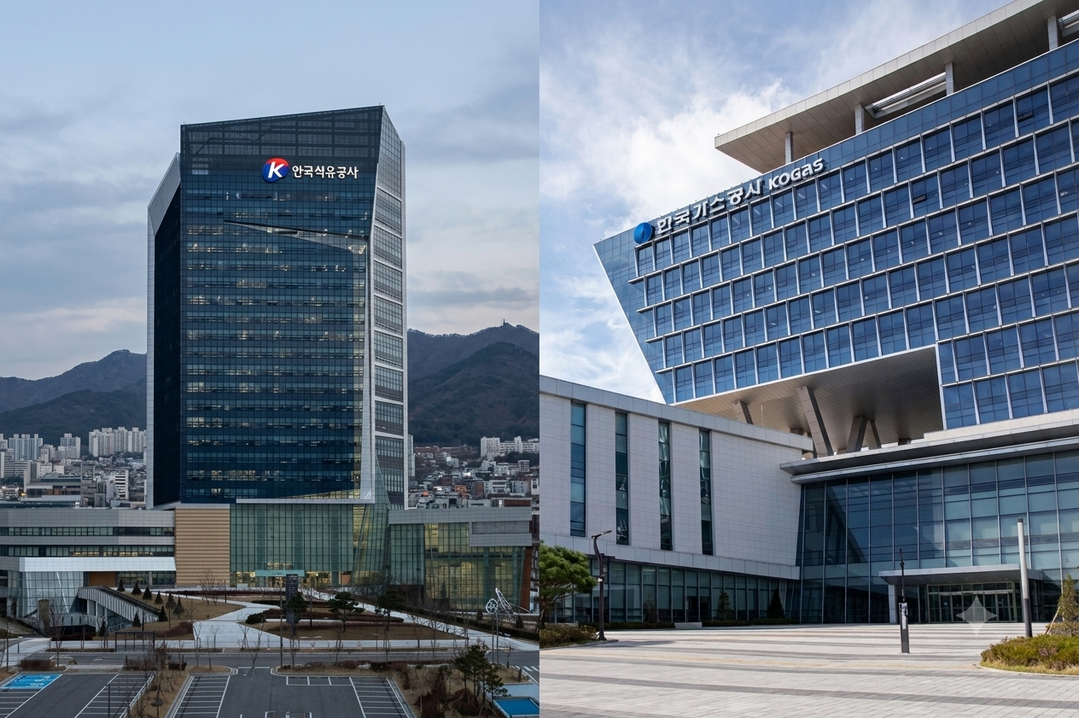
These market shifts have cast doubt on the government's September public-institution reform plan, which aims to merge KNOC and KOGAS into a single "Energy and Resources Corporation" to achieve economies of scale.
During a parliamentary audit last month, lawmakers scrutinized the practical value of KNOC's overseas assets. KNOC President Son Joo-seok revealed that only 2.13 million barrels of crude from its overseas fields were brought into South Korea following the outbreak of the Middle East conflict. Son explained that domestic refineries often lack the technical configuration to process certain grades of overseas equity crude, limiting their utility during emergencies.
Furthermore, the dire financial health of both state firms poses a major hurdle. KNOC has been in a state of complete capital impairment since late 2020, while KOGAS’s uncollected receivables—stemming from delayed utility rate hikes—are projected to reach 14 to 15 trillion won by the end of this year and 17 trillion won by late next year. Labor unions warn that absorbing KNOC's distressed assets could downgrade the merged entity's credit rating and raise foreign borrowing costs, while KOGAS President Hong himself has questioned the synergy between two fundamentally different business models.
Stranded Asset Risks Amid the Energy Transition
Misalignment between national power and gas infrastructure plans is also raising alarms over potential stranded assets.
While the government is drafting its 12th Basic Plan for Long-Term Electricity Supply and Demand—targeting 100 gigawatts (GW) of renewable energy by 2030 alongside potential new nuclear reactors—its 16th Long-Term Natural Gas Supply and Demand Plan, released in July, failed to fully incorporate these shifting power generation mixes.
A similar contradiction exists in residential heating. Even as the government promotes replacing gas boilers with electric heat pumps, local governments plan to invest 2.72 trillion won to lay 4,456 kilometers of new city gas pipelines through 2030. A November 25 report by the Green Energy Strategy Institute estimates that gas-heated households will peak in 2032, leaving roughly 1.35 trillion won of those new pipeline investments at risk of becoming stranded assets. Environmental group Solutions for Our Climate (SFOC) raised similar warnings in July regarding KOGAS’s 3.3 trillion won Dangjin LNG terminal project.
According to the IEA, stronger energy security and electrification policies could cut fossil fuel imports in importing regions by 15% by 2035, pushing electricity's share of global final energy consumption toward 30%, up from 23% last year. At the COP31 climate summit held earlier this month, South Korea joined international partners in pledging to raise electricity’s share of global final energy consumption to 35% by 2035—a commitment that underscores the urgency of aligning domestic energy infrastructure with a decarbonizing future.
[Copyright (c) Global Economic Times. All Rights Reserved.]