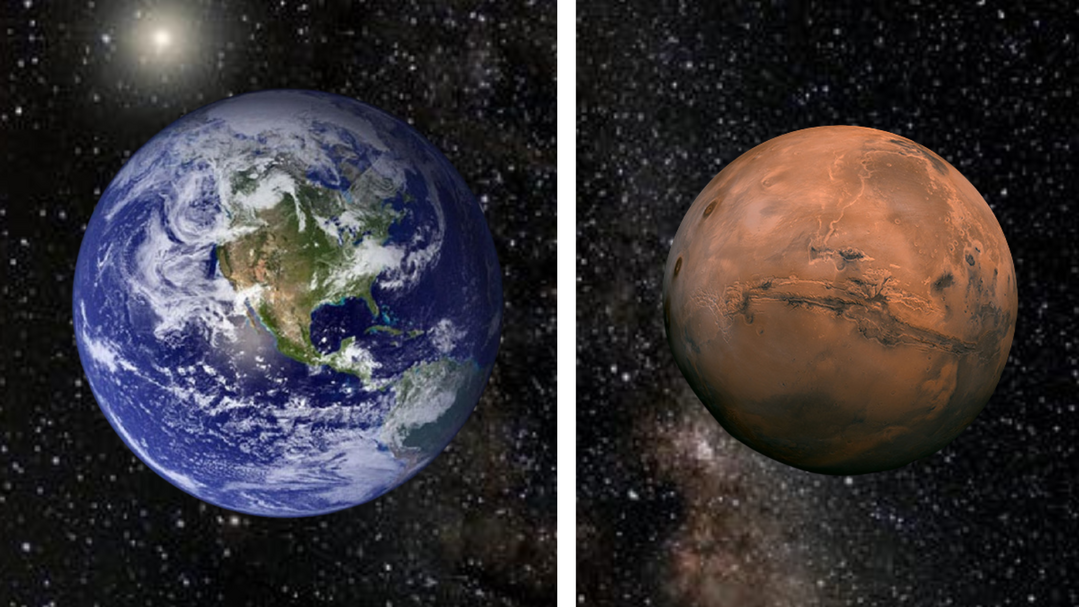
Despite sharing a birthday and a similar foundational neighborhood in the early solar system 4.5 billion years ago, Earth and Mars evolved into two drastically different worlds—one a vibrant blue oasis, the other a frozen, radiation-bathed desert. According to a recent study published in Nature Astronomy by an international research team led by the University of Copenhagen, the secret to this divergence may lie in how they were built.
For decades, planetary scientists have debated the primary mechanisms behind rocky planet formation. The two leading theories are planetesimal collision—where rocky bodies of kilometer-scale or larger smash together to form a planet—and pebble accretion, a process where a growing embryo sweeps up surrounding small pebbles via gravity, much like a snowball rolling down a slope.
To uncover which process built Earth and Mars, the researchers looked at their "chemical fingerprints": the abundance of volatile elements (such as sodium, potassium, zinc, and lithium) trapped within their mantles. Because mantle compositions have remained largely unchanged for billions of years, they serve as pristine archives of a planet's violent birth.
Through sophisticated computer simulations, the team tested various ratios of pebbles and planetesimals. The results revealed a surprising dichotomy:
Earth grew primarily through pebble accretion. Over 75% of Earth's mass originated from two protoplanets that grew rapidly via pebble accumulation, with the remaining 25% added later through planetesimal impacts.
Mars followed the exact opposite recipe. Roughly 73% of the Red Planet’s mass was forged from colliding planetesimals, while only about 27% came from pebble accretion.
Researchers suggest that Earth’s rapid pebble accumulation allowed it to gather its material efficiently, whereas Mars lagged behind, likely hindered by gravitational disturbances from neighboring protoplanets.
While experts note that these findings rely on certain geochemical assumptions—such as comparing planetesimal building blocks to the asteroid Vesta—and that volatile elements are only one piece of the puzzle, the study opens a compelling new chapter in understanding why two neighboring worlds turned out so entirely apart.
[Copyright (c) Global Economic Times. All Rights Reserved.]