![[등록] 2026-09-01 15:48:31](/support/_updata/banner2/tl181982910_6749.png)


(C) Reddit
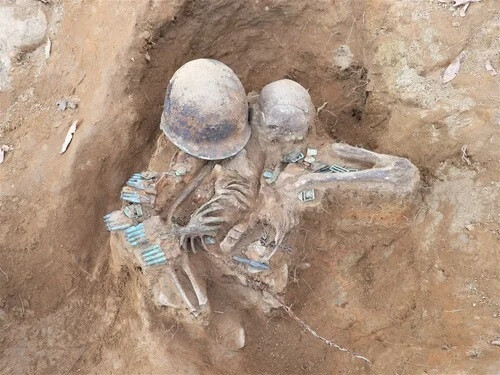
The South Korean Ministry of National Defense (MND) announced today the successful recovery of 25 sets of remains and 1,962 artifacts belonging to soldiers killed in the Korean War (1950-53) following an intensive excavation effort at White Horse Hill (Baekma-Goji) within the Demilitarized Zone (DMZ).
The excavation, a solemn yet critical undertaking to honor those who fell in defense of the nation, took place over approximately 40 days, spanning from October 15 to November 28, on the central front of the DMZ near Cheorwon, Gangwon Province.
Renewed Effort at Historic Battlefield
White Horse Hill is one of the most fiercely contested battlegrounds of the Korean War, notably the site of the pivotal Battle of White Horse Hill in October 1952. The recent operation resumed excavation work that had been suspended in November 2022. The MND had announced its recommencement on October 15, 2025, as part of broader measures aimed at reducing military tensions between the two Koreas.
The 40-day mission saw the dedicated participation of around 100 Republic of Korea (ROK) soldiers, alongside personnel from United Nations Command (UNC) member states, highlighting the international significance of the recovery effort. The collaborative nature of the mission underscores the enduring alliance and shared commitment to accounting for the war dead.
Identification and Analysis Underway
Following initial field analysis, the recovered remains are primarily presumed to be those of fallen ROK soldiers. The MND stated that the exact identities will be confirmed through meticulous forensic examination, including detailed DNA analysis, a process that can often be lengthy and complex due to the age and condition of the remains. The 1,962 recovered relics—which include personal effects, military gear, and fragments of uniforms—will also provide crucial circumstantial evidence for the identification process.
This latest discovery adds to previous significant finds in the area. Prior to this, unilateral South Korean efforts in the DMZ had already yielded substantial results:
Arrowhead Hill (Hwasalmeorigo-ji): From April 2019 to June 2021, a total of 424 sets of remains and 101,816 artifacts were recovered.
White Horse Hill (Previous Phase): From September 2021 to November 2022, 67 sets of remains and 15,670 artifacts were discovered.
Unilateral Action Follows Failed Bilateral Agreement
The current, sustained South Korean solo effort in the DMZ follows the breakdown of a bilateral commitment. The 'September 19 Military Agreement,' signed by North and South Korea in 2018, initially stipulated joint recovery operations for Korean War remains in the Cheorwon area of the DMZ. However, North Korea subsequently failed to participate in the promised joint excavations. Consequently, South Korea proceeded with the unilateral, albeit essential, mission to recover and identify the war dead.
The recovery of these remains is viewed not only as a humanitarian duty but also as a fundamental step toward national reconciliation and closure for the families who have waited decades for their loved ones to be returned. The MND has affirmed its unwavering commitment to continuing the excavation operations until all possible war dead are accounted for and brought home.
[Copyright (c) Global Economic Times. All Rights Reserved.]