• 2026.06.05 (Fri)
  • All articles
  • LOGIN
  • JOIN
Global Economic Times
fashionrunwayshow2026
  • Synthesis
  • World
  • Business
  • Industry
  • ICT
  • Distribution Economy
  • Well+Being
  • Travel
  • Eco-News
  • Education
  • Korean Wave News
  • Opinion
  • Arts&Culture
  • Sports
  • People & Life
    • International Student Report
    • With Ambassador
  • Column
    • Cho Kijo Column
    • Cherry Garden Story
    • Ko Yong-chul Column
    • Kim Seul-Ong Column
    • Lee Yeon-sil Column
  • Photo News
  • New Book Guide
MENU
 
Home > New Book Guide

Rising Resentment: Uncensored Voices Expose China's Surveillance State

KO YONG-CHUL Reporter / Updated : 2025-12-11 09:10:05
  • -
  • +
  • Print


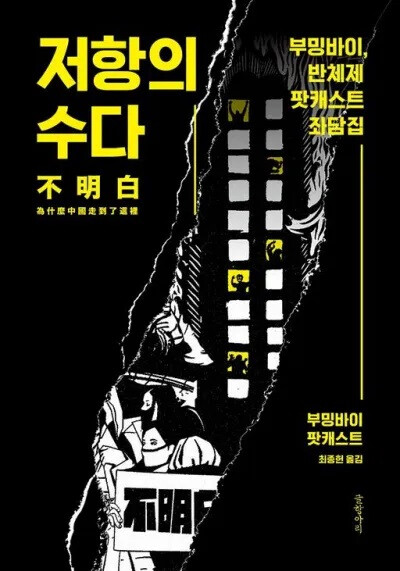
A new book, “Resistance Chatter” (저항의 수다 in Korean), based on the popular 'Bu Mingbai' (不明白 - 'I Don't Understand') podcast, has cast a stark light on the intensifying surveillance and growing popular discontent within China. The book, compiling conversations from the podcast co-founded in 2022 by a Chinese New York Times columnist and other Chinese journalists, paints a picture of a society where free expression is stifled and public dissent is bubbling beneath the surface.

The title, 'Bu Mingbai,' literally meaning "I don't understand," reflects the confusion and disbelief of ordinary Chinese citizens facing a torrent of incomprehensible events and policies. Though the podcast is blocked in mainland China, it has reportedly become essential listening for many seeking uncensored discussion on current affairs.

The Stranglehold of Surveillance

The book's sources assert that the current level of social control under President Xi Jinping’s regime is even more pervasive than during the Mao era, significantly strengthening following Xi's ascent to power in 2012 and subsequent pandemic-related lockdowns. The surveillance apparatus extends far beyond official channels. One professor quoted in the book estimates that at least one percent of China's population is engaged in constant monitoring and reporting on their neighbors and peers. These agents include not only official party and administrative staff but also a vast network of citizens recruited as 'spies.'

This chilling environment means that citizens in mainland China cannot freely criticize the state's policies or the supreme leader, Xi Jinping. The widespread use of cutting-edge technology, including facial recognition, DNA collection, and big data algorithms, has transformed China into what human rights groups have called a "dystopian digital surveillance state." Furthermore, the implementation of a "grid system" for neighborhood-level surveillance ensures systematic monitoring and immediate repression of potential unrest. This system is instrumental in the Chinese Communist Party's (CCP) ongoing goal of "stability maintenance," which prioritizes detecting and preventing protests and dissent.

Unrest and the Impulse for Expression

Despite the state’s rigorous control, public frustration is palpable. The book highlights the critical role of major public tragedies in amplifying this discontent. Incidents like the deadly Yangtze River cruise ship sinking, the Sichuan earthquake, and the Tianjin port explosion have repeatedly exposed the government’s priority of strict media and social media control to hide the truth and prevent criticism.

A powerful anecdote from the book recalls the memorial for the 2022 Urumqi apartment fire tragedy, where someone dared to shout the slogan, “CCP step down!” The shock and fear that rippled through the crowd underscore just how deep the self-censorship has become.

While state-run surveys often report overwhelming support for President Xi and the government, studies using anonymous methods reveal a much starker reality. When assured of anonymity, Chinese citizens' support for the party and government plummets by nearly 30 percentage points, and the fear of repression is acknowledged by an estimated 40% of the population as a major deterrent to protest. The suppressed criticism and simmering dissatisfaction voiced through 'Bu Mingbai' serve as a strong indication that "public sentiment is boiling," despite the CCP's comprehensive attempts to enforce silence.

[Copyright (c) Global Economic Times. All Rights Reserved.]

  • #Globaleconomictimes
  • #Korea
  • #Seoul
  • #Samsung
  • #LG
  • #Bitcoin
  • #Meta
  • #Business
  • #Economic
  • #The Woori Bank
KO YONG-CHUL Reporter
Reporter Page

Popular articles

  • BMW Korea Ignites May with Exclusive 9-Model Online Limited Edition Lineup

  • U.S. Intelligence: Iran’s Nuclear Capabilities Remain Intact Despite Two Months of Strikes

  • Kakao Hits Record Q1 Performance: Operating Profit Surges 66% as Focus Shifts to "Agentic AI"

I like it
Share
  • Facebook
  • X
  • Kakaotalk
  • LINE
  • BAND
  • NAVER
  • https://globaleconomictimes.kr/article/1065571758684135 Copy URL copied.
Comments >

Comments 0

Weekly Hot Issue

  • South Korea Emerges as Global AI Powerhouse, Ranking 3rd in Clarivate’s Inaugural 'AI50' Report
  • Star Historian Choi Tae-sung and 2NE1’s Sandara Park Appointed as Honorary Ambassadors for the Overseas Koreans Agency (OKA)
  • SKT Partners with NVIDIA to Bring Digital Twin Technology to SK Hynix Semiconductor Fabs 
  • South Korea’s Top Five Automakers Suffer Broad May Sales Decline Amid Weakening Domestic Demand and Global Headwinds
  • Chinese Humanoid Robotics Pioneer Unitree Clears Shanghai IPO Hurdle to Raise $580 Million
  • Hyundai Motor Bets on ‘The New Grandeur’ to Jumpstart Sluggish Domestic Sales

Most Viewed

1
From a moment of collective sacrifice to a moment of collective democracy: The Timing of the Election in Ethiopia and Korea
2
U.S. Holds Off on Immediate Comprehensive Semiconductor Tariffs, but Pressure Mounts for Samsung and SK Hynix to Accelerate Domestic Investments
3
[Interview] "Halal is Not a Religious Regulation, but a 'Trust Infrastructure'… Creating a Premium 'K-Halal' Centered on Data and Platforms"
4
‘600 Million Won Bonus’ at Samsung Electronics Triggers Deep Sense of Relative Deprivation Among Korean Workers
5
Musk’s SpaceX Secures Space Hegemony with Flawless Starship V3 Recovery Ahead of Historic IPO
광고문의
임시1
임시3
임시2

Hot Issue

South Korea Emerges as Global AI Powerhouse, Ranking 3rd in Clarivate’s Inaugural 'AI50' Report

Overcoming the Fragility of Robot Firms is Prerequisite to the Flourishing of Physical AI

South Korea’s Top Five Automakers Suffer Broad May Sales Decline Amid Weakening Domestic Demand and Global Headwinds

SKT Partners with NVIDIA to Bring Digital Twin Technology to SK Hynix Semiconductor Fabs 

Fashion Runway Show 2026

Global Economic Times
korocamia@naver.com
CEO : LEE YEON-SIL
Publisher : KO YONG-CHUL
Registration number : Seoul, A55681
Registration Date : 2024-10-24
Youth Protection Manager: KO YONG-CHUL
Singapore Headquarters
5A Woodlands Road #11-34 The Tennery. S'677728
Korean Branch
Phone : +82(0)10 4724 5264
#304, 6 Nonhyeon-ro 111-gil, Gangnam-gu, Seoul
Copyright © Global Economic Times All Rights Reserved
  • 에이펙2025
  • APEC2025가이드북TV
  • 반달곰 프로젝트
Search
Category
  • All articles
  • Synthesis
  • World
  • Business
  • Industry
  • ICT
  • Distribution Economy
  • Well+Being
  • Travel
  • Eco-News
  • Education
  • Korean Wave News
  • Opinion
  • Arts&Culture
  • Sports
  • People & Life 
    • 전체
    • International Student Report
    • With Ambassador
  • Column 
    • 전체
    • Cho Kijo Column
    • Cherry Garden Story
    • Ko Yong-chul Column
    • Kim Seul-Ong Column
    • Lee Yeon-sil Column
  • Photo News
  • New Book Guide
  • Multicultural News
  • Jobs & Workers