![[등록] 2026-09-01 15:48:31](/support/_updata/banner2/tl181982910_6749.png)


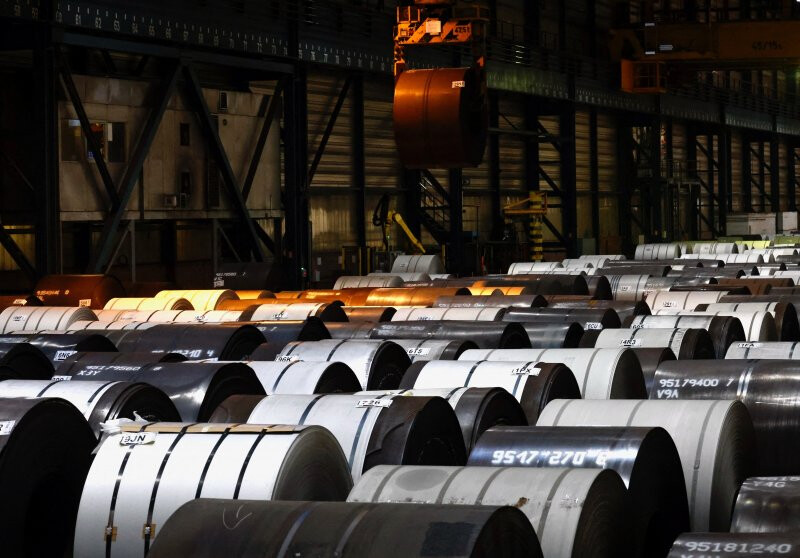
(C) News.az
SEOUL – In an ironic twist of global trade dynamics, South Korea’s steel industry is finding its "breakthrough" in the very market that sought to block it with formidable trade barriers. Despite the U.S. government’s imposition of a staggering 50% tariff on imported steel, South Korean rebar exports to the United States surged by more than 2,300% last year, signaling a dramatic shift in the sector’s survival strategy.
1. The Statistical Surge: Reversing a 14-Year Trend
According to recent data from the Korea Iron & Steel Association (KOSA), domestic steelmakers exported 151,562 tons of rebar in 2025, a massive 275.6% increase from the previous year. This marks the highest export volume since 2014.
More significantly, for the first time in 14 years, South Korea has become a net exporter of rebar, as imports plummeted by nearly 50% to 103,688 tons. The primary driver of this growth was the U.S. market, which swallowed 90,683 tons of Korean rebar—a 24-fold increase compared to the mere 3,698 tons recorded a year earlier. The U.S. now accounts for 58.4% of all South Korean rebar exports.
2. The Logic Behind the Anomaly: Why Tariffs Failed to Block "K-Steel"
At first glance, a 50% tariff should have rendered Korean steel uncompetitive. However, three critical factors converged to create a "perfect window" for export:
U.S. Domestic Price Hikes: Major American steel producers, including Nucor and Steel Dynamics, aggressively raised their product prices throughout 2025. This "price umbrella" allowed South Korean rebar to remain price-competitive even after the 50% tariff was factored into the landed cost.
The Currency Cushion: The persistent weakness of the Korean Won against the U.S. Dollar acted as a natural hedge. The favorable exchange rate effectively offset a portion of the tariff burden, allowing Korean mills to maintain higher margins in Won terms compared to domestic sales.
A "Push" from Home: The South Korean construction market remains in a deep freeze. Domestic rebar prices have hovered around 650,000 to 710,000 KRW per ton, well below the estimated break-even point of 780,000 KRW. In contrast, the U.S. export price averaged approximately $530 (approx. 768,000 KRW) per ton. While still tight, the U.S. market offered a "lesser loss" or "marginal gain" scenario compared to the stagnant domestic market.
3. Systematic Shift: Beyond Rebar to High-Value Steel
The export boom is not limited to rebar. Total steel product exports to the U.S. reached 2.54 million tons last year, making the U.S. the second-largest destination for Korean steel after Japan.
Industry analysts suggest that some of this volume was driven by "pre-emptive shipping" before the full implementation of the Section 232 tariff hikes in June. However, the sustained demand for Korean pipes, tubes, and sections indicates a structural reliance on high-quality Korean supply that U.S. domestic mills cannot yet fully satisfy.
4. Corporate Strategies: Diversification as the New Standard
Recognizing that the U.S. "export window" may fluctuate with political changes, South Korea’s "Big Two" in the long-product sector—Hyundai Steel and Dongkuk Steel—are accelerating their global diversification.
Hyundai Steel is focusing on expanding its local production footprints in India and Australia while targeting emerging demand in the Middle East and Southeast Asia to reduce its heavy reliance on the volatile U.S. and Chinese markets.
Dongkuk Steel has recently secured product certifications in Singapore and Thailand. By diversifying its portfolio of certified structural steel, the company aims to penetrate high-end infrastructure projects in the ASEAN region.
5. Outlook: A "Cold Winter" Still Lingers
Despite the export success, the immediate financial outlook for the industry remains cautious. Domestic demand for rebar in 2026 is projected to reach only 7.67 million tons, a negligible increase from the previous year’s dismal performance.
"The surge in U.S. exports is a testament to the agility of Korean steelmakers, but it is also a reflection of how dire the domestic situation has become," said an industry official. "Until the domestic construction sector recovers, the industry will remain in an 'emergency management' phase, forced to navigate the treacherous waters of global protectionism."
[Copyright (c) Global Economic Times. All Rights Reserved.]